
Every retail media network is chasing growth. But are you chasing the right kind of growth?
For years, the industry has obsessed over "monetization rate" — the percentage of your total Gross Merchandise Volume (GMV) captured as ad revenue. It’s a clean, comfortable number that looks great in an annual report.
But here is the question most operators aren't asking: What if monetization rate is actually a lagging indicator that masks the health of your ecosystem?
This question is becoming increasingly relevant as the retail media landscape matures rapidly.
By 2027, global retail media spend is projected to exceed $200 billion (opens in a new tab), accounting for approximately 16% of all global advertising spend. As the market becomes more crowded in 2026, simply "collecting" revenue from your top five brand partners isn't enough.
If you want to build a high-performance, sustainable program that empowers advertisers of all sizes, it is time to shift your focus. You need to start looking at investment rate.
What is investment rate (and why does it beat monetization rate)?
To understand why this shift matters, we first have to define what we’re measuring.
- Monetization rate tells you how much money you’ve already taken from the table. It’s a snapshot of the past.
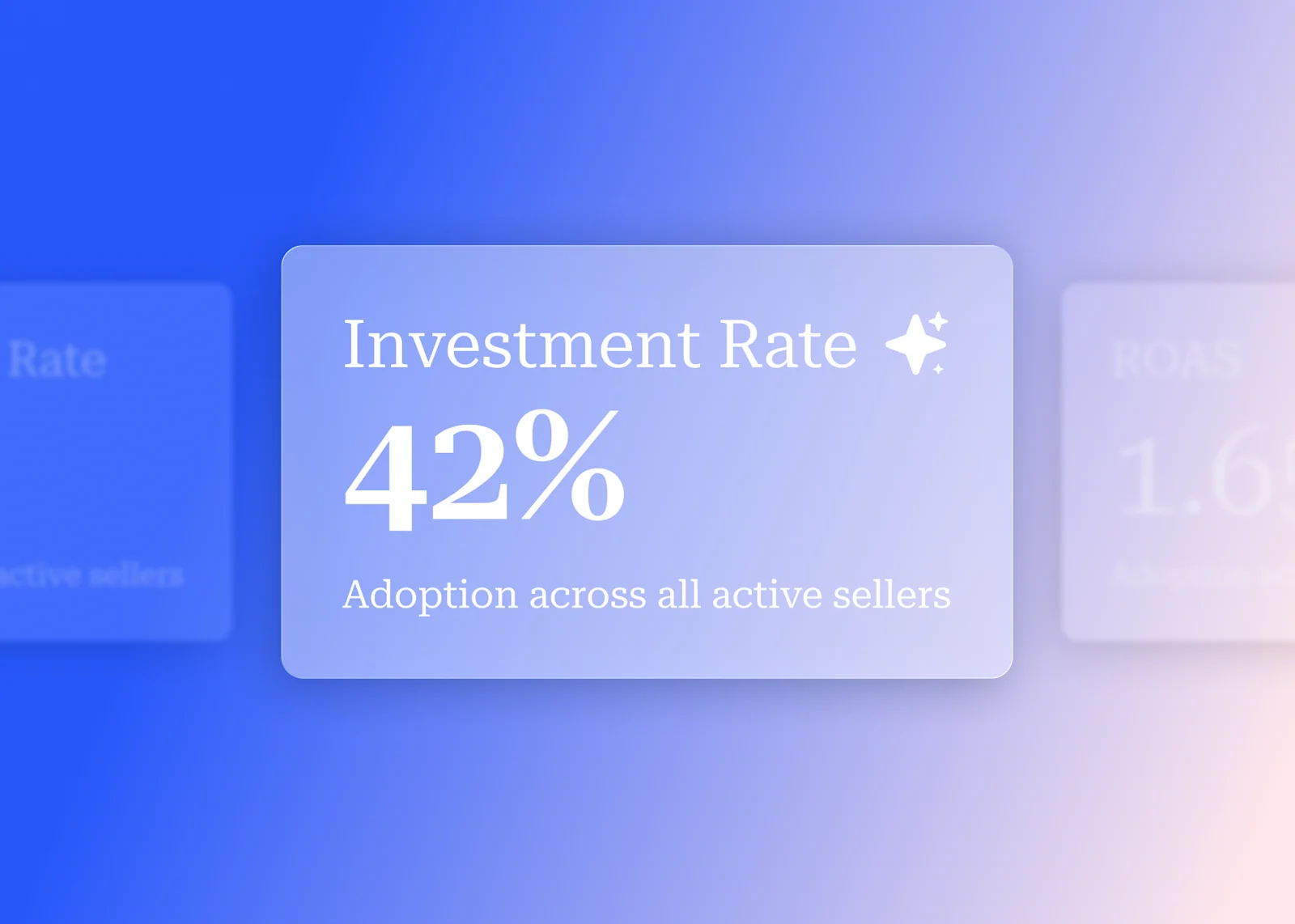
- Investment rate measures the percentage of your active brands and sellers who are actually spending on your retail media platform.
Think of it this way: Monetization rate tells you the size of the harvest. Investment rate tells you how many farmers are actually planting seeds.
Strategic Insight: A high monetization rate combined with a low investment rate indicates a "top-heavy" program. This creates extreme vulnerability to budget shifts from a few major brands. True sustainability comes from broad adoption.
How to measure investment rate
Calculating this metric is straightforward, but the insights it provides are profound:

By tracking investment rate monthly, you can see if your technology is actually accessible.
According to BCG (opens in a new tab), retail media margins can reach 70% to 90%, but only if the technology allows for efficient, self-service scaling.
Ask yourself: Are your tools working for the "long-tail" of your advertisers, or are they only usable by agencies with massive budgets? A rising investment rate suggests a healthy, democratic ecosystem where brands and sellers of all sizes see a clear path to growth.
How investment rate powers a healthy TACOS
Why is investment rate the "north star"? Because it is the primary lever for maintaining a healthy TACOS (Total Advertising Cost of Sale).
As Cédric Epiard, VP of Product at Mirakl Ads, has highlighted%3F-,Why%20TACOS%20matters,-That%20last%20question), high-performance programs move beyond simple ROAS to focus on how ad spend impacts the entire business. TACOS provides that holistic view:

When you optimize for investment rate, you are effectively "de-risking" your TACOS and driving program sustainability in three ways:
1. Diversifying the spend pool
If your TACOS is driven by only 5% of your advertisers, your entire revenue stream is at the mercy of a few large budgets. By increasing the investment rate, you distribute the ad load across a wider variety of advertisers. This prevents "ad fatigue" for shoppers and ensures that your total GMV isn't overly dependent on a handful of high-spending brands.
2. Improving organic discoverability
A higher investment rate means more "long-tail" products are entering the auction. When these products win placements and convert, it signals to your marketplace algorithms that they are relevant. This "flywheel effect" helps surface new, high-quality products that would otherwise remain buried, ultimately boosting your organic GMV — the denominator in the TACOS formula.
3. Scaling without operational complexity
To keep TACOS healthy as you scale, you cannot rely on manual campaign management. This is where AI-powered automation becomes critical. By empowering a high percentage of sellers to manage their own spend through self-service tools, you grow your ad revenue without a linear increase in overhead, maintaining the high-profit margins associated with retail media.
The long-tail opportunity
Recent industry analysis from EMARKETER (opens in a new tab) highlights that the fastest growth in retail media is no longer coming just from the "Big Three." Success in 2026 depends on a network's ability to scale beyond basic on-site search by empowering its entire 3P seller base with low-friction, self-service tools.
As Sarah Marzano, Principal Analyst at EMARKETER, puts it:
“Advertisers are juggling more networks than ever with finite budgets, and the dominance of Amazon and Walmart means every other player must fight for share. Networks that can ease the process of buying and reporting on retail media and show clear evidence of brand-building impact will be best positioned to win the trust and spend of advertisers operating in a resource-constrained environment.”
Turning the shift into an opportunity
The eCommerce world is on the brink of an agentic commerce transition. As LLMs and AI shoppers begin to navigate the web, the "old" ways of managing retail media — lengthy manual campaigns and managed services — won't scale.
To unlock sustainable growth, retailers must eliminate operational complexity. You need to give your advertisers total control through self-service management and campaign automation
When you focus on investment rate, you stop treating retail media as a "tax" on your biggest partners and start treating it as a growth engine for your entire eCommerce.
So, look at your dashboard today. Is your monetization rate climbing while your advertiser adoption stalls? If so, it might be time to reconsider your strategy and ask yourself: Is your platform built for the few, or is it powered by the many?
Dive deeper into building a sustainable program by jumping into our guide on building a high-performance retail media program.