What four conversations with Mirakl's Head of Agentic Commerce reveal about retail's next chapter
For the better part of two decades, the digital shopping journey followed a predictable script. A shopper landed on a homepage, browsed a category, refined a search, scrolled a results page and eventually clicked into a product. Every step generated a signal. Every signal fed a personalization engine, an ad auction or a merchandising decision.
That script is being rewritten in real time.
Over four episodes of the podcast, host Kiri Masters sat down with Amelia Van Camp, Mirakl's Head of Agentic Commerce, to map what's actually changing as LLMs insert themselves at the front of the shopping journey. Together they traced a single narrative across four shifts: discovery is moving upstream into AI tools, the product detail page is becoming a homepage in its own right, the behavioral signals retailers depend on are shrinking and a new advertising surface is emerging inside the LLMs themselves.
What ties it all together? A simple, almost contrarian idea: isn't a teardown of eCommerce — it's an extension of it.
The retailers who will win this transition aren't the ones racing to launch the flashiest shopping agent. They're the ones treating data integrity, product truth and customer trust as the foundation for everything that comes next.
Here's what each episode brought to the table.
How LLMs are quietly becoming the front door to shopping
How often are you, personally, using ChatGPT, Gemini or Perplexity to start a shopping decision? When Amelia puts that question to live audiences in the , the answer is striking.
"You usually see about 80% of the group raise their hand," she says. The follow-up question — how many of those people have actually purchased through an LLM — gets fewer hands, but the gap is closing fast.
The point isn't that retailer websites are dying. They aren't.
The point is that the first step of the journey, the discovery and decision-making part, is increasingly happening somewhere else. Shoppers are showing up to retailer sites with their minds already made up, having done their evaluation in a conversation with an LLM.
That changes what retailers need to optimize for.
LLMs don't browse the way humans do. They scrape, they compare and, most importantly, they evaluate trust before they recommend. Amelia describes how AI agents have been built to look for specific identifiers like accurate pricing, robust ratings and clear shipping details, before a product earns a spot in the answer surfaced to a shopper. Get those wrong and you don't show up at all.
There's also a new layer of optimization stacking on top of the basics: intent-based attributes. Where traditional product data answers what is this product?, intent-based attributes answer which conversational scenarios is this product the right answer for? This is the territory of and it's quickly becoming the new battleground for visibility in AI-powered shopping experiences.
The takeaway: Discovery has moved upstream, but retailer sites are still essential infrastructure. The work is in feeding the LLMs the data they need to recommend you with confidence.
When the product page becomes the entire shopping journey
Picture the new shopping path: a shopper does all of their research with an LLM, clicks through directly to a single product page, converts and leaves. Two pages.
The traditional onsite journey — homepage, category, search, browse, compare — collapses into the PDP and the checkout. That compression is the heart of , and it's where the implications for retail media start to bite.
For retail media leaders, that's a problem hiding inside an opportunity. As Amelia puts it, this kind of compressed traffic represents "an opportunity to think about the experience inside of that setting" and design around it rather than against it.
The compression matters because retail media has historically been fueled by browsing behavior. Sponsored placements on category pages, search results and homepage takeovers all assume the shopper is in exploration mode. When the shopper arrives pre-decided and pre-converted, those formats don't have anywhere to live.
So retailers face a design question, not a technology question. If a shopper is going to spend two pages on your site, what do you want those two pages to do?
Amelia points to retailers that are already executing this well, using sample programs, loyalty enrollment, post-purchase recommendations and tightly relevant adjacencies to add value to a shorter journey without making it feel cluttered or salesy. Think about the PDP the way you used to think about the homepage: as the place to communicate brand, build relationship and surface what comes next.
The opportunity for retail media is to evolve toward formats that feel native to a shorter journey, rather than forcing browsing-era ad units into a pre-decided shopping context.
The retailers willing to test now will be the ones who write the playbook for everyone else, and they'll be the ones whose programs grow on the back of rather than top-of-funnel browsing volume.
The data exhaust is shrinking. Now what?
If shoppers are doing their evaluation upstream and arriving at a single PDP, the rich behavioral signal that retail media networks were built on starts to thin out. Fewer searches. Fewer category pageviews. Fewer comparison sessions. Less data exhaust. That's the consequence Amelia and Kiri tackle in , and it raises a deceptively simple question.
What's a retailer to do when the data isn't coming to them anymore? Earn it.
Amelia is pragmatic here: Signals don't appear on their own. Retailers have to design the moments that produce them, like useful onsite assistants, post-purchase loops, education and tutorial content, review programs, loyalty enrollment and replenishment touchpoints.
The retailers who treat their site as a learning environment for both shopper and machine will end up with richer profiles than the ones who simply optimize for conversion at the PDP.
She's also blunt about the trap of chasing AI capabilities without a clear plan. Plenty of retailers stood up onsite shopping agents in the past year because the market pressure to act felt overwhelming.
Many of those agents underperformed not because the technology failed, but because the strategy behind them was thin. What a shopping agent is for, who it serves and how it ties back to data the retailer already owns are the questions that decide whether it works.
That brings us back to product truth.
Pricing accuracy, inventory reliability, shipping clarity, after-sale quality — these have always mattered in eCommerce. They matter even more in agentic commerce, because every fault doesn't just frustrate a shopper, it teaches an AI agent not to trust you.
The compounding effect is the part most retailers haven't fully internalized yet: In an AI-mediated shopping world, trust failures are double penalties. (For a practical breakdown of how AI agents actually evaluate a product page, is a useful next step.)
The mantra Amelia keeps returning to is the one she lands on here: "Data rich wins the race. It always has." The strategy isn't new. The stakes just got higher.
What happens when ads enter the AI conversation
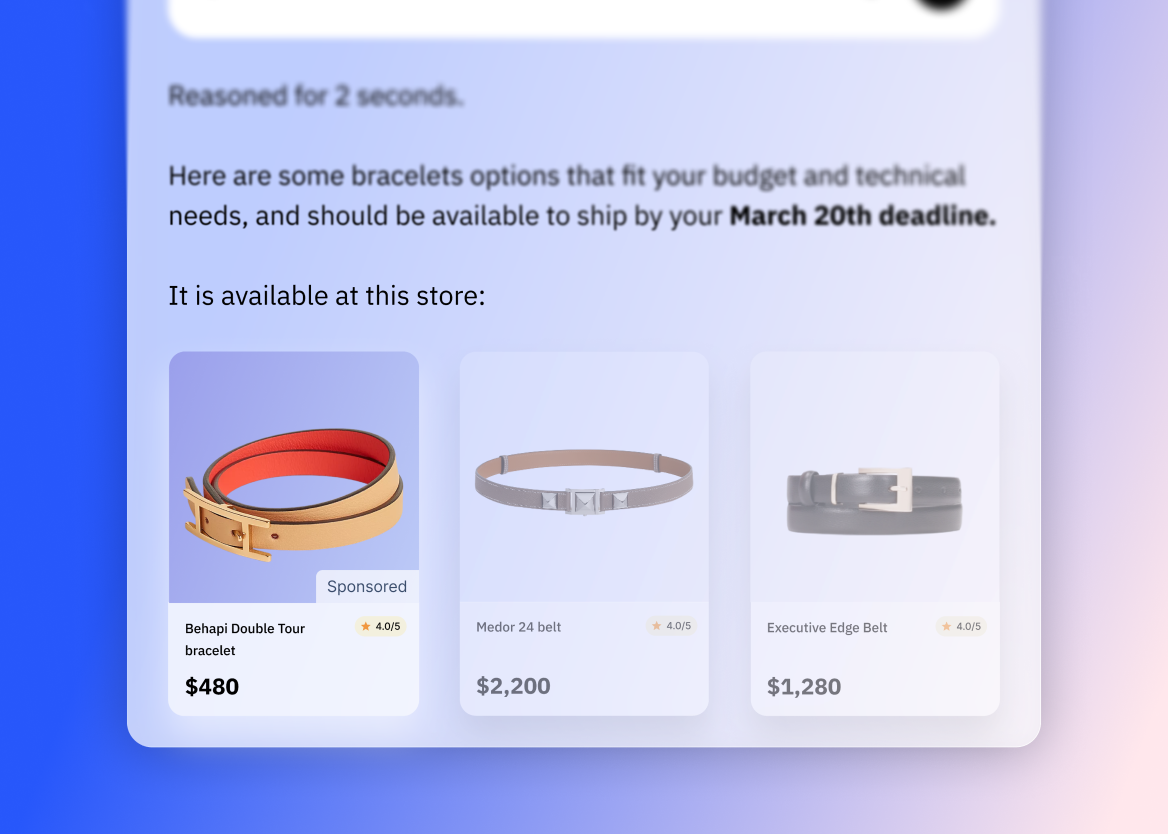
Every retail media operator is asking the same question right now: What does advertising actually look like inside an LLM? digs into that one head-on, starting with what OpenAI's early ad experiments tell us about where this is heading.
The early model is worth paying attention to.
Sponsored placements appear after the substantive answer, not woven into it, so the user's trust in the response itself stays intact. Whether that pattern holds and whether other LLMs follow suit will shape the next phase of retail media.
What Amelia is clear about is the standard advertisers will be measured against.
LLMs have built their entire user experience around one thing: hyper-relevance to the specific conversation a person is having. As she describes it, "It's relevancy on steroids in any avenue that they're pursuing." Ads that don't meet that bar won't just underperform, they'll erode the very experience the LLM has worked to build.
For retailers and brands, this lands the series back where it started: intent-based attributes. The same metadata layer that makes products discoverable in an LLM's organic results is the foundation for making them eligible for sponsored placements that actually feel earned.
Piecemeal strategies — one stack for ads, another for conversational commerce, a third for search — won't scale. The retailers who win will treat product data, intent attributes, ad inventory and agentic interfaces as parts of a single system, not separate workstreams.
This is the ground Mirakl Ads is built on.
Multi-merchant orchestration has been Mirakl's foundation for years, and extending that orchestration into agentic commerce — across multiple LLMs, multiple models, multiple ad surfaces — is what lets retailers plug new agentic capabilities into the systems they already run, instead of bolting on yet another disconnected stack.
It's also the thinking behind , which combines product enrichment for LLM discoverability with the connection layer that lets shoppers actually buy on those platforms.
The bigger picture
Across four episodes, one idea comes into focus. The shopping journey is being reordered, but the principles underneath it haven't changed — they've just become more consequential.
Data integrity. Product truth. Trust. Relevance.
The retailers and brands who treat agentic commerce as an extension of strong eCommerce fundamentals will adapt. The ones treating it as a separate frontier will spend the next two years building stacks they have to rebuild.
The good news is that the work is knowable.
Audit your core product data. Add the intent-based attribute layer. Redesign the PDP for the journeys it's actually receiving. Earn the signals you used to harvest. And demand that your retail media and agentic commerce strategies operate as one system, not two.
If you want to go deeper on what an MCP-native, agentic-ready ad serving stack looks like — and how Mirakl Ads is operationalizing the ideas in this series — read .