
Advertising remains one of the fastest-evolving segments of today’s economy. In December, WPP Media updated its 2025 forecast for global ad spend from 6% in June to 8.8% (opens in a new tab). Driven by an AI boost, WPP estimated last year’s total ad spend would top $1.14 trillion (opens in a new tab).
Within that expansion, retail media stands out, with global revenue projected to exceed $176 billion by 2028 (opens in a new tab).
However, figures alone don’t tell the whole story.
Retail media is entering a phase shaped by new pressures and new possibilities, with AI accelerating how products are discovered and how campaigns are optimized and measured. At the same time, the rise of agentic commerce signals a future in which AI agents play a more active role in shopping journeys, creating new surfaces for discovery and monetization.
As retail media matures, success in 2026 will depend less on expanding inventory and more on how effectively retailers adapt their infrastructure. Here are five trends that highlight the shifts that will define the next stage of retail media as well as the strategic choices retailers will need to make.
1. Agentic commerce will have a major impact on product discovery and visibility
Agentic commerce is no longer a buzz word. Today, more than 70% of shoppers have already integrated Large Language Models (LLMs) into their shopping journey (opens in a new tab) — leveraging them for everything from gift inspiration to price benchmarking and product feature analysis.
As commerce evolves toward agentic models, retailers and advertisers must adapt their strategies to ensure product visibility across LLMs that create both traffic acquisition and direct conversion.
This transformation places critical emphasis on product data infrastructure. AI systems rely on structured, comprehensive and accurate product attributes to surface relevant recommendations and maintain contextual relevance throughout the shopper journey.
Retailers that prioritize data foundation investments will achieve superior performance as AI increasingly mediates purchasing decisions.
For retailers, this evolution necessitates strategic realignment of 2026 priorities. That includes:
- Optimizing product data architecture to ensure consistency, structured taxonomy and agent-readability across all digital touchpoints.
- Establishing real-time data synchronization for inventory availability, dynamic pricing signals and promotional mechanics.
- Developing strategic partnerships with LLM platforms to enable affiliate integration and better product recommendation.
Retailers that proactively invest in agent-ready infrastructure will capture competitive advantages as AI expands the ecosystem of environments where product discovery, recommendations and conversion opportunities emerge.
2. Retailer-powered shopping agents provide a new ads environment
LLM platforms like ChatGPT and Gemini aren’t the only place shoppers are turning to for AI-powered retail experiences.
In fact, many retailers are beginning to deploy their own, personalized AI agents to bolster their on-site shopping experiences. Amazon’s Rufus (opens in a new tab) may have been the first, and potentially most well known, but other retailers have quickly followed suit, like Lowe’s Mylow (opens in a new tab).
These agentic interfaces present retailers with a new environment conducive to advertising and affiliate marketing. Behind the product recommendation algorithm, each retailer can decide on the rules and potentially offer sponsored placements, or at least a ranking influenced by a cost-per-click (CPC) or a commercial agreement.
These agent-powered recommendations can be significantly more personalized as retailers leverage their unique advantage: unified first-party data signals from both in-store and on-site purchase history, along with membership information.
By reconciling shopper identities across these channels and interpreting behavioral patterns in real time, retailers can deliver hyper-targeted product suggestions that reflect the complete customer journey. This comprehensive view of shopper behavior enables more precise attribution models and creates opportunities for advertisers to reach high-intent audiences at critical decision-making moments.
3. AI becomes more tightly integrated with leading retail media platforms
Rethinking retail media with AI isn’t just about adapting shopping agents and new consumer behavior. It’s also about leveraging a powerful tool that makes retail media more accessible to everyone, while maximizing its efficiency.
It starts with what should be table stakes in 2026:
- AI-powered ad server and vector search that understands complex intent queries and surfaces ultra-relevant products
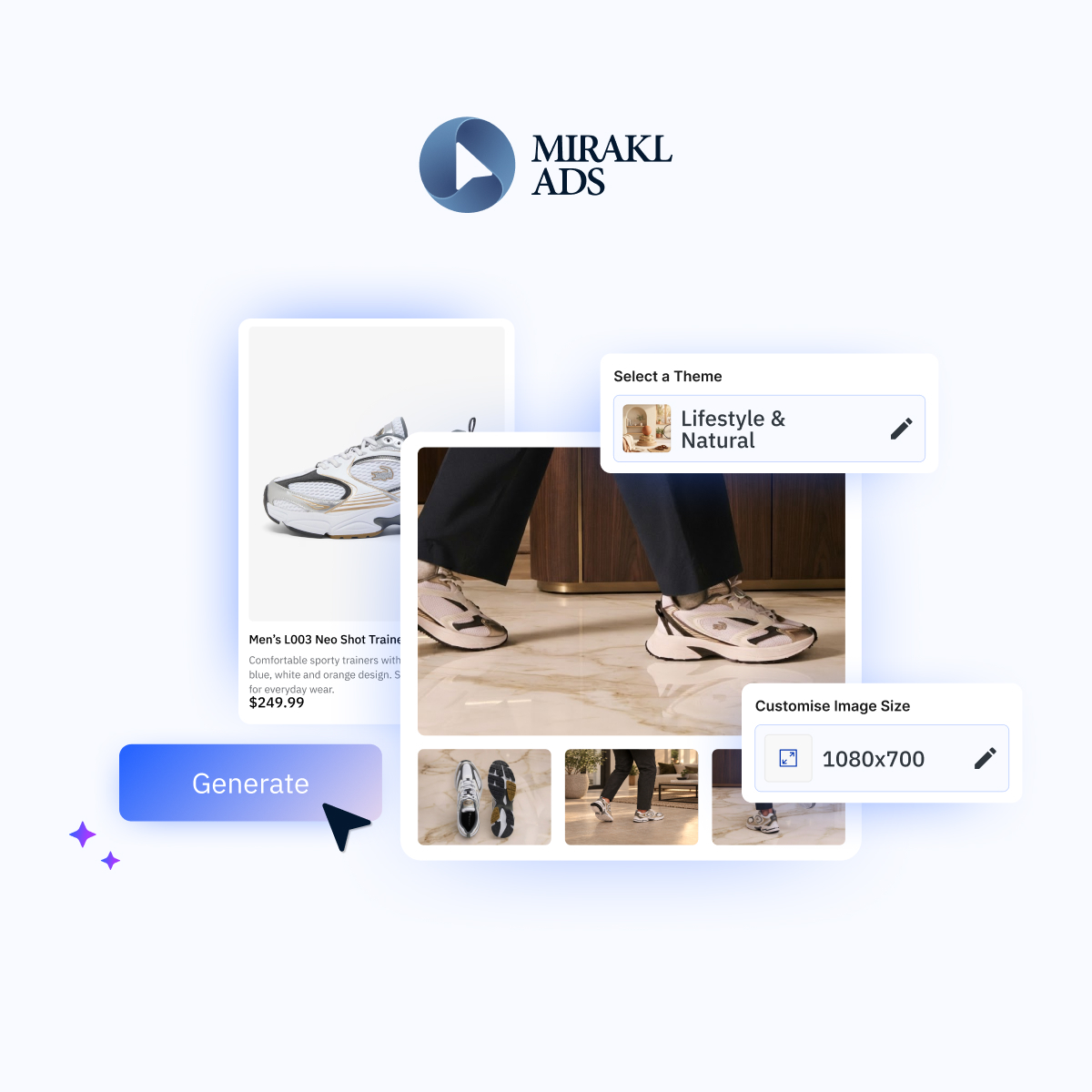
- The ability for advertisers to launch automated campaigns in just a few clicks, by selecting the right targeting, bids and products
- A platform that actively guides users with AI, offering personalized recommendations to build and optimize campaigns.
The next evolution — as Walmart recently announced (opens in a new tab) — is a conversational agent built as a true retail media expert, within ads platforms.
These assistants will be able to answer retailers’ questions like:
- How can I maximize monetization?
- What CPC floor should I set for Black Friday, and for which categories?
- Which advertisers are at risk of churn, and what levers can I use to retain them?”
And on the advertiser side, assistants will be able to answer questions like:
- What should I optimize in my campaign?
- How can I improve visibility for my hero products in the most efficient way?
- My audience is “XYZ”, how can I best target them?
As AI becomes more tightly integrated with retail media platforms, these kinds of questions won’t just be answered in real time, they’ll even trigger campaign creation and updates.
4. Retail media moves beyond retail
In 2026, more non-retail companies will enter the retail media space. For example, financial players (opens in a new tab) and payment platforms (opens in a new tab) are turning their purchase and behavioral data into advertising infrastructure, expanding what “retail media” can mean.
For retailers, this widening field raises the bar. Advertisers now have more media partners to choose from, so retailers will need to differentiate through the assets only they can provide:
- Rich, commerce-native shopper data
- Direct product context and relevance
- Marketplace-driven assortment breadth
Here, accessibility will remain a key competitive advantage.
Retailers that offer intuitive onboarding, automated optimization and transparent performance will continue to draw investment even as commerce media expands beyond retail. Those who streamline participation for all seller types will be best positioned to thrive in an ever more crowded landscape.
Building retail media for the agentic era
As AI changes how products are discovered, how campaigns are optimized and how performance is measured, retailers will need infrastructure that can evolve alongside the ecosystem.
The trends defining 2026 underline why doing so will be necessary.
With Mirakl Ads and Mirakl Nexus, retailers have a commerce-native foundation that supports automation, scalability and control today, while preparing them for the next generation of retail media experiences.
Whether adapting to new discovery surfaces, enabling broader seller participation or integrating AI-driven workflows, Mirakl is ready to help retailers move forward with confidence.
To learn more about how Mirakl uses AI to power scalable, accessible retail media, download our guide to AI-powered retail media here.
Download now | AI-powered retail media: How it works and why it wins