
"Winning search" used to mean one thing: ranking higher than your next competitor on a Google results page. That instinct still runs deep in eCommerce. It also explains why a lot of teams are now staring at the rise of generative AI — ChatGPT, Perplexity, Google's AI Mode, Claude — and asking the wrong question: Is SEO dead, and do we need to switch to GEO?
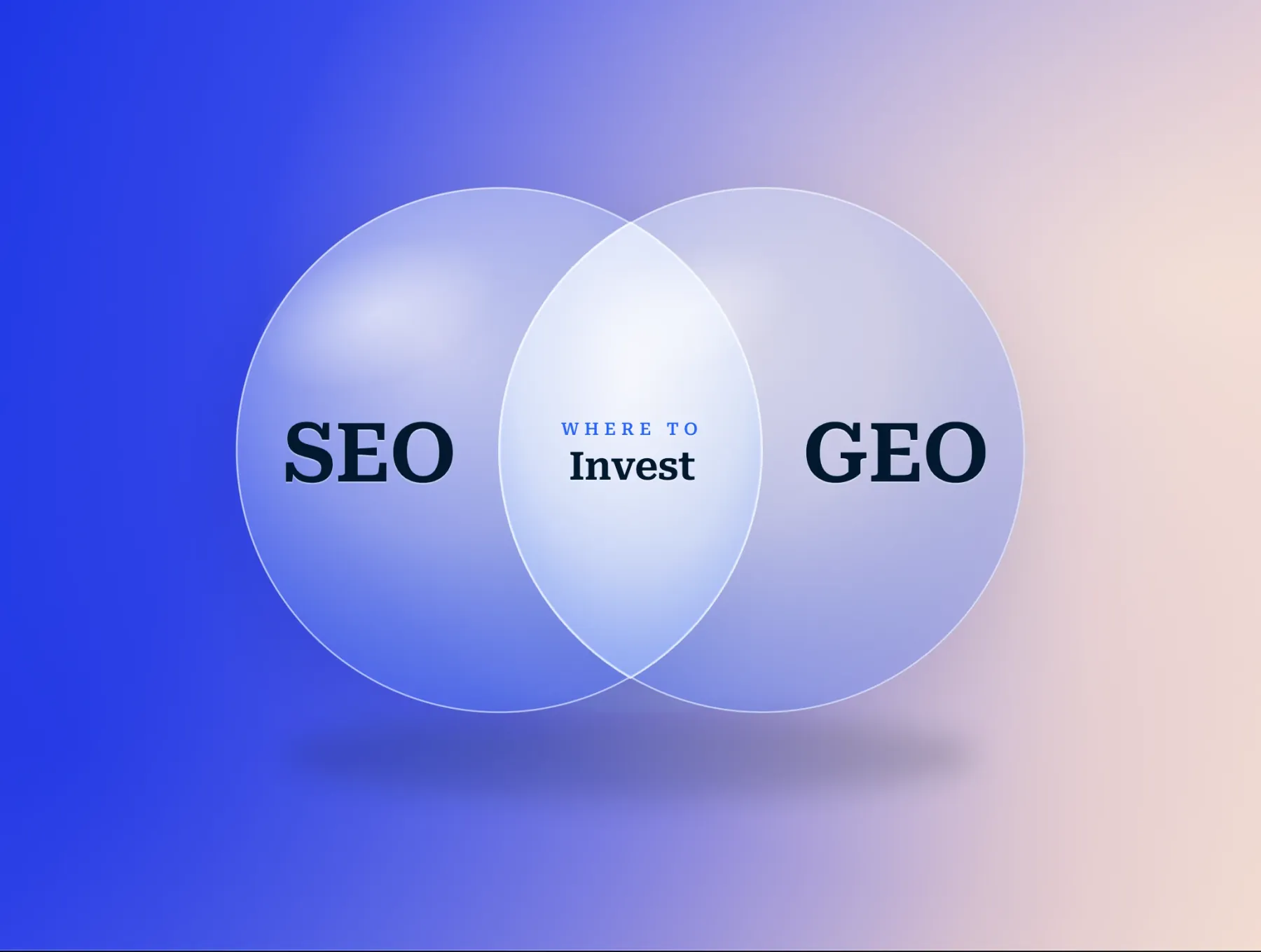
The framing is wrong. Search Engine Optimization (SEO) and Generative Engine Optimization (GEO) aren't rivals fighting over the same budget. They're two layers of the same discovery problem — and for retailers, brands and marketplaces, the layer that increasingly determines success in both is the quality and structure of your product data.
This guide breaks down how SEO and GEO actually differ, where they overlap and how to allocate effort across both — without putting the organic revenue you already have at risk.
What do SEO and GEO each actually mean?
Search Engine Optimization is the practice of earning ranked visibility on a results page so human searchers click through to your site. It rewards keyword-relevant content, technical health, internal linking and backlinks from authoritative sources.
Generative Engine Optimization is the practice of earning visibility inside AI-generated answers — being named, cited or recommended when a large language model (LLM) responds to a shopper's question. It rewards semantic clarity, structured data, factual precision and credibility across the broader web.
A quick note on terminology: GEO is the term we'll use throughout, but the practice goes by several names — answer engine optimization (AEO), large language model optimization (LLMO), AI search optimization (AISO). According to Forrester's Best Practices for Answer Engine Optimization (AEO), these labels describe the same underlying discipline. Don't get hung up on which acronym wins. The mechanics matter more than the name.
How is GEO different from SEO?
The two disciplines diverge in four places: the signals they reward, the content format that wins, how success is measured and the buyer behavior each one serves.
Ranking signals
Traditional SEO leans heavily on keyword targeting, backlink profiles and domain authority — signals built around how Googlebot crawls, indexes and ranks pages. Generative engines behave differently. Research on what these systems actually cite (opens in a new tab) points to a different set of preferences: passages with specific statistics and verifiable facts, claims backed by named sources and direct quotations, content that's structured to be cleanly extracted and facts corroborated across credible outlets. Keyword density and pure link volume don't translate. Stuffing a product description with keywords might still help on Google. It tends to do nothing — or actively hurt — in a model trying to summarize what your product is.
Content format
SEO rewards pages built to rank: optimized titles, comprehensive coverage, internal linking, schema markup. GEO rewards content built to be quoted. Some of that overlaps with what Google has long advised (opens in a new tab) — unique, valuable content; clean page experience; technical accessibility — but generative engines add their own layer. They favor passages a model can lift cleanly: clear definitions, well-structured data, direct answers to direct questions, and structured data that matches what a human reader actually sees on the page. The skyscraper article — longer than everything else on the topic — was a classic SEO play. Generative engines prefer concise, self-contained passages they can lift cleanly. According to Forrester's Best Practices for Answer Engine Optimization (AEO), the average ChatGPT prompt runs 23 words long — which means shoppers are arriving with fully formed questions, not fragments. The content that gets cited is the content that answers those questions directly.
Success metrics
SEO is measured in rankings, organic sessions and click-through rate. GEO is measured in citations, brand mentions, AI-traffic referrals to your website and share of voice inside AI answers. That measurement gap is real, and worth flagging: most teams don't yet have analytics dashboards for AI visibility the way they do for organic search, and AI platforms don't share prompt-level query data. Expect the metrics layer and measurement tools to keep maturing.
Buyer behavior
SEO serves the shopper who browses, compares and clicks. GEO serves the shopper who asks and purchases based on the answer they receive. That second behavior is rising fast — and often resolves without a click at all. Pew Research found that when a Google search returns an AI-generated summary, users click a traditional result just 8% of the time, compared with 15% without one (opens in a new tab), and they click a link inside the summary itself only 1% of the time. Browsing sessions are also more likely to end after an AI-summary search (26%) than after one without (16%).
Here's the contrast at a glance:
| Dimension | SEO (Search Engine Optimization) | GEO (Generative Engine Optimization) |
|---|---|---|
| Goal | Rank in the list of results | Be named or cited inside the AI answer |
| Where visibility happens | Search results page | Inside a synthesized and contextualized AI response |
| Primary signals | Keywords, backlinks, technical health, content relevance | Semantic clarity, entity precision, structured data, authoritative citation |
| Content format that wins | Ranked, optimized pages | Extractable, declarative, well-structured passages and data |
| Success metrics | Rankings, organic traffic, click-through rate | Citations, brand mentions, share of voice in answers |
| Buyer behavior served | Browse, compare, click | Ask, receive a recommendation (often zero-click) |
| Funnel coverage | Strong on transactional and branded queries | Strong on upper-funnel research and comparison |
Where do SEO and GEO overlap?
The temptation, looking at that table, is to treat SEO and GEO as parallel programs that share a logo and nothing else. That's a mistake. They overlap in one critical place — and for eCommerce teams, the overlap is the whole game.
Both channels reward a shared foundation: technical health, crawlability, topical authority and credible mentions across the wider web. But the highest-leverage shared asset for a retailer isn't a blog post or a thought-leadership article. It's the product catalog.
Here's why. Structured product data — names, brands, GTINs, materials, dimensions, use cases, compatibility, availability, price — is what earns rich results in traditional search. It's also what lets generative engines confidently discover, compare and recommend a product. The same JSON-LD product schema that powers a rich result on Google gives an LLM the entity clarity it needs to cite your product in an answer. Complete attribute coverage that ranks well for long-tail queries is the same coverage that lets an AI answer "which dishwasher fits a 24-inch cabinet and has a third rack?" The work compounds.
This is also why traditional SEO playbooks built around marketing copy don't translate cleanly. An LLM trying to recommend a product doesn't care about your keyword-optimized H1. It cares whether your catalog actually tells it what the product is, what it does and who it's for — backed by best practices on helpful content (opens in a new tab), in language a model can parse. Catalogs built only for human browsing tend to be thin on the contextual, experiential and usage attributes that AI engines need most: "good for small kitchens," "designed for sensitive skin," "compatible with iPhone 15 Pro." Those attributes don't just improve AI discoverability. They improve filtering, on-site search and merchandising too.
There's a competitive intensity issue here that's easy to underestimate. A traditional search results page surfaces 10 or more organic links. AI answers compress that visibility dramatically. A 2026 analysis of 680 million citations (opens in a new tab) across the major AI engines found that the top 15 domains capture 68% of all citation share — a concentration far more extreme than Google's organic rankings ever produced. The margin for error shrinks. The cost of an incomplete product record rises. The teams that invest early in catalog enrichment compound an advantage that's hard to close — because data quality takes time to build, and once a model has learned to cite your competitor, it keeps doing it.
If your structured product data is incomplete, you are not underperforming in one channel. You are underperforming in both.
Where should eCommerce brands invest in SEO and GEO?
Most pieces land on "do both" and leave it there. Here's a more useful framework, keyed to three variables: catalog size and complexity, audience and buying context, and where your customers actually search today.
Catalog size and complexity
The larger or messier the catalog, the more your binding constraint is data quality, not channel-specific tactics. Before you split resources between an SEO content sprint and a GEO citation strategy, fix the shared foundation: standardize attributes, fill gaps, enrich descriptions with contextual and experiential data and implement clean product schema. A complete, well-structured catalog pays into both channels simultaneously. A thin catalog limits both.
Audience and buying context
B2C discovery — especially in research-heavy categories like electronics, beauty, home and travel — is migrating fastest into AI assistants. B2B and considered-purchase journeys still rely heavily on direct site visits, search and salesperson involvement, but the upper-funnel research phase is shifting too. Marketplace and multi-seller catalogs face an extra wrinkle: the variability across seller listings is exactly the kind of inconsistency that hurts AI discoverability. A standardized attribute model across sellers is a GEO investment whether the operator calls it that or not.
Where customers search today
Transactional and branded queries still resolve overwhelmingly in traditional search — if a shopper knows what they want, they often type it straight into Google. That's where SEO continues to drive the revenue click. Upper-funnel research — the "what's the best…", "how do I choose…", "which one works for…" queries — is migrating into LLMs faster. EMARKETER projects that nearly a third (31.3%) of the US population will use generative AI search in 2026 (opens in a new tab), which means the top of your funnel is increasingly a conversation, not a results page.
A few principles to land on:
- GEO investment should be additive, not subtracted from SEO. Cutting SEO to fund GEO tends to soften organic revenue before AI visibility has time to compound. According to Forrester's Search Engine Optimization Solutions Landscape, Q1 2025, SEO budgets are projected to triple this year due to AI-integrated search — and that growth reflects the work expanding, not migrating.
- Sequence the shared foundation first. Catalog data quality, technical health and structured product data benefit both channels. Build that layer before you split into channel-specific work.
- Don't optimize for citations at the expense of conversions. AI-referred traffic is small in absolute terms but extraordinarily qualified. AI-referred traffic converted 42% better than non-AI traffic in March 2026 — a record high, and a full reversal from March 2025 when it converted 38% worse (opens in a new tab). The volume is still nascent; the quality is not.
Where is this heading?
The behavioral shift is real and accelerating. Traffic from AI sources to US retail sites grew 393% year-over-year in the first quarter of 2026 (opens in a new tab), continuing the momentum from a 2025 holiday season when AI traffic to retail was up 693% year-over-year. And Salesforce reports AI and AI agents influenced about 20% of all online retail sales globally over the 2025 holiday season — roughly $262 billion in revenue (opens in a new tab).
The bigger story is what comes next. McKinsey estimates AI agents could mediate $3 trillion to $5 trillion of global consumer commerce by 2030 (opens in a new tab), with the US B2C retail opportunity alone reaching roughly $900 billion to $1 trillion. Agents don't browse pages or click ads. They consume structured product data and make decisions based on it. As Forrester notes in its analysis of how generative AI is reshaping shopping (opens in a new tab), AI is reviving SEO precisely because the discipline it touches — making content and data machine-discoverable — is now the foundation of every search surface, not just one. As that world matures, machine-readable product information stops being an SEO nice-to-have. It becomes the baseline infrastructure for being discoverable at all.
If you want a fuller take on where agentic commerce is headed and what it means for catalog and merchandising teams, that's a conversation worth having separately.
So which one should you invest in?
Neither, exclusively. Both, deliberately.
SEO isn't dead — it still owns the transactional click and the bulk of branded demand. GEO isn't a replacement — it's the upper-funnel layer that's emerging as discovery moves from a list of links to a conversation. The thing that determines whether you win in either is the same thing: how complete, accurate and structured your product data is.
For eCommerce teams, that reframes the budget question. It isn't "SEO versus GEO." It's "how quickly can we make our catalog the foundation that compounds across every surface a shopper might use to find a product?"
That work — structured, complete, machine-readable product data — is the durable investment under both disciplines. Mirakl Agentic Activation is built around exactly that idea: making product data discoverable not just to Google's crawler, but to the AI agents increasingly making the recommendation.
FAQ
SEO earns visibility by ranking pages on a search engine results page so human searchers click through. GEO earns visibility inside AI-generated answers by structuring content and product data so large language models can discover, interpret and cite it. The end states are different: SEO produces a click; GEO produces a mention or recommendation.
No. The two serve different parts of the buyer journey. Transactional and branded queries still resolve in traditional search. Upper-funnel research and comparison are migrating into AI tools. Most eCommerce teams will need to invest in both for the foreseeable future, with the balance shifting as shopper behavior continues to move.
Start with the shared foundation: clean, complete, structured product data and technical health. Both channels rely on it, and improving it pays into both at once. Channel-specific work — content tactics for SEO, citation and authority building for GEO — comes second.
Yes, and this is where the two disciplines overlap most. The same JSON-LD product schema that earns rich results in Google gives generative engines the entity clarity they need to confidently surface and recommend a product. For retailers and brands, structured product data is the single highest-leverage shared asset.
The emerging metrics are citation frequency, brand mention share of voice in AI answers and AI-referral traffic and conversion. The honest answer: GEO measurement is less mature than SEO measurement, and AI platforms don't share prompt-level query data. Expect the tooling to develop quickly. In the meantime, track AI-referral traffic in analytics, monitor brand mentions in AI responses for your top queries and watch how branded search volume moves as AI visibility grows.
Partially. Authoritative external mentions still matter — generative engines weigh credibility across the broader web, including reviews, press and editorial coverage. Keyword density does not translate. LLMs evaluate semantic and factual precision, not keyword frequency. Stuffing copy with keywords can hurt GEO performance even when it doesn't visibly hurt SEO. Want to assess how ready your product data is for AI-driven discovery? Try our eCommerce GEO readiness analyzer now.