
The rules of B2B commerce are being rewritten in real time.
By 2028, AI agents will intermediate more than $15 trillion in B2B purchases (opens in a new tab), according to Gartner. That's not a distant future scenario — it’s a transformation that’s already underway.
That said, research shows (opens in a new tab) that while 64% of B2B leaders recognize AI will have a "very significant" impact on digital sales, only 20% feel prepared for what's coming.
The gap between awareness and action has never been wider, presenting a major opportunity. The organizations that move decisively now will establish advantages that compound over time.
In that regard, here are the five trends that will separate leaders from laggards in the AI-powered B2B economy.
Trend 1: Conversational AI reshapes B2B buying channels
B2B buyers are fundamentally changing how they discover and order products, and that transformation is happening across two fronts: new AI-powered channels and augmented existing ones.
On the new channel front, procurement professionals are using Large Language Model (LLM) platforms like ChatGPT, Gemini and Perplexity specifically for product discovery, using prompts like "Find me a supplier for industrial bearings with same-day shipping in the Midwest." These LLM platforms are becoming essential research tools in the buyer's journey.
Simultaneously, existing buying channels are being transformed by AI agents (opens in a new tab) — specialized AI interfaces that pursue goals, take actions and complete tasks on users’ behalf.
EProcurement systems now feature intelligent, easy-to-use agents in many forms. that understand natural language queries. Webstores deploy chatbots that guide complex product selections. Messaging platforms like WhatsApp are evolving into ordering channels, with restaurant owners in some markets sending voice notes detailing their supply needs and AI agents automatically converting those notes into structured orders.
The shift is accelerating rapidly.
In fact, in 2026 Forrester predicts (opens in a new tab) buyers' procurement teams will deploy agents capable of "scaling negotiation across hundreds of suppliers simultaneously," turning static pricing pages into dynamic negotiation interfaces. A full 80% of B2B sales interactions are already happening digitally, according to estimates from Gartner (opens in a new tab), and the majority of routine transactions will be handled by AI agents within the next few years.
The discovery phase has already come and gone, with LLM platforms rapidly building the infrastructure to support the purchase phase. Some already support transactions directly within their chat interfaces.
B2B organizations that position themselves across both new AI channels and augmented traditional ones will have a greater chance of capturing buyers as they default to these new interfaces.
Trend 2: Product data quality determines AI discoverability
AI agents, whether from new channels like ChatGPT and Perplexity or conversational interfaces within existing eProcurement systems, don't forgive incomplete product specifications or outdated pricing.
Unlike human buyers who might call to clarify missing information, AI simply moves to the next supplier with complete, structured data. This fundamental shift is giving rise to Generative Engine Optimization (opens in a new tab) (GEO) — a digital strategy for influencing how LLM platforms retrieve, summarize and present information in response to user queries.
According to Deloitte's Tech Trends 2026 (opens in a new tab) report, AI-generated answers already dominate search results across major search engines, reducing click-through rates to conventional websites by more than a third. AI platforms now drive 6.5% of organic traffic, projected to reach 14.5% within a year.
Just as paid search defined the 2000s and social media advertising dominated the 2010s, AI-generated responses are becoming the most critical marketing channel of the 2020s.
The challenge here is substantial.
B2B wholesalers managing diverse supplier networks face the perpetual struggle of inconsistent product data, like missing fitment data for automotive parts, incomplete specifications for industrial components, inconsistent naming conventions for food and beverage SKUs, and unclear replenishment cycles for accessories and consumables.
Traditional approaches require manual catalog management that can take months and become obsolete the moment new products arrive.
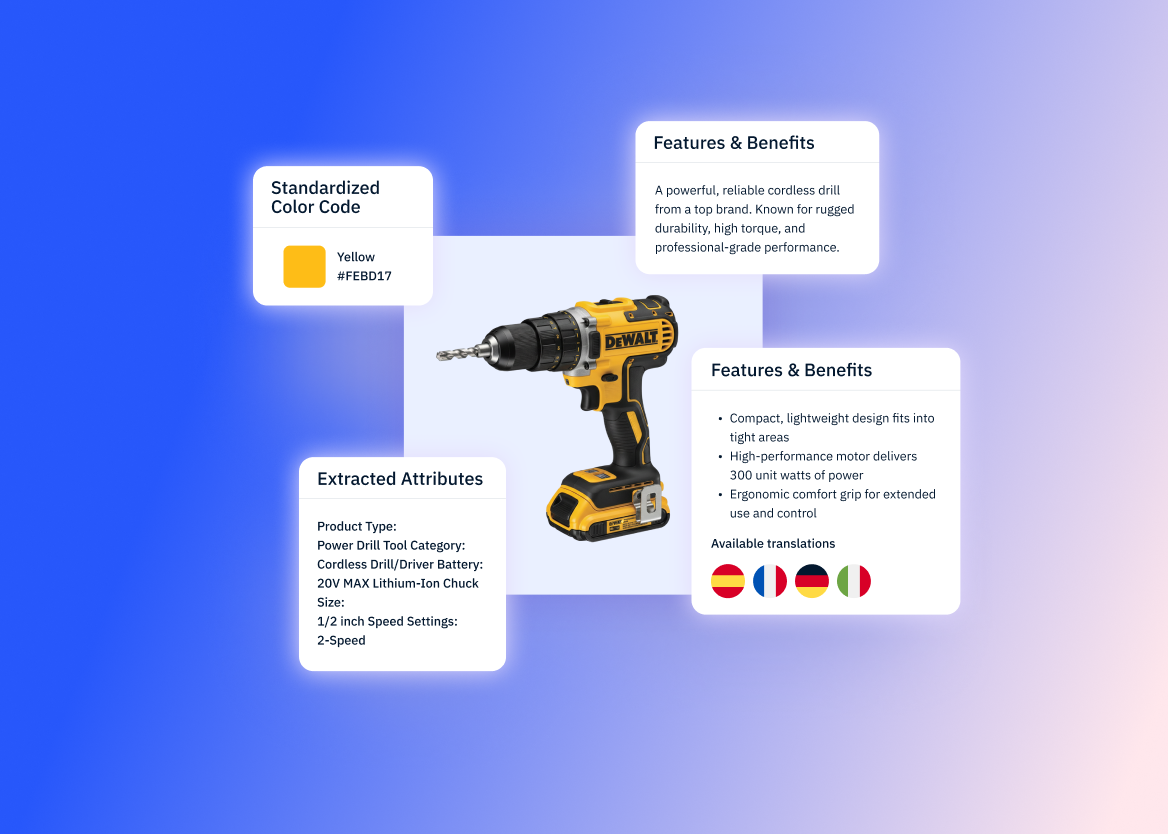
Modern, AI-powered catalog platforms can ingest and transform any supplier format — from PDFs and spreadsheets to EDI feeds — into agent-ready content in days instead of months.
For platforms managing thousands of suppliers, this creates a competitive moat. The more suppliers with clean data, the richer the transaction patterns AI can learn from, enabling smarter recommendations and better buyer experiences.
Trend 3: Task-specific AI agents reshape B2B procurement
B2B commerce will start to operate through specialized agents (opens in a new tab).
For example, negotiation agents will be deployed to secure contract terms, replenishment agents will be used for triggering orders, pricing agents for adjusting rates, and assortment agents will be tasked with optimizing suppliers’ product mix.
Leading companies (opens in a new tab) are already testing these agents, which work around the clock and expect immediate, accurate responses on four critical elements: pricing, promotions, inventory availability and delivery estimates.
McKinsey's 2025 research (opens in a new tab) shows 88% of organizations now use AI in at least one business function, but scaling remains the challenge. The companies seeing real impact — those attributing more than 5% of EBIT to AI — have redesigned their workflows around real-time data synchronization across these four pillars.
For platforms managing thousands of suppliers, this creates both opportunity and urgency. These task-specific agents help buyers make better decisions, like finding the right products faster, negotiating better terms and optimizing spend. But, they can only deliver on that promise when sellers provide what these agents need: accurate, real-time data.
The competitive advantage goes to B2B organizations that maintain real-time accuracy across the four elements these agents query constantly: pricing, promotions, inventory availability and delivery estimates.
Pricing must adjust dynamically based on contracts and market conditions. Promotional calendars need to reflect active campaigns. Inventory must show actual availability. Fulfillment status must update as orders move through the supply chain.
Organizations providing real-time accuracy across these pillars have better chances to win than those relying on periodic updates.
Trend 4: Post-purchase support goes AI-first
The sale is just the beginning.
AI agents are now handling everything from order tracking inquiries to processing returns and refunds autonomously, delivering the consumer-grade experiences B2B buyers increasingly expect.
Companies using AI-driven customer management have seen up to 50% increases in customer acquisition and 20% rises in upselling and cross-selling, according to research from the Boston Consulting Group (BCG) (opens in a new tab).
In B2B, where post-purchase traditionally involved multiple stakeholders, approval workflows and contract-specific terms, AI is cutting through complexity that once required heavy human involvement. Automated tracking updates, proactive delay notifications and instant status queries reduce the manual workload on customer service teams while ensuring consistency at scale.
That means the challenge isn't the technology, per se. It's orchestrating the data foundation that powers it.
Rich product attributes, real-time inventory and pricing, detailed transaction history, and account-specific rules must all be unified and accessible across systems. When these elements are in place, AI can analyze patterns across millions of historical transactions to surface the right products, prices and terms for each buyer’s unique context.
This isn't about replacing human relationships in B2B. It's about augmenting them.
With the right technology, sales teams can focus on strategic relationships and complex negotiations while AI handles operational personalization — custom product recommendations based on purchase history, dynamic pricing tailored to account relationships, personalized catalog views by industry and contextual offers based on buyer behavior.
Trend 5: Orchestrated buyer data powers sales
Information about B2B buyers is scattered across disconnected systems, including CRM platforms, ERP systems, procurement platforms, support tickets and email threads. Without consolidation, AI agents operate blindly, unable to access the context needed to help companies sell effectively.
That’s why companies that are embedding AI agents across the customer journey are achieving up to 40% higher lifetime value from client portfolios, according to BCG (opens in a new tab).
The difference comes from consolidating buyer data into unified profiles: negotiated contract pricing, product preferences, complementary product affinities, post-purchase queries, seasonal patterns and delivery requirements.
This complete view enables AI to surface the right opportunities and help sales teams close deals more effectively.
That said, the technical requirement is substantial. Systems need to communicate, and context must be centralized. Companies need a data strategy that breaks down silos and creates a single source of truth for buyer intelligence, orchestrating data across the entire commerce stack so AI agents can operate with complete context.
Effectively leveraging this new technology equips sales teams with complete buyer intelligence. This frees up time for sales professionals to focus on strategic conversations while AI provides instant access to everything relevant about each buyer. The end result is the enablement of smarter recommendations, faster responses and stronger relationships.
The foundation everything else depends on
The pattern across these five trends is impossible to miss: every advancement circles back to data infrastructure.
AI assistants need structured catalogs to surface products. Real-time sync requires orchestration across systems. Post-purchase automation depends on complete order data. Personalization engines need transaction history and customer context.
The companies winning in agentic commerce aren't just adopting AI tools. They're rebuilding the foundation, from data processes for ingesting product information at scale and order management systems that sync in real time, to fulfillment infrastructure that handles autonomous transactions and payment systems ready for machine-to-machine negotiation.
It's not glamorous work. But it's the difference between being discoverable in the $15 trillion, AI-mediated B2B economy or being invisible in it. Organizations that wait for AI tools to become more sophisticated while neglecting their data infrastructure will find themselves with powerful engines and no fuel to run them.
The race isn't to deploy the fanciest AI. It's to build the infrastructure that lets AI actually work. B2B leaders who recognize this distinction — and act on it now — won't just participate in the AI transformation, they'll define it.
Join our webinar, five best practices to prepare B2B businesses for the agentic commerce revolution (opens in a new tab), to get a clear, actionable playbook you can put into motion immediately.