
2026 will be a defining year for brands and sellers navigating marketplace expansion. From the rise of AI-powered shopping to the hidden costs of multichannel complexity, success will require more than just adding new sales channels.
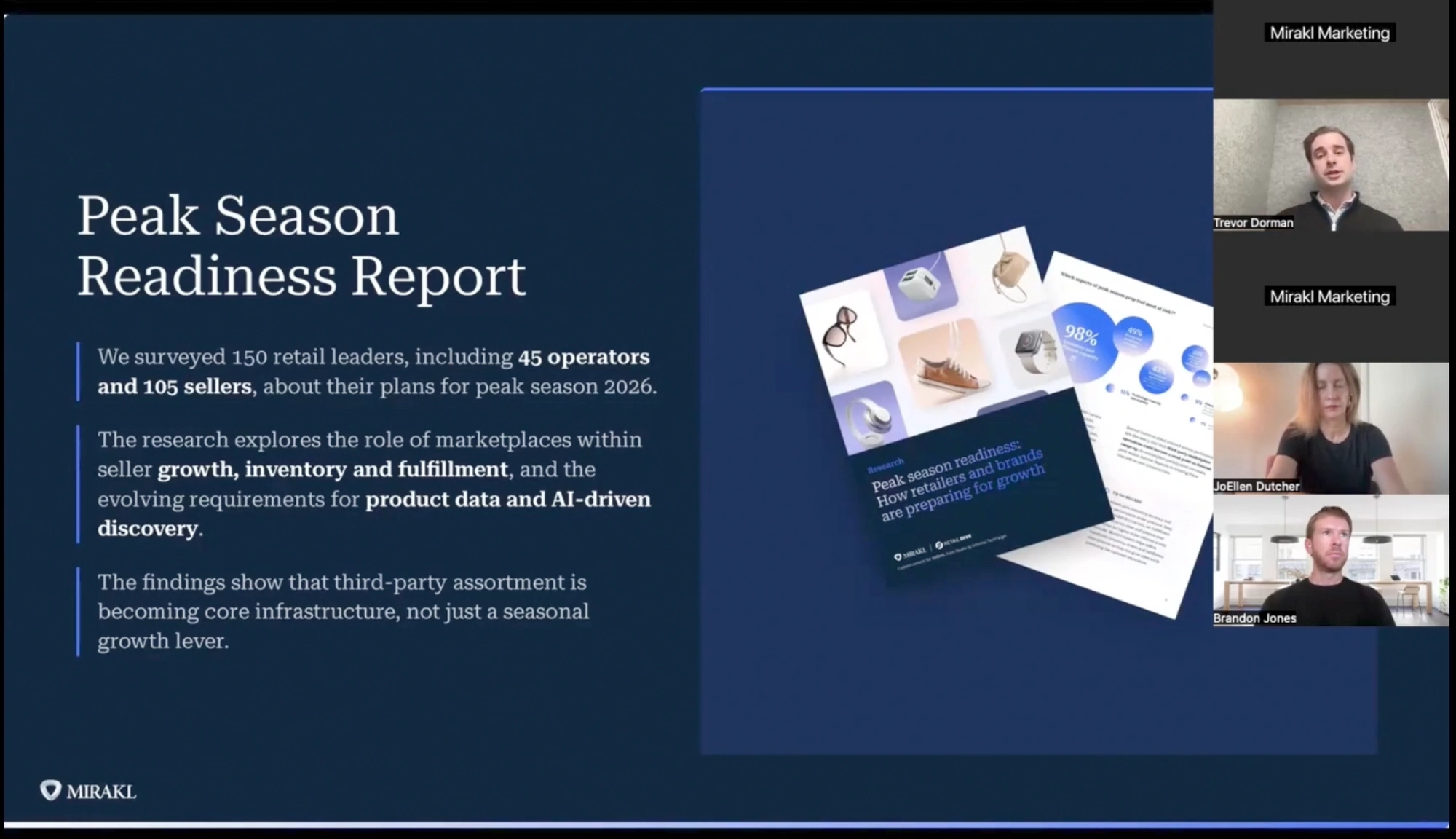
We recently hosted a webinar featuring Ross Allsop (opens in a new tab), global brand ambassador from Swap Commerce (opens in a new tab) and Vianney Lacroix (opens in a new tab), product marketing manager for Mirakl Connect, to unpack trends shaping marketplace strategy this year.
Here are the three biggest structural shifts — and what every brand and seller must do to adapt, compete and grow sustainably in 2026.
1. Agentic commerce is reshaping brand discovery
AI is rapidly gaining ground in consumer shopping search. According to Adobe’s research (opens in a new tab), AI referral traffic to eCommerce sites grew twelve times in seven months, and 72% of consumers who use AI for shopping now make it their primary search tool.
Unlike traditional search, where consumers scroll through pages of results and sponsored listings, shopping with AI works differently. Shoppers describe what they need, compare options directly within the LLM and only then land on a brand's site as an already qualified lead. They're not browsing, they're buying.
If your products don't appear in AI-generated results, they simply don't exist for these ready-to-buy shoppers.
The takeaway for brands: Optimizing your product data for generative engine optimization (GEO) is the new competitive advantage. The brands that win early in this shift will capture organic search traffic without relying on crowded and expensive paid ad channels.
Can AI find your products? Take this quick test (opens in a new tab) to get your GEO readiness score.
2. Multichannel expansion shifts from "be everywhere" to "be profitable everywhere"
Marketplaces are growing at nearly four times the rate of traditional eCommerce, now accounting for 67% of all online sales (opens in a new tab). Multichannel expansion is more than just a growth lever — it's a profitability imperative.
Consumer behavior is driving this shift as shoppers increasingly prefer specialized marketplaces (opens in a new tab) over "everything stores." They want depth, curation and expertise, not endless generic options.
But not all marketplaces are created equal. A curated presence across the right channels doesn't just drive sales. It sends trust signals to LLMs, improving a brand's chances of surfacing in AI-powered product recommendations.
The takeaway for brands: Strategic channel selection, understanding different audience behaviors and curating inventory by channel will be critical for success in 2026.
3. Scaling demands operational excellence
Scaling across multiple marketplaces creates hidden costs that most companies don't even realize they're bleeding.
Consider this: $1.2 trillion (opens in a new tab) is lost globally every year to stockouts. Not supply chain issues. Not demand problems. Just products that exist in warehouses but aren't available where customers are trying to buy.
The problem multiplies with every marketplace you add. When your inventory data is out of sync — even by an hour — you get oversells, stockouts and cancelled orders. Customers leave and they don't come back.
In 2026, operational excellence will separate winners from laggards.
The takeaway for brands: Avoiding common multichannel mistakes with smart inventory management and real-time synchronization across channels is critical for multichannel selling.
Navigating the new eCommerce era
Future-proofing your business in 2026 means staying ahead of rapidly evolving consumer behavior — from “search and scroll” to AI-driven “ask and act” shopping — while building operational resilience and identifying the most profitable strategies.
Watch the full webinar (opens in a new tab) to get the complete breakdown and a clear roadmap for what comes next.