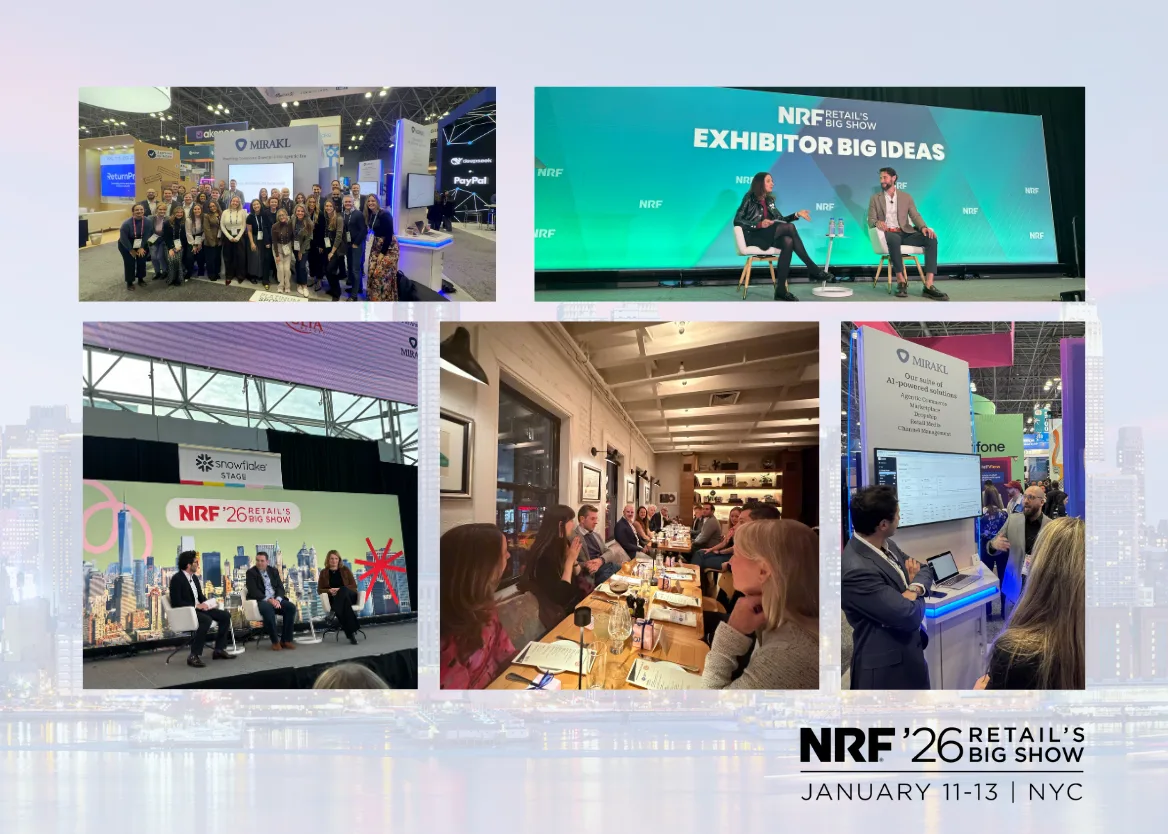

If you missed NRF 2026, here's your reality check: the conversations happening on the show floor weren't about whether AI will change retail — they were about which retailers will still be discoverable when AI agents reshape how people shop.
Looking back at 2025's marketplace momentum
Before we get into what NRF revealed about retail's future, let's talk about the momentum that carried us here. 2025 wasn't just another year of incremental eCommerce growth — it was the year marketplace infrastructure became a core competitive advantage.
Glossy called it "the year of the Mirakl marketplace" (opens in a new tab), and the numbers back it up. Mirakl-powered marketplaces and dropship programs grew 34% in 2024, nearly four times the global eCommerce industry's 8-9% growth rate. Major retailers including Ulta Beauty, Best Buy and Lowe's launched digital marketplaces, joining an ecosystem that now includes more than 100,000 sellers across more than 450 marketplace operators. (opens in a new tab)
At the same time, retail media emerged as a serious profit engine — not a "nice to have" but a structural advantage. Walmart Connect generated $4.4 billion in global revenue in fiscal 2025 (opens in a new tab), with advertising now representing nearly one-third of the company's operating income. (opens in a new tab) That's high-margin revenue funding faster fulfillment and technology investments.
And then there's agentic commerce. By the end of 2025, nearly 60% of consumers were already using AI to help them shop — setting the stage for what McKinsey predicts could be a $900 billion to $1 trillion shift in U.S. retail revenue (opens in a new tab) orchestrated by AI agents by 2030.
Here's the thing: Traditional growth strategies like more stores and more first-party inventory are delivering diminishing returns. The retailers winning at NRF have stopped asking "Can we compete?" and started asking "How do we control our own destiny?"
What dominated NRF 2026
Marketplaces moved from experiment to enterprise strategy
Best Buy, Nordstrom and Target weren't just present at NRF — they were center stage, sharing how marketplace integration has become core to their growth plans.
The numbers are striking. Best Buy's marketplace, which launched in August 2025, already has approximately 1,100 sellers and increased SKU count by 11 times. (opens in a new tab) That's not incremental expansion — that's structural transformation.
For Target, Chief Digital and Revenue Officer Sarah Travis noted that the marketplace plays "an enormous role in helping us to identify trends" (opens in a new tab) for overall assortment strategy. In other words, third-party seller data is becoming first-party merchandising intelligence. That's the kind of competitive advantage that compounds over time.
The key shift: The smartest retailers are using marketplaces to achieve curation at scale — offering breadth where it makes strategic sense while protecting brand identity. As Nordstrom's President of Digital and Customer Experience Miguel Almeida put it: "We were very deliberate about not becoming the 'everything store.'" (opens in a new tab)
This lets retailers experiment with new categories in a "risk-free way" while preserving what makes their brand unique. It's not about being everything to everyone — it's about being strategically comprehensive in the categories that matter most to your customers.
Retail media became the marketplace flywheel everyone's talking about
Here's what most retailers are missing: every marketplace seller you onboard is a potential advertiser. And the economics are compelling. Third-party marketplace sellers spend 127% more on advertising than first-party brands. (opens in a new tab) Why? They can't rely on existing brand recognition. They need visibility, and they're willing to invest to win it on your platform.
The flywheel works like this: more sellers → more products → more traffic → more competition for placement → more advertising revenue. And this is high-margin revenue that requires virtually no inventory.
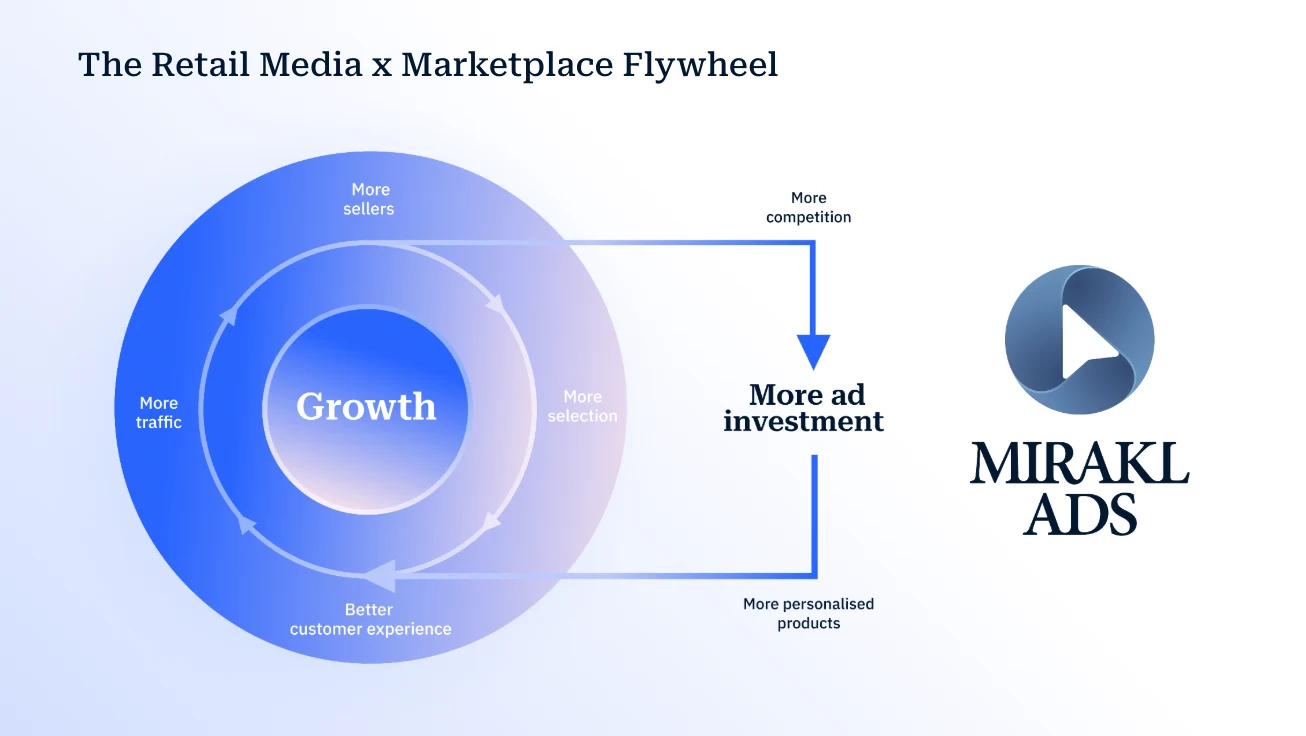
The proof is in Walmart's numbers. Their advertising business grew six times faster than overall retail sales (opens in a new tab), with operating margins exceeding 70%. (opens in a new tab) That's the kind of margin that subsidizes faster fulfillment, quick commerce infrastructure and technology investments.
What you need to know: Mirakl Ads enables retailers to unlock this flywheel from day one by empowering marketplace sellers to self-serve on retail media networks. The retailers who launched in 2025 are already seeing this incremental, margin-rich revenue that only exists because they built a marketplace.
Agentic commerce moved from discovery to transactions
AI dominated the NRF 2026 agenda, but the conversation shifted from "what if" to "what now."
At the AiR Summit (opens in a new tab), the keynote "Beyond Discovery: How to Win the Agentic Commerce Race" — featuring Anne-Claire Baschet from Mirakl and Prashant Sharma from J.P. Morgan Payments — tackled the harder question: what needs to change behind the scenes to make AI-executed transactions possible?
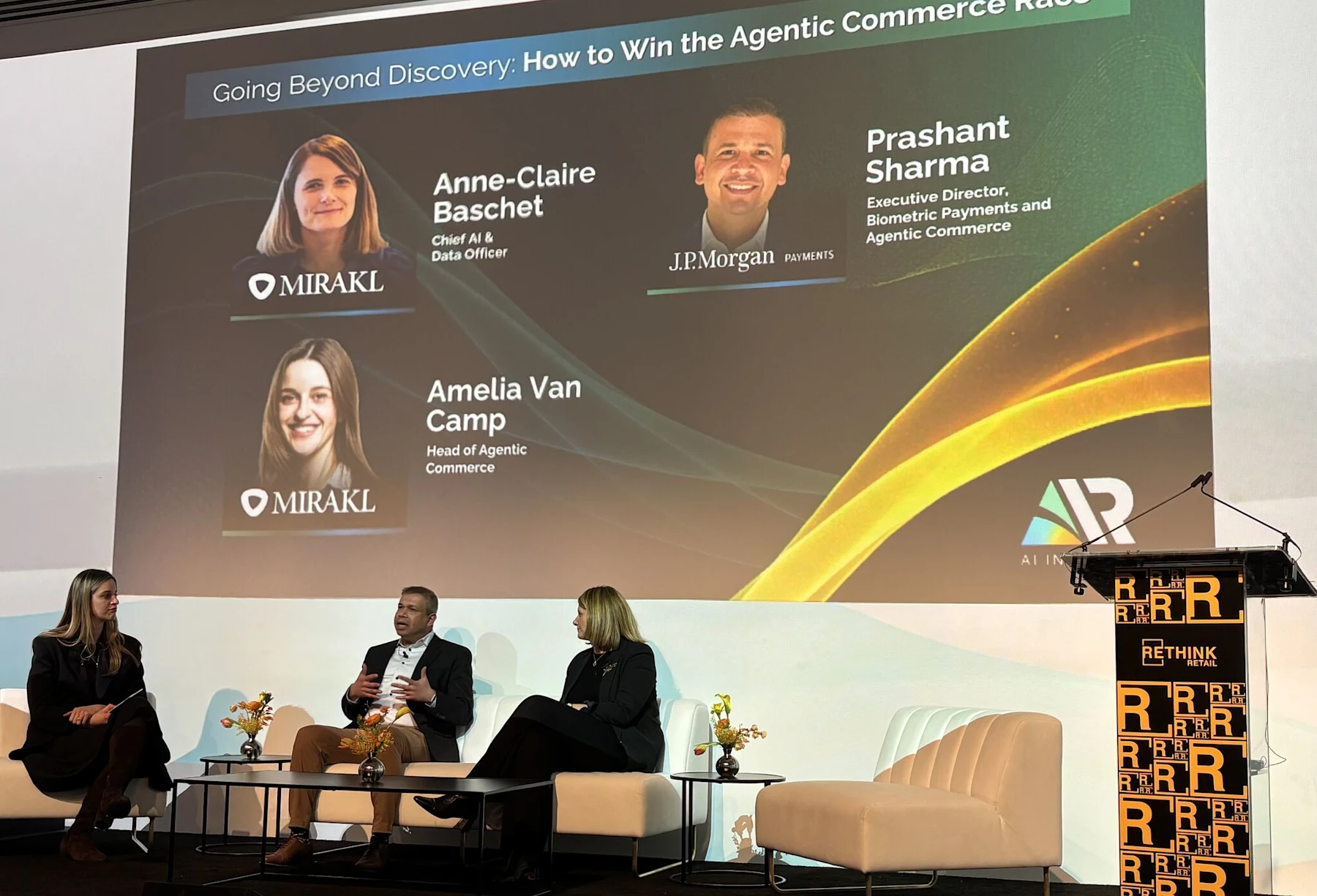
The reality check: Discovery is already happening at scale. ChatGPT processes more than 50 million daily shopping queries (opens in a new tab) — but most still redirect to traditional checkout. The infrastructure for AI-executed transactions isn't there yet.
Here's the issue: Traditional eCommerce was built for humans clicking buttons. Agentic commerce requires infrastructure built for machines making decisions. The retailers winning this race are building three critical capabilities:
- Payment infrastructure integrated with AI assistants
- Fraud protection for conversational commerce contexts
- Trust mechanisms for agent-to-agent transactions
Why marketplace platforms have the advantage: They're already built for what AI agents require. When an AI agent searches for "sustainable outdoor furniture under $500," it needs comprehensive selection to match user intent. Marketplace operators can scan thousands of SKUs across multiple sellers in milliseconds — traditional retailers with limited first-party inventory simply can't compete.
Mirakl's enterprise marketplace platform delivers this AI-ready infrastructure out of the box: standardized product catalogs, real-time inventory feeds and unified pricing across channels. This keeps retailers discoverable as AI agents reshape commerce.
The timeline is aggressive. Gartner forecasts (opens in a new tab) that by the end of 2026, 40% of enterprise applications will include task-specific AI agents. The window to build transactional capability is closing fast.
What the leaders are doing
During the NRF session "Igniting strategic growth by renovating your business model," Lowe's SVP of Digital Joe Cano shared insights on what became the fastest marketplace launch in Mirakl history. Lowe's created an industry-first unified retail media flywheel that's fueling explosive online expansion while building omnichannel capabilities that seamlessly blend physical and digital.
Ulta Beauty's story is equally impressive. SVP of Digital and eCommerce Josh Friedman revealed how the company launched UB Marketplace with more than 100 brands in just six months (opens in a new tab) — reducing new product launch time. That speed-to-market advantage positions Ulta Beauty at the forefront of agentic commerce readiness.
These aren't isolated success stories. Across Mirakl's network of 450+ marketplace operators, we're seeing retailers transform their business models, unlock new revenue streams and build the AI-ready infrastructure that will define the next decade of retail.
Your 2026 reality check
If you walked the NRF floor or caught any of the main stage sessions, one message came through clearly: the retailers winning in 2026 aren't just adapting to change — they're building the unified platform foundation that makes transformation possible.
Success requires three core capabilities:
- Comprehensive product catalogs that AI agents can discover
- Retail media infrastructure that drives high-margin revenue
- Unified technology platforms that enable real-time operations across all channels
Traditional retailers operating with fragmented systems face an urgent choice: transform now or risk becoming invisible in AI-driven discovery. The retailers partnering with Mirakl aren't waiting — they're launching marketplaces in record time, activating retail media networks and building the comprehensive catalogs that position them to win in the agentic era.
Here's what matters most: In 18 months, marketplace infrastructure won't be a first-mover advantage. It'll be table stakes. The performance gap between platform-powered retailers and traditional operators is widening every quarter, and that gap isn't going to close on its own.
See us at Shoptalk 2026
The conversations don't stop at NRF. Join us at Shoptalk 2026 (opens in a new tab) to continue exploring how marketplace strategies and agentic commerce will shape retail's future. Our team will share real-world insights from retailers already winning in the platform economy — and what they're building for next.
Can't wait until Shoptalk? Schedule a personalized demo today to see how Mirakl can help you build your agentic commerce foundation and accelerate your marketplace growth.