
AI agents are reshaping commerce right now — not in 2027 or 2028, but today. The consensus among retailers, tech leaders and commerce innovators is unanimous: AI will fundamentally transform how consumers discover, evaluate and purchase products.
But are retailers actually prepared for this shift?
We surveyed leading technology and consultancy partners — Deloitte Digital (opens in a new tab), Adobe (opens in a new tab), Accenture (opens in a new tab), Merkle (opens in a new tab), McFadyen Digital (opens in a new tab), AWS (opens in a new tab) and Globant (opens in a new tab) — who work directly with retailers on digital transformation. These partners see the roadmaps, know the budgets and understand what's being prioritized. We asked them to rate retailer readiness across critical dimensions.
The results reveal a stark preparation gap. While everyone sees the transformation coming, almost no one is ready for it.
The "no-visit" revolution is already here
While many treat agentic commerce as a future scenario, AI-driven commerce is already changing consumer behavior today. Research shows (opens in a new tab) AI agents are increasingly handling product research, comparison and in some cases, autonomous purchasing.
When visits disappear, so do the assumptions underpinning modern eCommerce: cross-sell opportunities, on-site media monetization, loyalty engagement, first-party data collection and attribution models based on clicks. Brands built their entire digital strategy assuming humans would land on their sites, but AI agents don't need to.
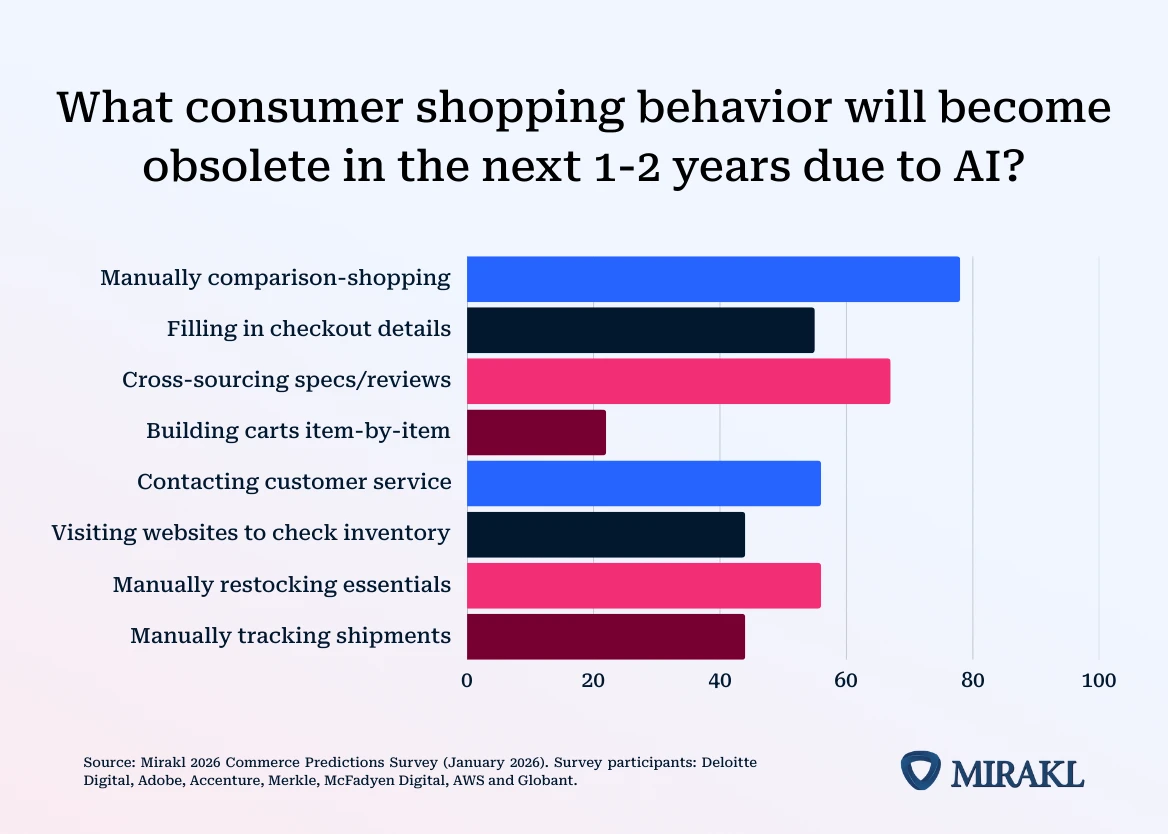
Shopping behaviors becoming obsolete
Our partners identified which consumer actions are already fading — with near-unanimous agreement on several behaviors.
Partners predict that by 2026, the most valuable commerce capability won't be personalization or experience design. It will be supporting autonomous, agent-completed transactions cleanly and reliably.
The readiness reality check: Failing three critical tests
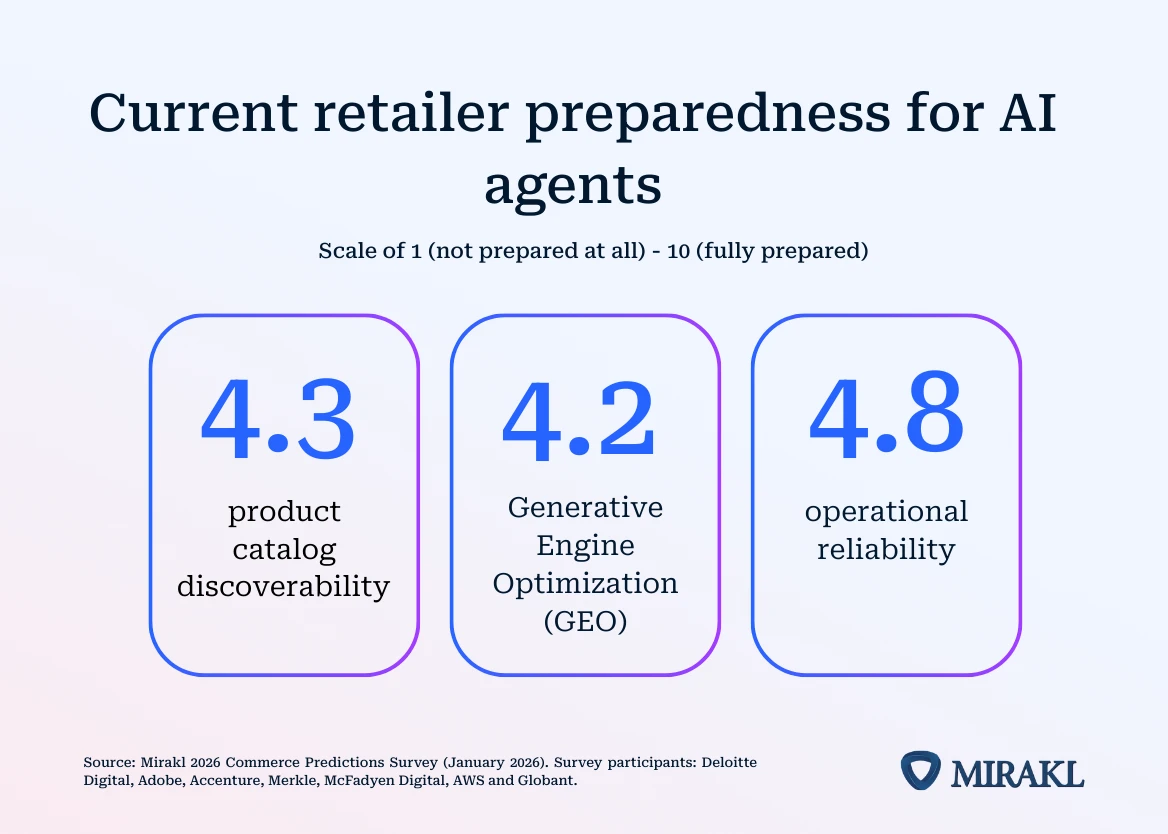
The survey exposed three preparation gaps where retailers are falling short.
Gap #1: Catalog readiness for AI discovery
Merkle's commerce technology team identified a fundamental mismatch: Product content optimized for humans and Google doesn't work for AI agents. Agents need structured, machine-readable data that enables instant comparison and synthesis.
When Merkle tested AI agents for TV recommendations, all research and pricing happened inside the large language model. Brand websites never loaded.
Marketing copy doesn't include the technical specifications agents need. Even detailed descriptions fall short without structured attributes like dimensions, compatibility and certifications in machine-readable formats.
Partner insight: Brands prioritizing catalog, product and pricing data are beginning to pull ahead of competitors who don't. As one partner observed, "I haven't seen them prioritize for AI agents to the extent it's needed."
The marketplace advantage: Managing multiple sellers already requires clean, structured data as an operational requirement. Mirakl Catalog Platform enforces data standards with automated audits. Your product feed becomes your storefront in the age of AI.
Gap #2: Visibility and monitoring capabilities
Partners gave the lowest readiness scores to something most retailers haven't started: monitoring their presence in AI-driven search.
Adobe's EMEA commerce leadership highlights the blind spot — brands don't know which queries trigger their products in LLM responses or where they rank. They're competing in a channel they can't see.
Partner insight: Adobe emphasizes that "visibility in LLMs requires a new kind of content and brands need to start monitoring their visibility and build GEO practices." Most brands are just beginning this journey.
The marketplace advantage: Marketplace platforms monitoring thousands of products develop visibility faster. They see patterns in what agents surface and where gaps exist. Broader assortment via marketplace and dropship improves match rates and completes the basket for complex queries
Gap #3: Operational reliability for AI agents
AI agents prioritize retailers that consistently deliver on operational promises. They require real-time inventory accuracy, instant pricing access, specific delivery timeframes and clear returns processes.
Current infrastructure was designed for human shoppers who can interpret "low stock" warnings or adjust expectations when information changes. AI agents work differently — they need reliable data to make confident recommendations. When operational promises don't align with reality, agents learn to deprioritize those sources.
Partner insight: Deloitte Digital predicts that by 2026, "one of the most valuable commerce capabilities won't be personalization or experience design — it will be the ability to support autonomous, agent-completed transactions cleanly and reliably."
The marketplace advantage: Managing seller performance and data accuracy across thousands of contributors builds operational discipline. Automated validation, real-time inventory syncing and API-first architecture are embedded requirements.
What drives purchase decisions in 2026?
Partners were split on the single most important factor that will influence consumer purchase decisions.
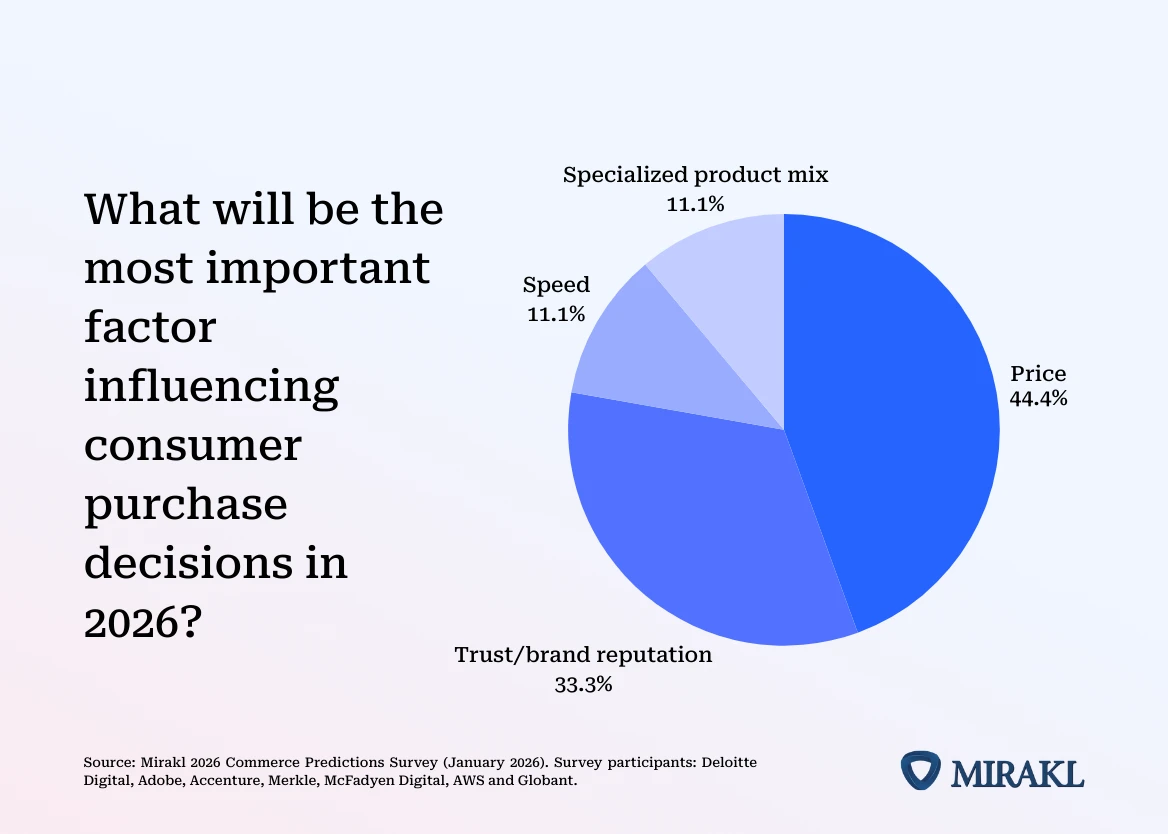
The near-even split between price and trust highlights a critical tension: While AI agents may optimize for price and specifications, brand reputation remains a powerful factor in recommendations.
Where will discovery happen?
Partners overwhelmingly predict AI agents and assistants will dominate product discovery by year-end.
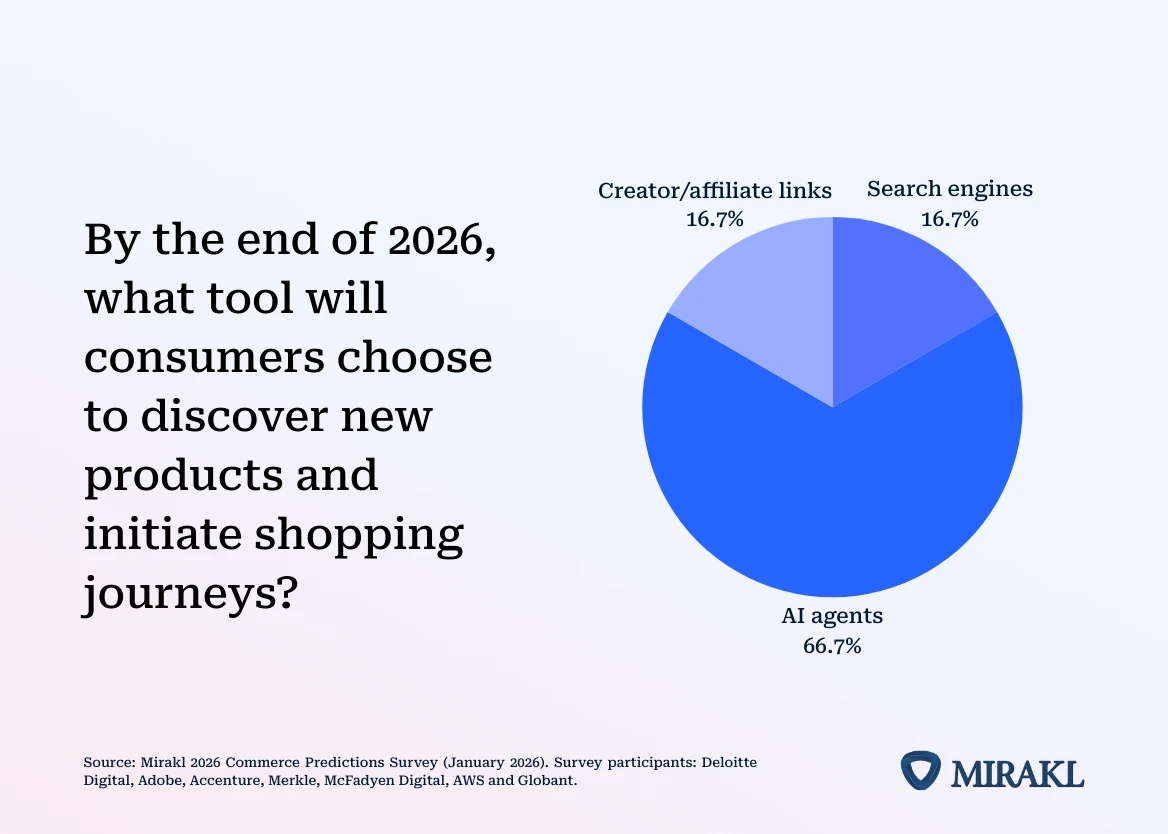
This shift from search engines to AI agents represents a fundamental change in how products get discovered — and why catalog readiness and GEO preparedness matter so urgently.
Why marketplace platforms will win the AI commerce race
While first-party retailers struggle with readiness, one business model is already positioned to succeed.
McFadyen Digital predicts winners in agentic commerce will be those who invested in marketplace business models. Marketplaces have been building the right infrastructure all along.
Ulta Beauty, a Mirakl customer, is already seeing this advantage. Josh Friedman, SVP of Digital and eCommerce at Ulta Beauty, explains: "We knew having more assortment that our guests were asking us for was the right thing to do. And now having all the content that comes with it — both the content we get from the sellers and the content that generates in the community — is going to really serve us well this year and in future years with agentic commerce."
The marketplace advantage is simple: AI agents can only recommend products they know about. Expanded assortment dramatically increases discoverability. Every seller becomes a content contributor, enriching the dataset agent's access. More products mean more relevance signals. More reviews mean more context.
The structural advantages:
- Clean, structured data — Required for multi-seller catalog management
- API-first architecture — Built to integrate with third-party systems
- Broader assortment — More SKUs improve AI agent match rates and rankings
- Orchestration capabilities — Systems managing complexity across fulfillment sources
- Performance management — Automated quality controls translating to agent reliability
Opportunities and risks: Two sides of the same transformation
High-value opportunities
Over half of partners identified enhanced customer experience as the biggest opportunity AI and agentic commerce present.
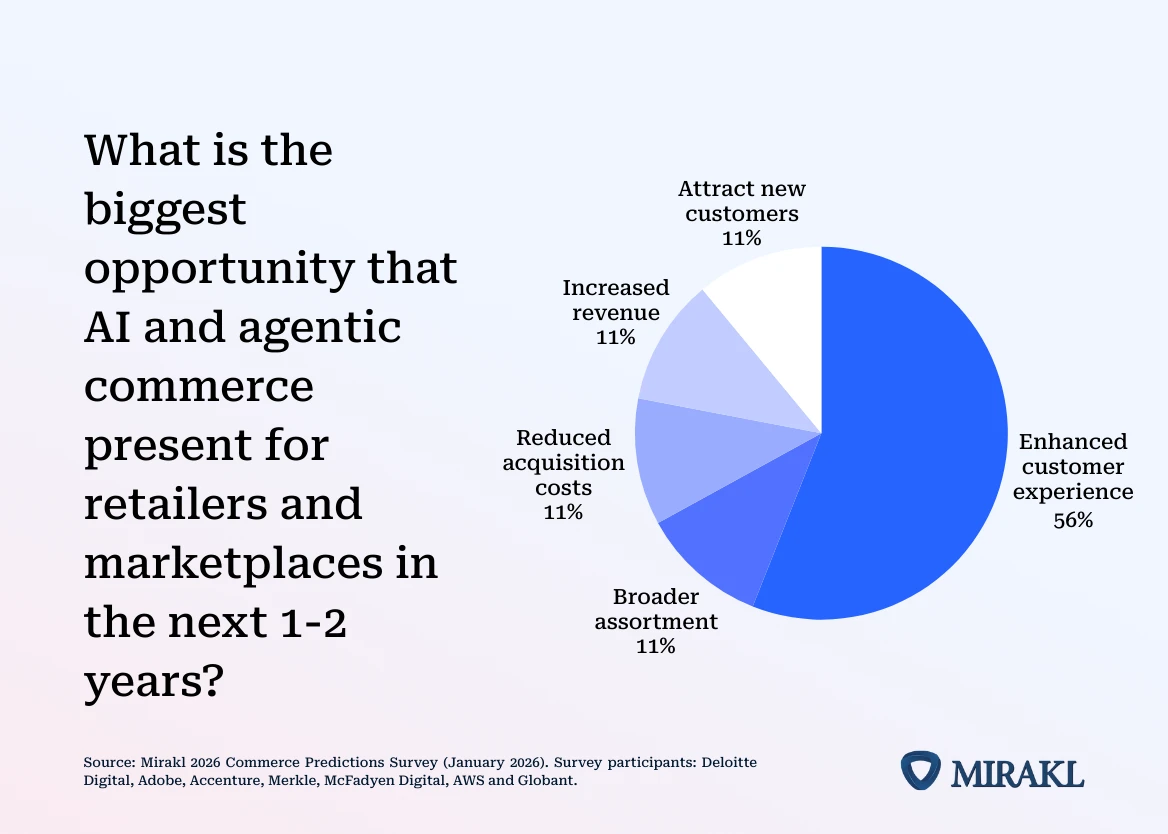
Beyond enhanced experiences, partners see opportunities for lower acquisition costs as agents drive qualified traffic, new customer segments through discovery beyond traditional search and social, and 24/7 revenue channels operating without per-transaction marketing spend.
Partners identified several major challenges businesses face when implementing AI-driven commerce solutions.
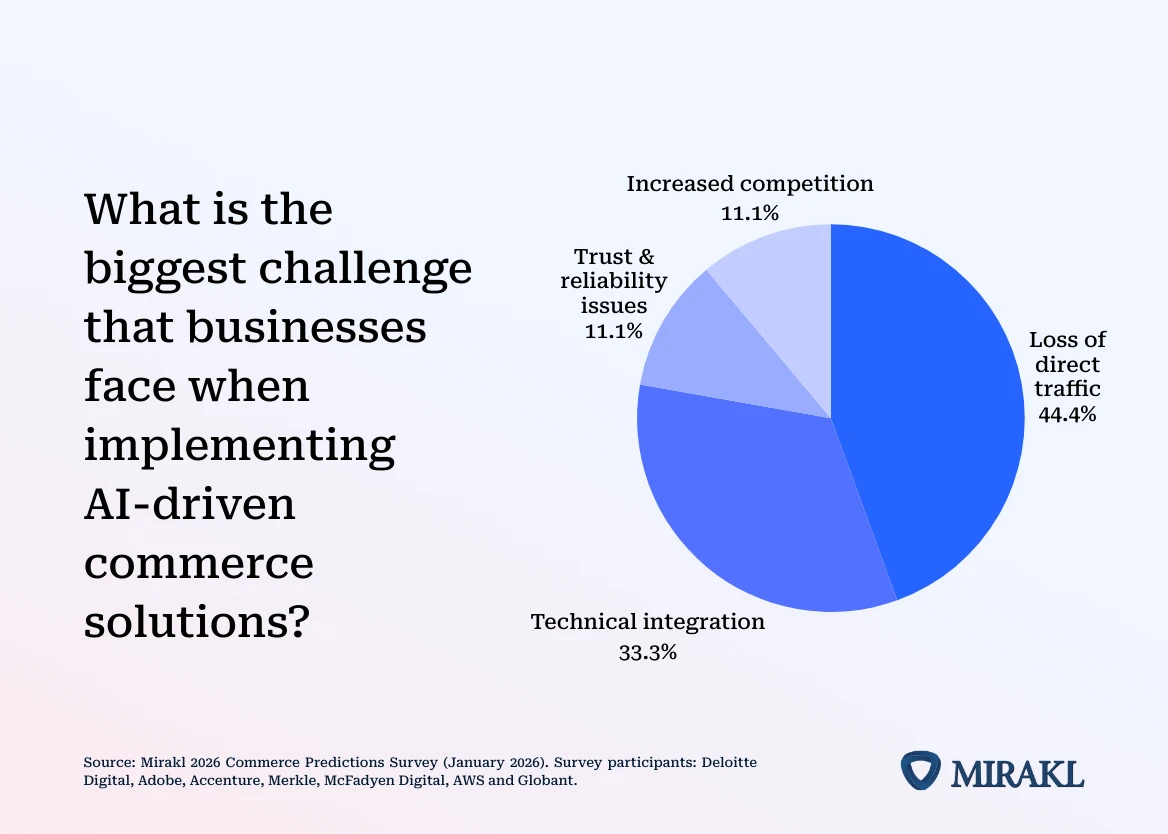
Disintermediation (most cited): Loss of direct traffic and customer relationships as discovery shifts to AI platforms. Brands lose behavioral visibility, engagement opportunities and narrative control.
Data and infrastructure challenges: Integration complexity, quality issues and real-time feed requirements expose technical debt. Legacy systems weren't built for agent-level precision and speed.
Trust and reliability concerns: Inability to guarantee accuracy undermines credibility across all AI platforms. One failure multiplies as agents learn from it.
Competitive pressure: Agents optimize for utility, value and fit — not brand loyalty. Switching costs approach zero when agents handle everything seamlessly.
Brands capturing opportunities while mitigating risks will define commerce's next chapter.
Contrarian predictions worth watching
While consensus formed around AI transformation, several partners challenged conventional wisdom:
B2B will outpace B2C
Adobe predicts agentic commerce will accelerate faster in B2B, where procurement agents help companies source from multiple suppliers. B2B's complexity plays directly to agent strengths. Check out Mirakl's B2B solution.
Creators and social commerce still matter
Merkle's B2B team argues that while everyone fixates on agentic commerce, creators and social commerce deserve continued focus. Many retail decisions remain emotion-driven, influenced by creators.
Not all purchases will become rational, optimization-driven AI transactions. Emotional, aspirational and identity-driven buying may stay deeply human — and influenced by creators agents cite as trusted sources.
Brand sites become AI "source of truth"
Merkle predicts that with marketplace proliferation, brand websites become more critical as agent truth sources. Traffic may flatten or decline, but accuracy matters more — resolving conflicting product pages and narratives.
As agents reconcile information across platforms, authoritative brand sources gain new strategic value establishing the canonical records AI systems reference.
AI friends, not assistants
Accenture envisions shopping with virtual AI friends recommending products based on daily conversations — not just potentially biased assistants. This suggests more nuanced consumer-AI relationships: moving beyond transactions toward ongoing, trusted advisors understanding context, preferences and emotions.
Voice becomes the primary interface
While others focus on chat and autonomous agents, Globant sees voice as the breakthrough interface for eCommerce. Commerce becomes even more invisible, integrated seamlessly into daily life.
The preparation window is closing
The survey findings are clear: AI commerce transformation is happening now, not later. Retailers face a stark choice—build what AI agents require (clean data, operational reliability, and broader assortment) or watch traffic and transactions migrate to better-prepared competitors.
Brands recognizing this moment as opportunity rather than threat will define commerce's next era. Marketplace infrastructure — built on structured data, real-time accuracy and API-first architecture — isn't just advantageous anymore. It's increasingly the foundation of agentic commerce demands.
Ready to assess your AI commerce readiness? Let's talk about marketplace strategies, catalog optimization and infrastructure modernization for the agentic commerce era.