
TL;DR
- Agentic commerce is putting AI agents between retailers and shoppers, shaping which products get considered before a retailer sees a single visit.
- Marketplaces, product data, trust and retail media will decide which retailers agents recommend.
- Retailers that prepare early can extend the flywheel they've already built into a lasting advantage.
What if the most important shelf in retail is no longer a page on your website?
For years, retailers have grown by pulling more products, customers and brands into their digital ecosystems:
- Marketplaces expand assortment.
- Loyalty and personalization turn customer activity into insight.
- Retail media monetizes that demand and funds the next round of investment.
That system still works. What's changing is where shoppers start. AI shopping agents can now identify products, compare options, check availability and, with permission, complete purchases. As more decisions happen inside those interfaces, the flywheel has to work beyond a retailer's own site and app.
A new article from BCG, "How Retailers Can Reinvent the Digital Flywheel for Agentic Commerce (opens in a new tab)," offers independent, third-party analysis of how retailers can protect the relationships they've built while becoming more visible and trusted to AI agents.
Agentic commerce by the numbers: what BCG's research found
BCG surveyed 50 of the top 300 global retailers and 100 of the top global brands. Four findings stand out:
| Finding | Why it matters |
|---|---|
| Marketplaces account for 26% of retailers' online gross merchandise value (GMV) on average | Marketplaces are meaningful growth engines |
| 81% of US consumers and 53% of European consumers expect to use AI agents when shopping | Agentic commerce is entering the near-term customer journey |
| Only 18% of retailers consider their marketplaces ready for agents | The readiness gap rewards early movers |
| 79% of retailers and brands expect prepared companies to pull further ahead | The competitive window is already narrowing |
Source: BCG (opens in a new tab)
Why is a marketplace more than an assortment play?
Because it powers the whole digital flywheel: assortment brings traffic, traffic brings data and retail media turns both into revenue. A strong marketplace also helps a retailer enter new categories, serve more customer needs, sharpen price competitiveness and build new revenue streams without carrying all the inventory risk of a first-party model.
BCG’s numbers show how far that reaches:
- Third-party sellers generate an average of 28% of retail media revenue.
- 95% of retailers see retail media as a major source of future profit growth.
The real value comes from how the pieces work together:
- A wider assortment gives shoppers more reasons to visit. Every new seller and brand adds selection you’d never stock yourself.
- More visits generate more transactions and richer customer insight.
- Better insight improves personalization, loyalty and ad performance.
- A thriving brand ecosystem turns that traffic into revenue. Sellers and brands become advertisers, and their ad investment funds further growth in assortment and customer experience.
Source: BCG (opens in a new tab)
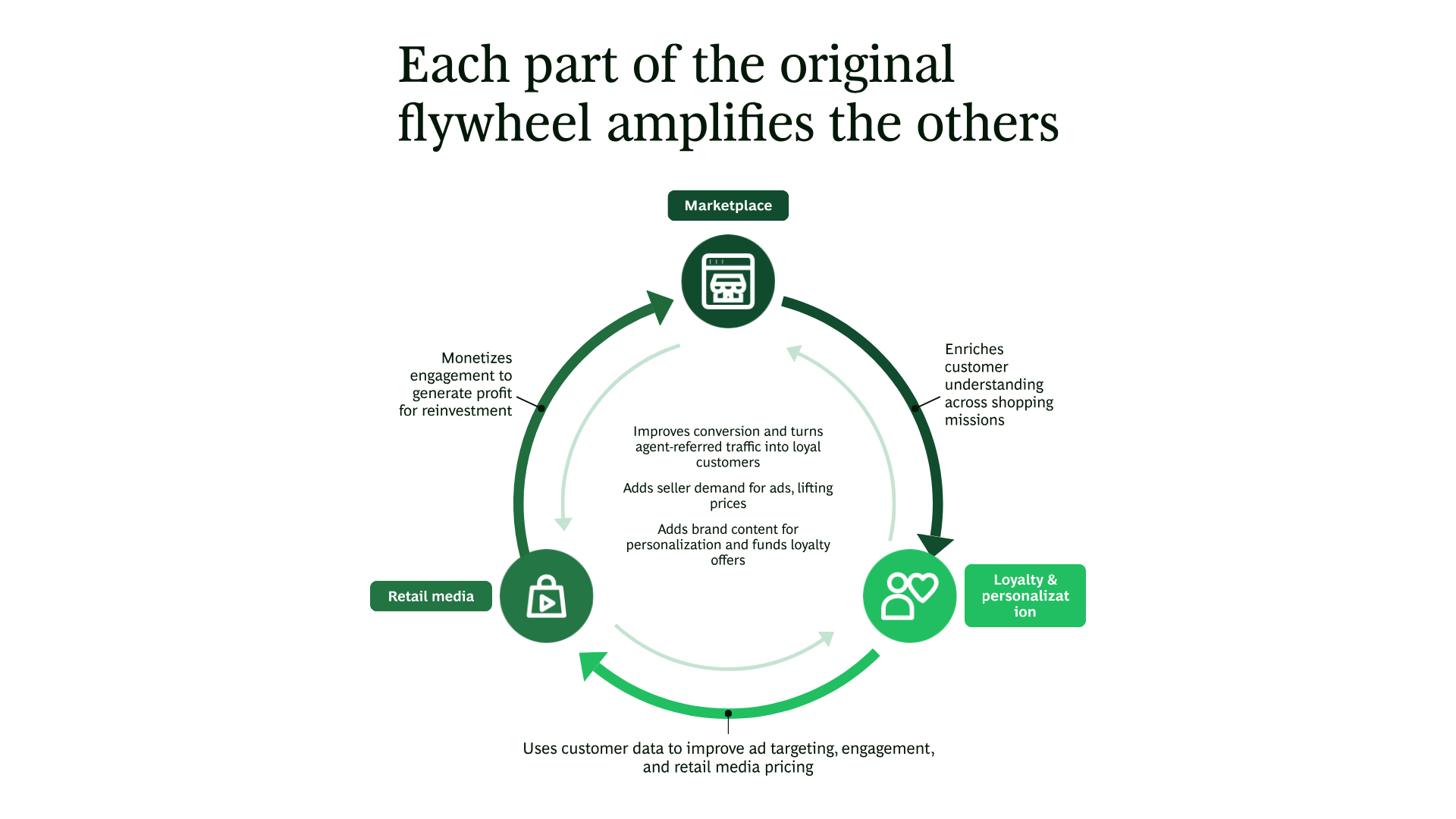
Run that loop and the marketplace becomes a demand engine, a data engine and a monetization engine at once.
What is agentic commerce, and what changes when an agent makes the shortlist?
Agentic commerce (opens in a new tab) is shopping in which an AI agent identifies and compares products, makes recommendations and, with authorization, completes purchases and manages post-sale tasks on a customer's behalf. Instead of searching retailer sites and deciding on their own, customers hand part of that work to the agent.
That puts a new layer between retailers and shoppers. A retailer still owns the inventory, the brand and the experience. But an agent may decide whether that retailer is considered at all.
So retailers now play two games, and one flywheel has to support both:
| Direct shopping | Agent-led shopping | |
|---|---|---|
| Who decides | The customer | The AI agent, on the customer's behalf |
| How you win | Be the destination shoppers choose | Win the agent's evaluation |
| What matters most | Brand experience, product availability, loyalty, post purchase experience | Product data, availability, trust, post-purchase experience |
The shift starts small. Among leading European retailers and brands, referrals from external agents made up less than 1% of site visits in late 2025, but BCG says they could reach 5% by 2026. In the US, where the shift is further along, AI-driven traffic could overtake organic search traffic as early as 2028.
The retailers best positioned will make their products easy to discover, easy to evaluate and easy to trust. For more on how other retailers are responding, see how leading eCommerce businesses are adapting to agentic commerce (opens in a new tab).
How Best Buy's marketplace flywheel is extending into agentic commerce
Best Buy's third-party marketplace, powered by Mirakl (opens in a new tab), and Best Buy Ads already feed each other:
- More sellers, SKUs and categories give customers more choice.
- That choice draws shoppers, drives transactions and generates richer data.
- Best Buy Ads monetizes the ecosystem by putting brands in front of customers at discovery and purchase.
- The revenue funds price competitiveness and the customer experience, from stores and delivery to services and support.
- Those investments win and keep customers, which makes the marketplace more attractive to sellers and the ad platform more valuable to brands.
The numbers back it up. Best Buy's second quarter results (opens in a new tab) credit growth in both for part of its gross profit rate gain, and on its fiscal Q2 2027 earnings call (opens in a new tab) the company shared:
- About $300 million in marketplace GMV in the quarter
- $1.3 billion in marketplace GMV expected for the full year
- 10% growth expected for Best Buy Ads, on $900 million in prior-year collections
Now the flywheel is reaching into agentic commerce:
- Customers can discover Best Buy products and complete purchases through ChatGPT, which puts the retailer inside the conversations where shopping decisions increasingly begin. Best Buy announced the experience (opens in a new tab) ahead of the holidays, and Digital Commerce 360 (opens in a new tab) covered the rollout.
- The marketplace's long-tail assortment gives agents more relevant products to match against specific, natural-language requests. What helped Best Buy win in search can help it get selected in agent-led discovery.
- Stores, associates and services reinforce trust, and every interaction adds demand, data, seller participation and advertising value.
What makes a product visible to AI shopping agents?
Complete, current, structured product data, backed by an assortment worth recommending. Customers rarely type a product name or SKU. They ask for things like:
- A laptop for video editing under a certain price
- A gift for a cyclist who already owns a smart trainer
- A replacement part that fits a particular appliance
The retailer with the most relevant assortment and data has the most chances to answer. That's where the long tail pays off. A marketplace can offer more brands, variations, price points and use cases than first-party sourcing alone.
But assortment without usable information doesn't help. BCG notes that agents evaluate retailers on product data, prices, availability, delivery, returns and offers they can interpret. We boil that down to five questions an agent needs answered about every product and seller:
- Product: What is it, who is it for and what makes it different?
- Price: What does it cost and which promotions apply?
- Availability: Is it in stock right now?
- Fulfillment: When can it be delivered or picked up?
- Trust: Who is selling it and what happens if the customer needs support or a return?
Few retailers can answer all five today. BCG found that only 18% of those surveyed consider their marketplaces ready for agents. Within two years, 67% plan to enrich their product data and 58% plan to provide real-time availability.
Product data used to live in the back office, supporting search and conversion. Now it can decide whether a product is considered at all. Missing attributes, inconsistent naming, stale inventory and vague delivery promises all make it harder for an agent to recommend a product with confidence. For a closer look at making product data discoverable to AI platforms, see our guide to eCommerce GEO (opens in a new tab).
BCG points to Nordstrom as an example of what this looks like in practice. The retailer cleaned and enriched its product data, integrated its feeds with AI platforms and holds third-party sellers in its Mirakl-powered marketplace (opens in a new tab) to a high data standard, so agents can discover those sellers too.
Why do trust and retail media decide who wins the sale?
Because being recommended is only the first step. Customers still need confidence that the retailer will deliver the right product, at the right price, on time, and brands need proof that their ads drive incremental sales.
BCG found that losing the customer relationship is the top concern about agentic commerce for 91% of retailers. It's also where established retailers hold an edge an unknown seller can't match:
- Brand trust
- Stores and services
- Loyalty programs
- Expert advice
- Fulfillment capabilities
Retail media will evolve too. As discovery moves into AI assistants and other offsite environments, brands will want a say in the recommendations customers get there. BCG recommends that retailers will need to extend sponsored visibility beyond onsite formats, with:
- Sponsored products and search
- Offsite and video placements
- In-store media
- Agent-based recommendations
- Measurement that connects exposure to incremental sales
Brands are already signaling where their budgets will go. In BCG's survey, 65% expect to spend more on retail media as shopping agents become common, and only 12% expect to spend less.
Retailers with proprietary customer, transaction and product data are best placed to link exposure to conversion and prove incremental sales. That revenue then funds the next round of investment in assortment, data quality and customer experience. Learn more about how Mirakl Ads (opens in a new tab) approaches retail media for retailers.
How to get agent-ready: 5 steps for retailers
- Audit your product data against the five agent questions. Find gaps in attributes, naming and fulfillment promises, starting with your highest-demand categories.
- Make availability real-time. Outdated inventory makes it harder for an agent to recommend your products.
- Hold marketplace sellers to the same data standard. Your long tail only helps if third-party offers are accurate, complete and consistent.
- Extend retail media beyond your site. Plan for offsite, in-store and agent-based formats, with measurement that proves incremental sales.
- Make trust visible. Show agents what sets you apart: stores, loyalty programs, service, returns and delivery promises.
How Mirakl helps: We help retailers build the marketplace foundation behind these steps: broader assortment, higher seller standards and the product data quality agents rely on. With Mirakl Agentic Activation (opens in a new tab), retailers, brands and sellers can enrich product catalogs so AI platforms can discover and compare their products.
Is your flywheel ready for agentic commerce?
The digital flywheel isn't going away. It's reaching into a new distribution environment. Retailers that connect marketplaces, loyalty, personalization and retail media will be better positioned to win customer visits, agent recommendations and profitable transactions.
The window is narrowing. Seventy-nine percent of retailers and brands expect companies that prepare their flywheels for agentic commerce to pull further ahead. So which part of yours would an agent struggle to read today?
See the full data on agent readiness, retail media and what early movers are doing. Read "How Retailers Can Reinvent the Digital Flywheel for Agentic Commerce (opens in a new tab)."
Agentic commerce FAQ
Agentic commerce is shopping in which an AI agent identifies and compares products, makes recommendations and, with authorization, completes purchases on a customer's behalf. It adds a new layer between retailers and shoppers, so retailers must win the agent's evaluation as well as the customer's visit.
An agent-ready marketplace gives AI agents clean, structured, real-time information on products, prices, inventory and fulfillment through data feeds and application programming interfaces (APIs). BCG found that only 18% of retailers consider their marketplaces ready today.
Still a small share, but it's growing fast. Among leading European retailers and brands, referrals from external agents were less than 1% of site visits in late 2025 and could reach 5% by 2027, according to BCG. In the US, BCG projects AI-driven traffic could overtake organic search traffic by 2028 or 2029.
Third-party sellers do more than expand assortment. BCG found they generate an average of 28% of retail media revenue, rising to 42% among top-quartile retailers.