
In the age of agentic commerce, AI agents are reshaping the buying journey: they interpret intent, then select and recommend the products they find most relevant.
According to Semrush (opens in a new tab), AI-driven traffic could overtake traditional organic traffic within two to four years, deeply transforming product discovery.
Being present across multiple channels is no longer enough. The real challenge is to be visible and recommended where purchasing decisions are actually made.
The Mirakl team will be at NRF Europe (opens in a new tab), Stand F028, from September 15 to 17 in Paris, to discuss the challenges behind a multichannel strategy.
Here are five concrete levers to grow your business and stay ahead of the competition in this new agentic era.
1. Open your ecosystem to create new opportunities
The customer journey is no longer linear. Before buying, consumers move between search engines, social media, eCommerce sites, marketplaces and LLMs.
Relying solely on your historical channel now means limiting your visibility to only part of your audience.
Faced with this fragmentation, the most advanced retailers are rethinking their model. They are moving beyond their traditional role as distributors by opening their platform to third-party sellers through a marketplace (opens in a new tab) or a dropship (opens in a new tab) model.
By combining 1P (owned assortment) and 3P (third-party seller products), retailers are reinventing themselves as one-stop destinations, with richer, more resilient offerings that are better positioned in both search engines and AI-generated responses.
Decathlon illustrates this shift. The sporting goods retail leader has rolled out its marketplace across several European markets to complement its offering with carefully selected sellers.
As Joanna Kusmierczyk (opens in a new tab), Head of Marketplace at Decathlon (opens in a new tab) Poland, explained at the 2026 Mirakl Summit in Munich: "Our main parameter when expanding our offer is to operate on this idea of one Decathlon offer."
Marketplaces are now growing 4.5 times faster (opens in a new tab) than traditional eCommerce. For online retailers that adopt a multichannel strategy, the performance gains are significant: within the Mirakl Connect (opens in a new tab) ecosystem, sellers active on two or more channels generate an average of over $10 million in GMV, compared to $575,000 for those active on a single channel.
This trend reflects a structural change: the new era of commerce rewards retailers that are willing to open up to new opportunities. The ones getting ahead are already building their seller networks, expanding their assortments and optimizing their visibility on AI platforms.
2. A selective multichannel strategy
With channels multiplying, retailers could be tempted to be everywhere at once. The best-performing brands do the opposite: they select platforms that reinforce their positioning and value proposition.
Choosing a channel comes down to three key criteria: alignment with brand identity, audience quality and the shopping experience it offers.
This approach is becoming even more strategic in the agentic era. LLMs don't just select products, they also evaluate the platforms that distribute them.
A selective marketplace, one that guarantees a consistent experience and a qualified offering, sends trust signals that influence AI agent recommendations.
For a brand, choosing the right platforms means choosing the contexts in which it will be recommended.
Lancel (opens in a new tab) illustrates this strategy. Over its 150-year history, the house could have multiplied its distribution channels to maximize visibility. Instead, it chose the opposite path, favoring partners capable of preserving its premium DNA and exacting standards.
When we select a partner, we look at three main pillars: geography, audience and brand image. We need to make sure the marketplace's storytelling matches our values and the language we use to speak to our customers. — Audric Bringuier, Global Digital Manager at Lancel, at the 2026 Mirakl Summit in Paris
In the agentic era, the goal is no longer just to be visible, but to be chosen. As Audric Bringuier puts it: "Lancel's goal on multichannel platforms is to stop being just one option among many and become the answer an agent chooses first. And that comes down to the quality of the product information we publish online."
The marketplace model thus combines the advantages of retail, control over assortment, pricing and experience, with those of wholesale, reach and access to new audiences, without the drawbacks of either.
3. Turn the marketplace into a growth pillar
The marketplace is no longer just a complementary channel. For retail leaders, it has become a strategic growth lever.
It allows retailers to broaden and diversify their offering without increasing inventory risk, while boosting their chances of being recommended by AI agents.
At Galeries Lafayette, the marketplace now accounts for more than a third of eCommerce revenue.
To support its growth, the retailer has gradually shifted long-standing partners, including SMCP (Sandro, Maje, Claudie Pierlot) and later Lancel, to a 100% marketplace model via Mirakl Connect.
Beyond the business model itself, it's the quality of curation that creates differentiation.
A marketplace that's too generalist loses its differentiating factors. Where there's still room to stand out is on marketplaces with strong curation. — Régis Penel, eCommerce Director at Galeries Lafayette, at the Mirakl Summit in Paris
4. Monetize your audience by activating retail media
Marketplaces attract a qualified audience. The best-performing ones now treat that audience as an asset, one they monetize through retail media.
The more buyers a marketplace attracts, the more sellers it draws in; the more sellers there are, the more valuable its advertising space becomes.
Retail media thus becomes a profitable growth engine, while giving brands visibility right at the point of purchase intent.
For brands selling on these platforms, it's an opportunity to gain visibility exactly where purchase intent already exists. Retail media is emerging as an increasingly relevant alternative to traditional acquisition channels, whose costs keep rising.
Jumia, Africa's leading eCommerce platform, offers a concrete example. After migrating its program to Mirakl Ads (opens in a new tab) in six weeks, its ROAS rose from 5 to 10, while retail media revenue grew twice as fast as the rest of the marketplace.
"This revenue line is critical to reaching profitability," says Antoine Maillet-Mezeray (opens in a new tab), Group CFO of Jumia (opens in a new tab).
Showroomprivé shares the same view: "For a retailer, retail media is the engine that drives EBITDA," says Elise Ophele (opens in a new tab), Head of Retail Media.
5. Product data as a strategic priority
In a world dominated by traditional search engines, product data quality was mainly a matter of execution. In the agentic era, it becomes a strategic issue.
AI agents don't judge a product by its design or a website's usability. They evaluate data quality: the richness of attributes, the consistency of descriptions and the reliability of information. Incomplete data is invisible data.
Product data is the first contact we have with our customers. It's their first interaction with our products. — Audric Bringuier, Global Digital Manager at Lancel
And in the agentic era, that first interaction no longer involves only human buyers, but also the AI agents that select products before consumers even discover them.
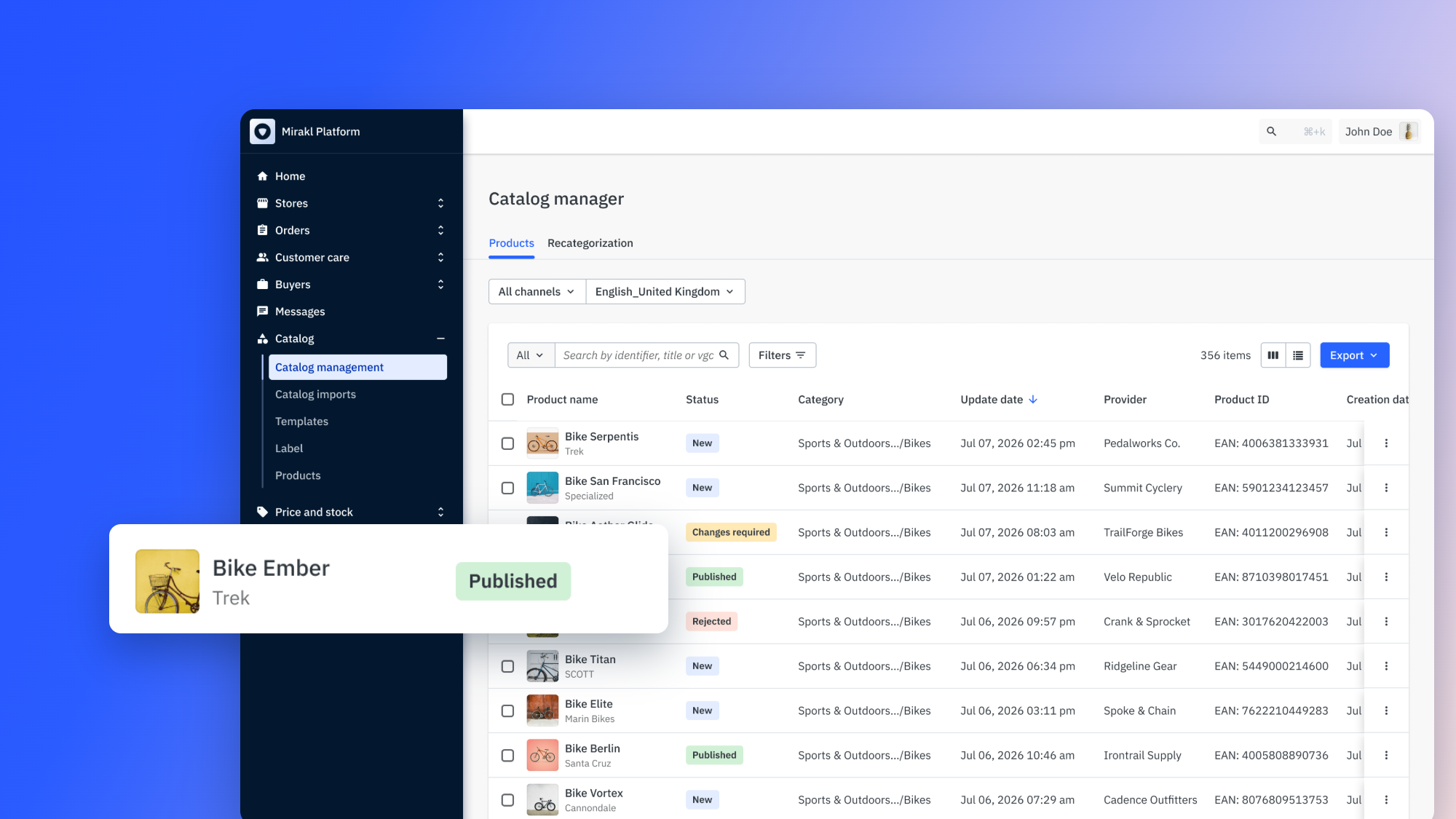
For Lancel, investing in product data has become a strategic choice. With Mirakl Catalog Transformer, the brand automatically enriches its catalogs to meet each marketplace's standards, completing 39% more attributes than manual processing would.
Meet Mirakl at NRF Europe
The agentic era doesn't call the value of multichannel into question, quite the opposite: it makes multichannel a central lever.
Tomorrow's leaders will no longer win simply by multiplying channels. They will win by building a coherent, high-performing, interconnected ecosystem.
Come talk with our team at NRF Europe 2026, September 15–17, at Paris Expo Porte de Versailles — Hall 6, Stand F028.