
You closed the supplier agreement in two weeks. You planned the launch. Then the spreadsheet came back: wrong format, half the fields empty, descriptions copy-pasted from a product that doesn't exist anymore.
That was six weeks ago. The product still isn't live.
This isn't a bad-supplier problem. It's what bad onboarding actually costs, and almost nobody is counting it.
You think you handle it. You don't know what it costs.
Ask any team how supplier onboarding works and you'll hear the same answer: "We have a process for that." Ask what that process costs in hours, headcount or revenue, and the room goes quiet.
The cost isn't missing. It's invisible, because it never lands in one place. A category manager chases a missing attribute. A data specialist reformats a supplier file at 6:00 PM. An eCommerce lead wonders why a launch slipped again. A marketer discovers the campaign pointed at products that weren't there.
Everyone pays in their own way, but nobody sees the final bill.
If you work in merchandising, catalog operations or product data, you feel this cost every week in hours spent harmonizing supplier files. If you sit in the C-suite, you feel it as growth that moves slower than the deals you sign. Either way, it breaks down into four hidden costs.
Hidden cost #1: The time tax
The number that comes up again and again when retail teams walk through their onboarding: 10 to 15 back-and-forth supplier interactions (opens in a new tab) and two to five hours of verification to get a single SKU live.
Each interaction looks harmless on its own. The file arrives in the wrong format. A mandatory field comes back empty. The description is generic, copy-pasted across 40 other products. The supplier calls your team for help navigating your taxonomy. Your team fixes, explains, resends and waits. Then the loop starts again.
Most of that loop runs on email and spreadsheets, outside any shared system. Nobody can tell you where a given SKU sits in it or whose move it is.
And here's the quiet part: After 15 rounds, the data might still be wrong. At some point someone decides it's good enough, because the alternative is round 16.
Your team isn't managing suppliers. It's managing spreadsheets on behalf of suppliers. There's a difference, and it's costing you.
It doesn't have to work this way. When suppliers see validation errors the moment they upload, most of the loop disappears. In benchmark data from AI-assisted catalog validation (opens in a new tab), 60% of products pass on the first import and suppliers correct another 32% on their own. Only 8% ever need someone on your team to take action.
Hidden cost #2: The vanishing supplier
The agreement is signed and weeks pass, but no items get created, and nobody on your side can say why.
Look closer and the reasons can be tricky to spot. The supplier picked the wrong category and its mandatory attributes reset. It hit a technical wall your team never saw.
In a 2025 survey of eCommerce merchants (opens in a new tab), technical integration hurdles topped the list of challenges, with back-and-forth communication right behind. That's exactly the friction that stalls a supplier halfway through onboarding.
The supplier didn't vanish, your onboarding process stopped them in their tracks.
The bigger cost is quieter. Suppliers with large ranges rarely walk away entirely. They ration. They send their best sellers, the ones worth the effort, and the long tail never arrives. The assortment gap (opens in a new tab) your category team blames on sourcing actually started at onboarding.
It also skews who makes it through. The suppliers who finish your process aren't necessarily the ones with the strongest products. They're the ones with the biggest technical teams. Over time, your assortment gets shaped by who's easiest to process instead of what your customers want to buy. What most suppliers want is simple: a way to keep moving the process forward without waiting on your team.
Hidden cost #3: The revenue hole
Once a supplier agreement is signed, four to six weeks is a reasonable time to get its products live. When every SKU has to go through those 10 to 15 rounds of back-and-forth first, that timeline often stretches to three to six months. For all of those months, products you've already committed to selling bring in no revenue.
Meanwhile, the rest of the business keeps working toward the original date. Marketing builds campaigns around the launch, the media team books placements, and merchandising slots the products into seasonal promotions. When the product data isn't ready, those plans run anyway. Shoppers click through to pages missing key details, or to products that aren't live yet, and leave. If the launch was tied to a season, the window can close before the products ever appear.
The campaign went live. The products didn't. You paid for the traffic and sent it to an incomplete page.
The delay also caps growth in a way that's easy to miss. The team chasing data for one supplier is the same team that has to onboard the next one, so every extra week spent on a stalled catalog pushes every supplier behind it further back. Over time, your onboarding capacity, not the number of suppliers your buyers sign, becomes the real limit on your speed to market (opens in a new tab).
Hidden cost #4: The quality debt
Speed pressure always wins. The commercial team can't wait, so the SKU goes live missing half its attributes, with a plan to clean it up later, but later rarely comes.
Without a real data collection process, that becomes the standard.
This isn't a one-time hit. It's a permanent drag that compounds across every category you've ever launched. Missing attributes break filters and variants, they bury products in on-site search, and they spawn duplicate pages that split reviews and confuse shoppers.
Then the bill lands on someone else's desk. The National Retail Federation projected that nearly one in five online sales (opens in a new tab) were returned in 2025. In a KPMG survey (opens in a new tab) of online shoppers in Germany, six in ten said an inaccurate description or a mismatch with the product images had driven them to send an item back. That cost shows up in reverse logistics and customer service, not in the catalog budget that created it.
And the stakes keep rising.
As AI shopping agents take on more of the discovery journey, McKinsey warns (opens in a new tab) that catalogs which machines can't read, simply won't get found. A missing attribute used to cost you a filter click — increasingly, it costs you a place on the agent's shortlist (opens in a new tab).
The retailers pulling ahead treat supplier data as something to enrich before it goes live, not something to clean up after shoppers and AI agents find the gaps.
"In partnership with Mirakl, we are able to significantly enrich our first-party product data, especially for the international brands we distribute. This collaboration allows us to enhance our catalog quality and product information, ultimately delivering more value to our customers. —Thibaut Peeters, Global Lead Marketplace, Decathlon"
The investment that never gets made
The reason this keeps happening is simple: No single P&L line carries the full cost of bad supplier onboarding.
Each team sees its own slice and treats it as a workflow issue. Operations absorb the supplier emails, buyers focus on the agreement and the item setup, the eCommerce team inherits the conversion hit, and marketing finds out after the campaign is already running.
| Hidden cost | Who absorbs it | Where it shows up |
|---|---|---|
| The time tax | Catalog and operations teams | Hours spent chasing and reformatting supplier data |
| The vanishing supplier | Buying and category management | Partial catalogs and a thinner assortment |
| The revenue hole | eCommerce and marketing | Missed launch windows and media spent on incomplete pages |
| The quality debt | Customer service and returns | Lower conversion and more returns |
Nobody adds those rows together, so the full bill never lands on a single desk. With no one looking at the total, no one owns the fix either. Supplier onboarding gets treated as an operational chore instead of a growth opportunity, so it never earns a budget line of its own. Each team keeps absorbing its slice, and the process behind all four costs stays exactly as it is.
What fixing bad supplier onboarding looks like
Fixing a bad supplier onboarding experience doesn't take a transformation program. It takes a change in process architecture, starting with who adapts to whom.
Today, suppliers adapt to you: your template, your taxonomy, your attribute rules. Every mismatch becomes a task for your team.
The model that works flips that around.
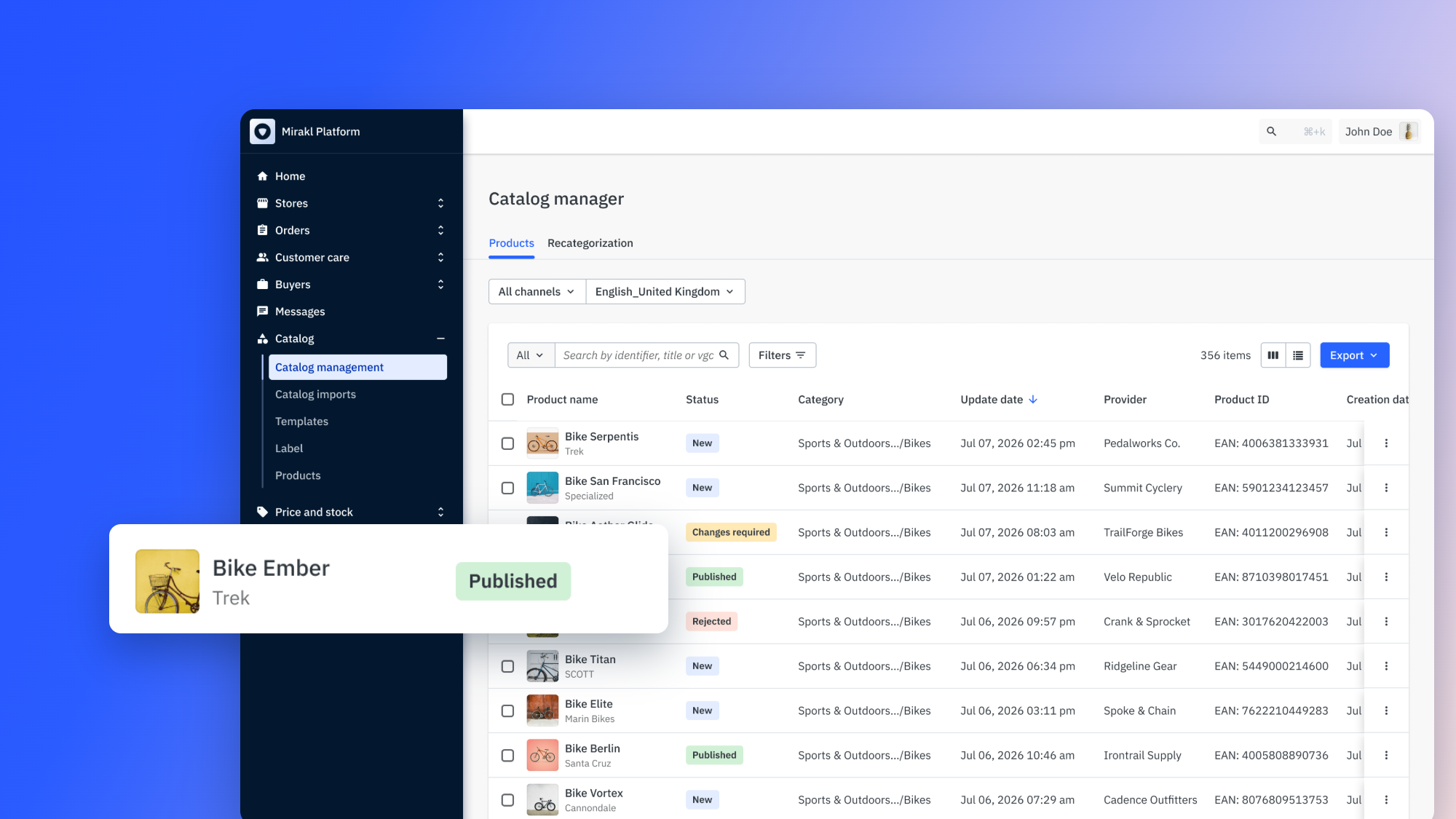
Suppliers upload their catalog in whatever format they already use (opens in a new tab). AI maps it to your taxonomy and standardizes the attributes. Validation rules catch what's missing the moment a file arrives and send it straight back to the supplier with specific guidance, before bad data ever reaches your PIM (opens in a new tab).
Your team stops chasing and starts reviewing, AI handles the mapping, and people make the calls that need judgment.
Each hidden cost shrinks with that one change. The time tax falls because most products clear validation without a human touch. Suppliers stay because the process meets them where they are. Launches hold their dates. Products go live with complete data (so they convert instead of coming back). With changes like these, one Fortune 500 distributor (opens in a new tab) cut new SKU time-to-live from days to hours.
The question isn't whether you can afford to fix it, it's whether you can afford to keep ignoring the associated costs.
Stop chasing supplier data
Every one of these hidden costs starts at the same point: the moment supplier data enters your business. Fix it there, and the rest follows.
Learn more about getting supplier data sale-ready, here → (opens in a new tab)