
What happens to retail media when shoppers stop browsing?
More shoppers are handing discovery to AI assistants. They describe what they need, and the assistant compares options and builds a shortlist, often before the shopper ever lands on a retailer's site.
For retail media, that can sound like a threat. Most programs were built on a simple equation: more traffic, more impressions, more ad revenue. If AI agents do the browsing, it's fair to ask what happens to that equation.
But what if AI shopping is retail media's biggest opportunity yet?
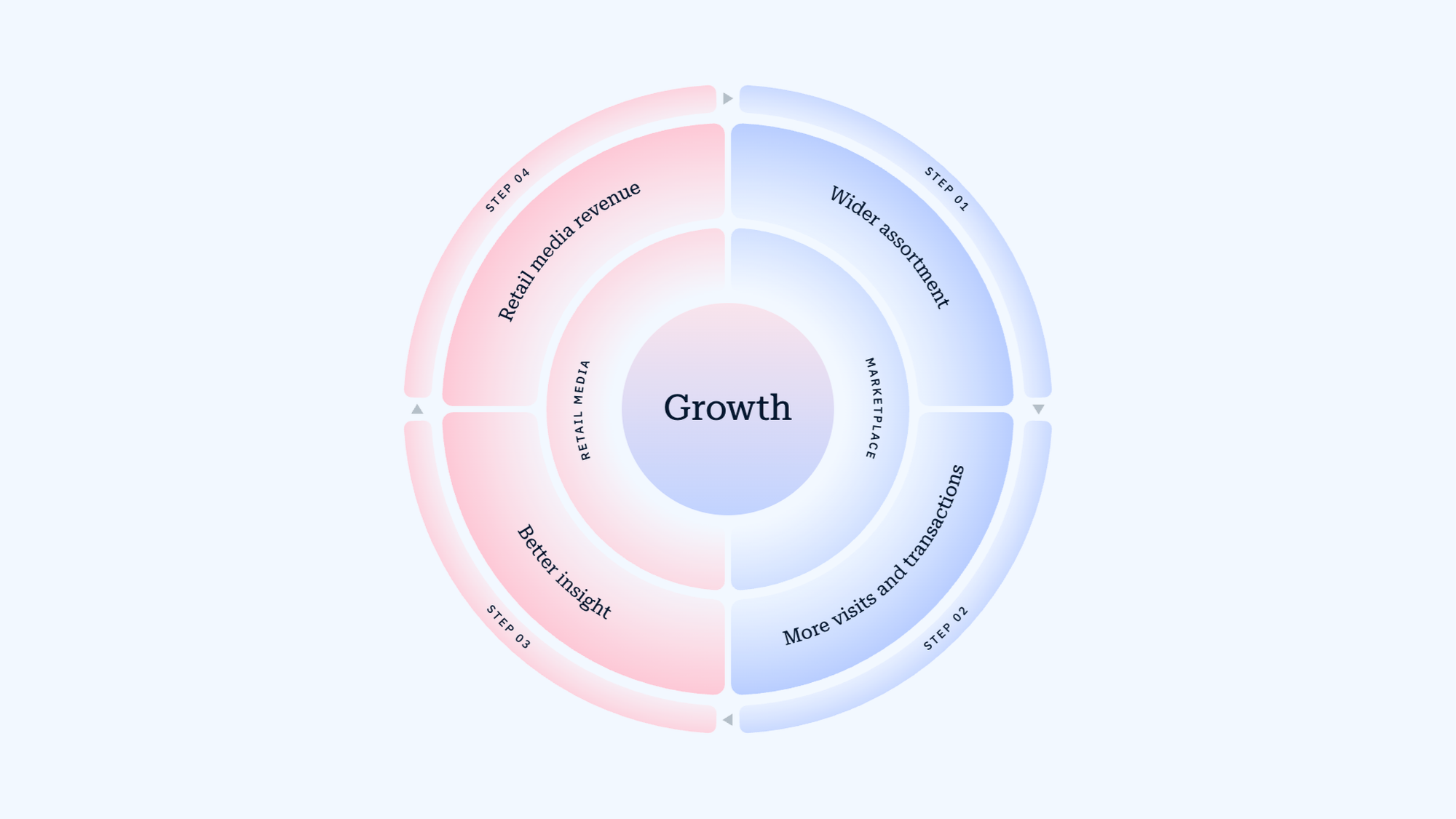
Retail media has always done more than sell ad space. It's a core part of the retail flywheel, the self-reinforcing cycle in which marketplaces, loyalty and personalization, and retail media feed one another to drive growth.
New research from BCG (opens in a new tab) finds that retail media's margins already help fund that flywheel. As AI reshapes shopping, that funding role is about to matter more than ever.
Retail media already sits at the center of the retail flywheel
Here's how the retail flywheel works:
- Marketplaces expand assortment and bring in new customers.
- Customer activity generates data that sharpens personalization and loyalty.
- Engaged shoppers attract advertisers.
- High-margin ad revenue funds the next round of investment in assortment, data and experience.
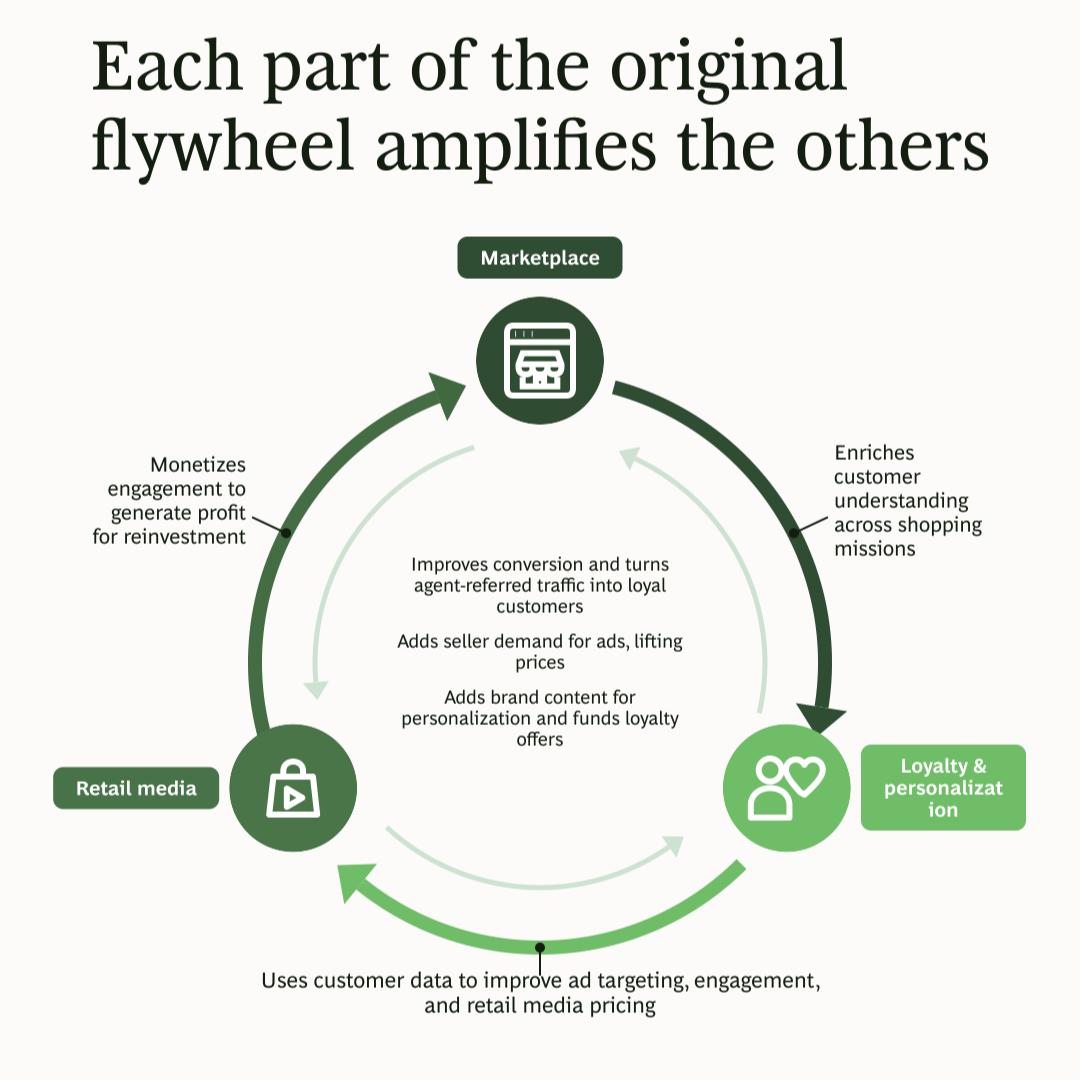
Source: BCG, "How Retailers Can Reinvent the Digital Flywheel for Agentic Commerce (opens in a new tab)”
Retail media is what keeps that cycle moving. In BCG's survey of 50 of the top 300 global retailers and 100 of the top global brands, 95% of retailers named retail media as a major source of future profit growth. Third-party marketplace sellers already supply 28% of retail media revenue on average, and 42% among top performers.
You can see the flywheel at work at the largest retailers. In the first quarter of its 2027 fiscal year, Walmart's US marketplace sales jumped nearly 50% (opens in a new tab), while its global advertising business grew 37% (opens in a new tab). More sellers and more advertising grew side by side.
When nearly every retailer expects profit growth from the same business, retail media is no longer a side project for the eCommerce team. It's a financial lever for the whole company, and a source of funding that keeps the flywheel spinning.
How AI shopping is reshaping the retail flywheel
It should go without saying, but eCommerce was built for humans. It was built for consumers who search and shop on eCommerce sites and retailers’ apps. But with the advent of LLMs and AI shopping agents, retailers now need to consider more than their human shoppers. They need to consider software shopping on the consumers’ behalf.
That shift is already underway. BCG estimates that by 2030, more than half of eCommerce spending could be agent-assisted.
That means retailers need to seriously consider the other half of what is quickly becoming a two-part shopping journey — the half run by LLMs and AI agents. They need to optimize their eCommerce sites as destinations for the shopper as they always have, and consider optimizations that will make it more likely they get recommended by AI today and, increasingly, in the future.
Retail media can help with both. It creates new ways to engage shoppers in owned channels, and it generates the revenue retailers need to invest in the assortment, product data and loyalty benefits that agents and shoppers reward.
Why AI shopping is good news for retail media
AI shopping doesn't remove demand, but concentrates it.
Shoppers who arrive from an AI recommendation tend to know what they want. The early data backs this up. According to Adobe (opens in a new tab), AI-driven traffic to US retail sites grew 393% year over year in the first quarter of 2026, and in March those visitors converted 42% better than visitors from other channels.
Shoppers who use a retailer's own assistant are just as valuable. They reveal exactly what they want, in their own words. Both moments sit closer to the purchase decision than a traditional search result or display banner.
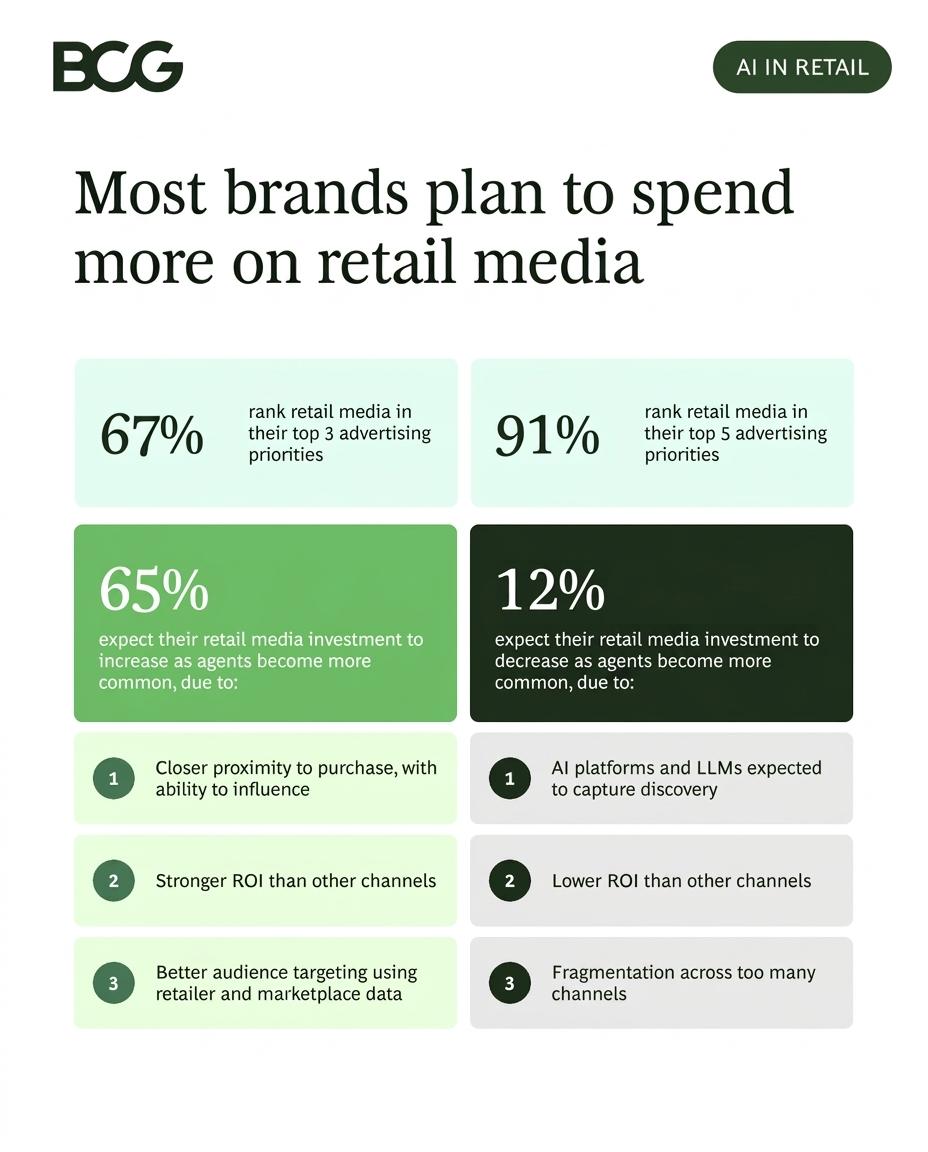
Brands see the opportunity. Among the brands BCG surveyed, 65% expect to spend more on retail media as shopping agents become common, while only 12% expect to spend less.
That appetite gives retailers room to experiment, and a reason to move now.
Brands want proof, and retail media is built to deliver it
There's one condition attached to that budget. BCG found that brands want proof of incremental sales, not just attributed sales, before they invest materially.
That's a high bar, but it's one retailers are well positioned to clear. Every sale on a retailer's site, app or shopping assistant is tied to a real transaction, so retailers can compare what shoppers who saw an ad bought with what similar shoppers who didn't see it bought.
As new ad surfaces appear in AI-driven journeys, retailers that can show what advertising truly added will earn a bigger share of brand investment. (For more on measuring retail media by the value it creates, see why investment rate should be your north-star metric in retail media (opens in a new tab).)
Source: BCG, "How Retailers Can Reinvent the Digital Flywheel for Agentic Commerce (opens in a new tab)”
4 ways retail media can evolve for AI shopping
What does retail media look like when it funds a next-generation retail flywheel? Four shifts stand out.
1. Bring sponsored products into owned shopping agents
A retailer's own shopping assistant is the one AI environment it fully controls: the ranking logic, the data and the ad experience. That makes it the natural place to start. The rule is simple: A sponsored product should answer the shopper's question, not interrupt it.
The technology is ready, too. Mirakl Ads, for example, now offers MCP-native ad serving (opens in a new tab) that lets onsite shopping agents retrieve contextually relevant sponsored products in real time, without changes to existing campaigns.
2. Design ads for shoppers who arrive ready to buy
When a shopper lands on a product page from an AI recommendation, most of the research is already done. Ads that try to restart discovery will miss. Formats that help complete the decision, such as complementary product ads (opens in a new tab) that suggest what goes with the item already in the cart, are a better fit for the moment.
3. Extend reach beyond the retailer's site
Shoppers move between screens and stores, and advertisers want to plan for that journey with one brief and one view of results, not a separate deal for every channel.
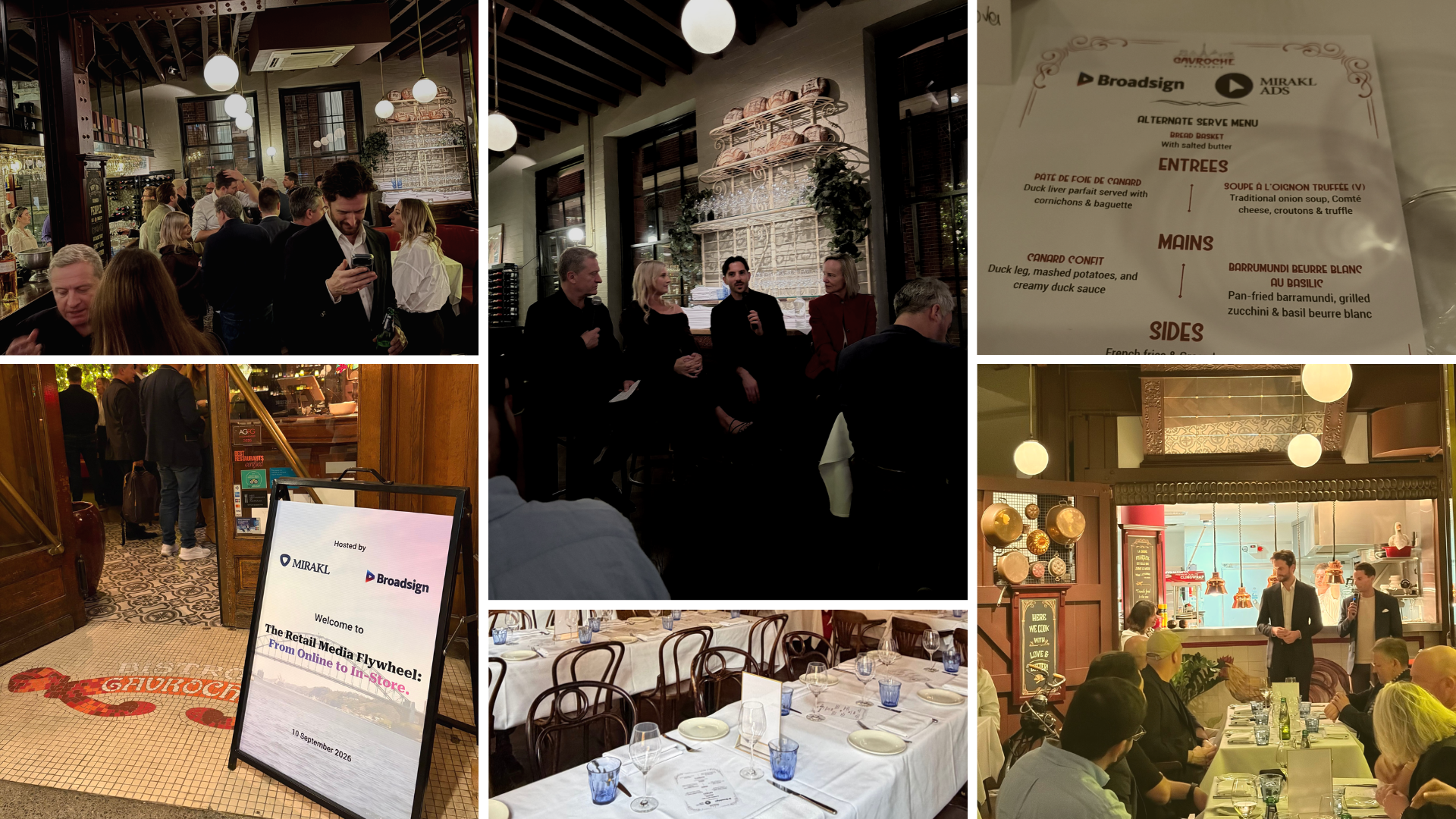
Partnerships are already making this practical, for example, the partnership between Broadsign and Mirakl Ads (opens in a new tab) is designed to give advertisers one campaign brief across eCommerce placements and in-store digital screens, with a consolidated view of performance.
4. Make incrementality the standard
Every new format needs a measurement plan from day one, because better measurement leads to better results. As BCG’s research found, among retailers that have already strengthened their data, targeting and measurement capabilities, 65% report better campaign performance.
Incrementality also means growing the pie, not just shifting existing budgets. Activating marketplace sellers as advertisers is one of the fastest ways to add net-new spend, as explored in the winning retail media formula for a profitable peak shopping season (opens in a new tab).
Treat retail media as growth infrastructure
The retailers that win the next era of commerce won't necessarily be the ones with the most ad slots. They'll be the ones that turn ad revenue into lasting advantages: broader assortment, cleaner product data, richer loyalty programs and measurement brands trust.
That calls for a different question. Instead of asking, "How do we monetize our traffic?" retailers can ask, "How does advertising fund the capabilities that keep shoppers and agents choosing us?"
Ready to build a retail media program that can fund your next-generation retail flywheel?