
Earnings season shows which marketplace metrics prove value
What you'll learn
- Why GMV alone doesn't show whether a marketplace is working
- Which customer, economics and operations metrics retailers point to on earnings calls
- How to build a scorecard with one metric per layer (customer, economics and operations) and set your baseline for next quarter
Gross merchandise value (GMV) tells you how much business has moved through a marketplace. It doesn't tell you whether the marketplace brought in new customers, improved margin or kept your delivery promise.
That matters when a large retailer reports a number you can't match. Walmart reported 52% growth in marketplace and fulfillment services (opens in a new tab) in the second quarter of fiscal 2027, and its global advertising grew 38%. If your marketplace is newer or smaller, it's easy to wonder how you'd ever compete.
Marketplaces already carry significant impact. Boston Consulting Group's new survey (opens in a new tab) of 50 of the top 300 global retailers found:
- Marketplaces account for 26% of retailers' total online GMV on average, rising to 35% among top-quartile retailers.
- New marketplace customers generate 23% of retailer traffic on average, rising to 30% among top-quartile retailers.
So which question should you be asking: how big is your marketplace, or what is it doing for your customers, economics and operations?
We reviewed the latest quarterly results of 15 public marketplace operators outside Asia that discussed their marketplace, from Amazon and eBay to Kingfisher. Here is what they reported:
- 7 of 15 gave a dollar GMV figure, and all seven paired it with advertising, customer or profit metrics.
- 12 of 15 pointed to a benefit beyond sales, most often advertising and retail media revenue. Four went further and tied the marketplace to profit or margin.
- 3 of 15 only provided marketplace growth rates or broadly spoke about growth in ecommerce sales.
GMV shows that a marketplace is active. It can't always show whether the marketplace is helping the business. For that, look at three layers: customer, economics and operations. That means the customers your marketplace brings in, the margin it adds and the delivery promise it keeps.
Below, we break down what this earnings season reveals about each, and the one metric worth tracking for your marketplace.
Customer: Which marketplace metrics show new customer growth?
A marketplace can bring in new shoppers, win back lapsed loyalty members or give existing customers a reason to shop more often. Quantify and track these specific outcomes rather than a generic count such as total marketplace shoppers. Start with new customers. They already drive a meaningful share of retailer traffic, so the share of your new customers who arrive through the marketplace is the first number to track.
Ulta Beauty said (opens in a new tab) its marketplace, powered by Mirakl (opens in a new tab), is "attracting new and reactivated lapsed loyalty members, serving as a source of newness that elevates our assortment." Marketplace brands are also helping grow UB Media by using Ulta's media network to reach shoppers.
Track this:
- Marketplace-first share: new customers whose first order was a marketplace order, as a share of all new customers
- First-party cross-shop rate: the share of those customers who buy first-party within 12 months
- Repeat purchase rate and lifetime value: watch both for marketplace-first customers
Economics: Does a marketplace hurt retail margin?
Short answer: not in the retailers we reviewed.
Best Buy (opens in a new tab) expects its annual gross profit rate to improve by roughly 30 to 40 basis points. It named "growth from our Best Buy ads and our U.S. marketplace" as the primary drivers.
Kingfisher's marketplace (opens in a new tab) contributed more than £13 million of retail profit in the first half (opens in a new tab). Its CFO said that alone was more than the marketplace earned in the whole of last year.
Ceconomy, the parent of MediaMarktSaturn, said on its earnings call (opens in a new tab) that its marketplace businesses carry structurally higher margins.
The reason is simple: a marketplace adds commission, advertising and services on top of the existing business, and its sellers compete for retail media inventory, which can lift cost per click and grow retail media revenue.
Marketplace and retail media reinforce each other: sellers bid for visibility, and the retailer earns advertising revenue on top of commission. Upfront fixed costs, such as initial integration, marketing spend and seller onboarding resources, can leave the first year thin. But the asset-light model means margin expands as volume grows and the marketplace matures.
The advertising link is measurable. BCG found (opens in a new tab) that retail media draws an average of 28% of its revenue from third-party marketplace sellers, rising to 42% among top-quartile retailers.
Track this: marketplace contribution margin
- Commission revenue
- Plus advertising revenue
- Minus variable costs, such as payment service provider fees
- Minus fixed costs, such as your seller management team
- Equals marketplace contribution margin
Define the cost scope up front, including marketing, customer service, fraud, returns and technology if they belong. Report it separately from first-party margin.
Operations: Which marketplace metrics show delivery performance?
More products don't make a better marketplace if orders arrive late or feel off-brand. Retailers define the promise differently. Kingfisher (opens in a new tab) ties B&Q Marketplace to Click & Collect and three-hour delivery.
When hundreds or thousands of independent sellers fulfill orders, you can’t control every part of the delivery experience. You can still keep a dependable delivery promise with accurate, AI-powered delivery estimates and the technology to support them. Customers should always know when their order will arrive.
Few retailers disclose delivery metrics, so this is where your own data matters most. Start by finding where your promise breaks and confirming you can capture the data to track it, such as seller ship dates, carrier tracking events and customer inquiries. Then track the matching metric:
- Convenience: on-time delivery rate
- Omnichannel: share of marketplace orders using pickup, such as Click & Collect
- Customer service: return rate, customer inquiries per order and NPS on customer inquiries
How to build a marketplace scorecard
The scorecard has three layers: customer, economics and operations. Choose one primary metric for each layer. Use the supporting signals to understand what's driving the result.
| Layer | Question | Start with | Supporting signals |
|---|---|---|---|
| Customer | Is your marketplace creating incremental demand? | New customers whose first order was a marketplace order, as a share of all new customers | First-party cross-shop rate, repeat purchase rate and lifetime value |
| Economics | Is your marketplace creating value that lasts? | Marketplace contribution margin | Advertising revenue, commission rate and contribution per order |
| Operations | Can your marketplace deliver your customer promise? | On-time delivery rate, or the metric that matches your promise | Pickup adoption, return rate, customer inquiries and inquiry NPS |
Start with the job your marketplace needs to do. Ulta uses it to bring back lapsed loyalty members, Kingfisher to broaden choice and attract traffic, and Best Buy (opens in a new tab) to lift margin alongside ads. The job decides which metrics matter most.
Then read the three layers (customer, economics and operations) together. Picture a digital flywheel (opens in a new tab): assortment brings traffic, traffic brings data and retail media turns both into revenue that funds further growth in assortment and customer experience.
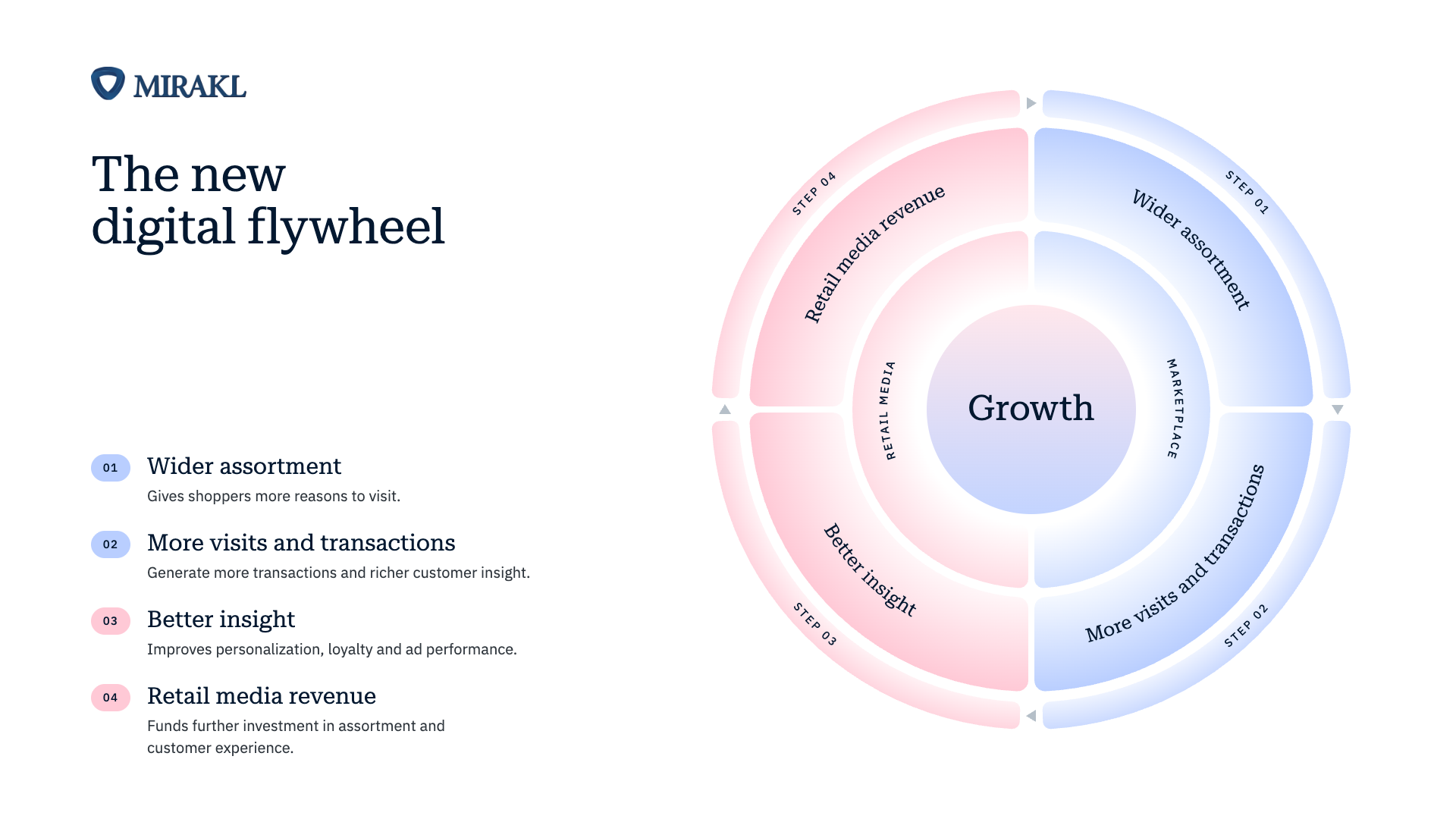
Your scorecard should work the same way. If GMV grows but contribution margin doesn't, scale is hiding an economic problem. If on-time delivery slips while GMV grows, you are trading future repeat customers for today's sales.
Put the scorecard to work:
- Set a baseline this quarter. Record where each metric stands today.
- Give each metric a trigger. Decide in advance what result would make you pause a seller category, shift marketing spend or fix a delivery gap.
- Review it every quarter with your leadership team. If you don't report marketplace results publicly, treat the scorecard as your internal earnings call.
Your marketplace doesn't need Amazon's or Walmart's scale to prove its value.
GMV tells you how much sold. Your scorecard should tell you what that volume did for the business.
Which of these metrics could you report today? Start there, then build the tracking for the other two.
If your marketplace earns advertising revenue, a good next step is our guide to why investment rate should be your north-star metric in retail media (opens in a new tab).
About this analysis: We reviewed the latest quarterly results from 15 public marketplace operators outside Asia as of October 13, 2026, drawing on earnings releases, presentations and call transcripts. The selected companies show reporting patterns and don't form an exhaustive sample.
FAQ section
GMV is useful for measuring the volume of business moving through a marketplace, but it does not show whether the marketplace creates new customers, improves margin or meets the delivery promise.
Retailers should track at least one metric across three layers: customer, economics and operations. Useful examples include marketplace-first customer share, marketplace contribution margin and on-time delivery rate.
Marketplace contribution margin is the revenue generated from commissions, advertising and services, minus the variable and fixed costs required to operate the marketplace.
Start with the job your marketplace is meant to perform, then track customer impact, economic value and operational performance together. GMV should be treated as a scale indicator, not the complete measure of success.