
What does it really take to bring a vendor live?
More than an account and a product catalog.
Before a vendor can accept its first order, the retailer and vendor need to agree on how they will work together, what information they will exchange and which workflows they need to test.
The process can vary depending on whether the vendor joins through a marketplace or a dropship program. But across both models, onboarding typically follows five stages.
By the end of this article, you'll understand:
- What vendor onboarding involves from qualification through launch
- How marketplace and dropship onboarding can differ
- Which catalog and operational requirements vendors need to prepare for
- What can affect the onboarding timeline
- How retailers and vendors can reduce avoidable delays
Vendor onboarding at a glance
Across marketplace and dropship programs, vendor onboarding typically follows the same core stages. The people, systems and approvals involved in each stage can vary, but the overall journey remains consistent.
| Onboarding stage | Retailer focus | Vendor focus | Launch outcome |
|---|---|---|---|
| Qualification | Assess assortment, fulfillment capability and integration readiness | Share business, product and operational information | Confirm that the relationship can move forward |
| Setup | Establish account, commercial and operational requirements | Complete account configuration and provide documentation | Create the vendor's operating foundation |
| Catalog readiness | Validate product data, attributes and content standards | Submit and correct product and inventory information | Approve products for launch |
| Operational testing | Define test scenarios and review results | Test orders, inventory, shipping and exception flows | Confirm readiness for live operations |
| Launch and hypercare | Publish approved products, monitor early orders and resolve issues | Support first live orders and respond to launch issues | Transition the vendor to ongoing management |
The stages are shared, but the work inside each stage can change. Marketplace onboarding may follow more standardized seller requirements, while dropship onboarding may require more vendor-specific alignment around contracts, pricing, catalog content, fulfillment and operations.
Start with vendor readiness
Every onboarding journey begins with a practical question: Can the vendor operate within the retailer's requirements?
At this stage, the retailer is looking at three questions:
- Can the vendor provide the required product and inventory information?
- Can the vendor fulfill orders and meet the retailer's service expectations?
- Can the vendor support the required integration and operational workflows?
The retailer reviews the vendor's assortment, fulfillment capabilities, inventory availability and integration readiness. It may also assess whether the vendor has the people, systems and processes to support expected order volume.
This early assessment surfaces potential risks before they become launch blockers. A vendor may have a strong assortment but lack the technical resources to support the integration. Another may be technically prepared but need more time to provide complete product data or confirm its shipping and returns processes.
Qualification gives both sides a clearer view of what launch will require.
Set up the relationship
Once the vendor is qualified, the retailer and vendor establish the account and operating framework.
This can include:
- Account or shop configuration
- Business verification
- Payment or payout information
- Shipping settings
- Operational settings
- Integration requirements
The setup process can take different forms.
In a marketplace program, the vendor may accept standard terms and complete a repeatable account setup process. The vendor configures its shop profile, shipping information and other operational settings before submitting products and offers.
In a dropship program, the retailer and vendor may need to define more of the working relationship before moving forward. They may align on payment terms, shipping and returns responsibilities, service-level expectations, integration requirements and other operating details.
The important question is not how many setup fields the vendor needs to complete. It is whether both sides understand what will happen after the vendor goes live.
Prepare the catalog for launch
A vendor cannot go live with incomplete or inconsistent product information.
The vendor provides:
- Product titles and descriptions
- Images and specifications
- Category information and required attributes
- Prices
- Inventory data
The retailer then reviews that information against its catalog and content standards.
Depending on the quality of the submission, the team may need to correct missing attributes, recategorize products, enrich descriptions or validate inventory information. For dropship vendors, the retailer may also review the proposed launch assortment before approving the initial products.
The retailer and vendor may need to collaborate across several teams, including catalog, merchandising, technical and operations. That work can move quickly when the vendor has complete, structured data. It can take longer when the data requires multiple rounds of correction.
The Mirakl Catalog Solution, part of its Marketplace and Dropship Platform helps retailers bring together vendor product information, validate catalog data and enrich content before launch.
The retailer and vendor need to confirm that the catalog is complete, accurate and ready to support the customer experience before launch.
Test the order lifecycle
Product information gets a vendor onto the page. Operational readiness gets the order to the customer.
Testing helps the retailer and vendor confirm that the full order lifecycle works as expected. Depending on the program, testing may cover:
- Inventory updates
- Order acceptance
- Shipment confirmation
- Tracking information
- Cancellations and returns
- Invoicing and exception handling
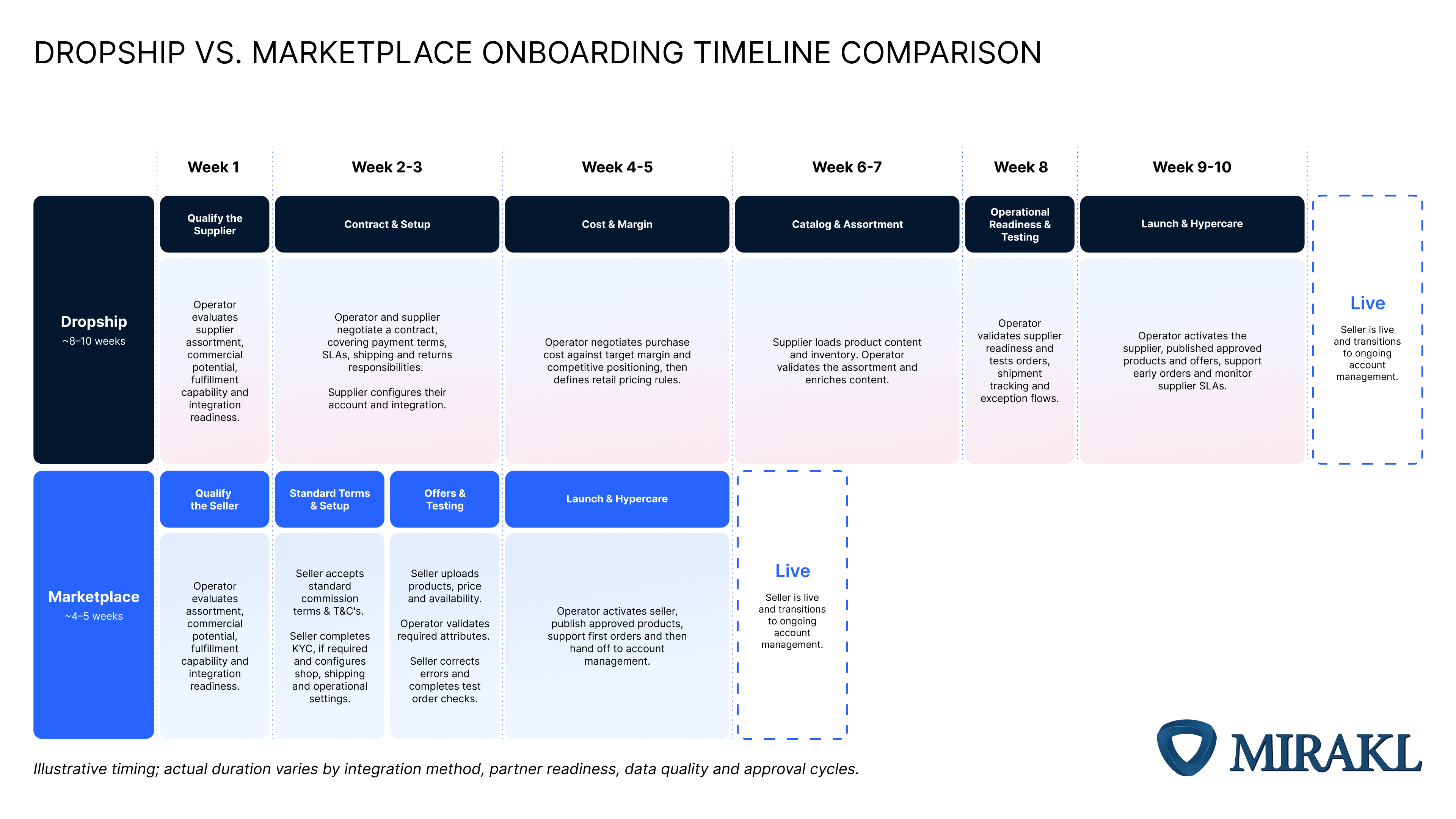
The onboarding timeline graphic includes testing across inventory, order acceptance, shipment, tracking, cancellations, returns, invoicing and exception flows as part of the dropship journey.
This work matters because a vendor's ability to submit product data is only one part of launch readiness. The retailer also needs to know that the vendor can accept orders, provide accurate inventory, ship products, share tracking information and respond when something goes wrong.
Testing gives both sides a way to identify issues, assign responsibility and confirm that the vendor can support the customer experience after an order is placed.
A dropship platform such as the Mirakl Dropship Platform (opens in a new tab) can help retailers manage vendor onboarding, operational testing and ongoing dropship workflows.
Launch, monitor and learn
Once the vendor, products and workflows have been approved, the retailer can move into launch.
| Launch stage | What happens | Outcome |
|---|---|---|
| Activate and publish | The retailer activates the vendor and publishes approved products and offers | Products are available to customers |
| Support first orders | The retailer and vendor support the first live orders and respond to questions or issues | Early orders move through the expected workflows |
| Monitor performance | The retailer reviews order processing, inventory accuracy, shipment activity, tracking and exceptions | The team identifies and resolves issues in production |
| Complete the handoff | Both sides confirm when launch support ends, who owns future questions and how updates will be managed | The vendor transitions to ongoing account management |
Launch is not the end of onboarding. It is the first opportunity to see whether the setup, catalog and testing work translated into a reliable live experience.
A clear handoff matters, too. Both sides should understand what happens after launch support ends, who owns future questions and how the retailer will manage catalog or operational updates going forward.
How long does vendor onboarding take?
There is no single answer. The timeline depends on the vendor, the retailer and the requirements of the program.
The timeline below shows marketplace onboarding at approximately four to five weeks and dropship onboarding at approximately eight to 10 weeks. These figures are illustrative. Actual timing varies based on integration method, vendor readiness, data quality and approval cycles.
Several factors can affect the timeline, including the vendor's technical preparation, the quality of its product data, the size of the initial launch, contract requirements, testing needs and stakeholder availability.
The best way to manage those variables is to define requirements, owners and approval points before onboarding begins.
How Sitano went live on Nordstrom in under three weeks
Sitano's experience shows how those conditions can shape the outcome.
| 15-20 days | $125,000 | No new headcount |
|---|---|---|
| Time to go live on Nordstrom | GMV in the first six months | Team size stayed the same |
The brand went live on Nordstrom's marketplace in 15 to 20 days using Mirakl Connect (opens in a new tab). Its existing Shopify store connected to the platform, while Sitano reviewed and adjusted product data to meet Nordstrom's listing requirements.
The two-person team launched a new marketplace channel without adding headcount or building a custom technical solution. The example illustrates how integration readiness, catalog preparation and dedicated onboarding support can influence the path to launch.
Read the full Sitano customer story. (opens in a new tab)
How retailers and vendors can prepare
The most effective preparation happens before onboarding officially begins. Retailers and vendors can reduce avoidable delays by clarifying requirements, assigning owners and preparing the information needed for launch.
Retailers should:
- Define catalog, commercial and operational requirements before vendor outreach
- Provide clear product data templates and content standards
- Confirm the integration method and technical owners
- Define testing scenarios and launch-readiness criteria
- Assign owners for commercial, technical, catalog, fulfillment and customer operations approvals
Vendors should:
- Review onboarding requirements before submitting information
- Gather complete product and inventory data
- Validate technical capabilities and identify key contacts
- Confirm shipping and returns processes
- Prepare test products, orders and operational contacts
- Allocate resources to support testing, first orders and launch issue resolution
Clear ownership matters when multiple teams contribute to launch approval. Everyone should know what they own, what they need to approve and when the handoff occurs.
Graybar's experience offers another perspective on vendor catalog onboarding in this on-demand webinar (opens in a new tab).
Build the foundation before the first order
Marketplace and dropship vendor onboarding may follow different paths, but both prepare the vendor, the retailer and the supporting processes for launch.
The work starts with qualification and setup. It continues through catalog review, operational testing and early-order support. When both sides define requirements, assign clear owners and resolve issues early, they create a stronger foundation for ongoing operations.
The best vendor relationships do not start with the first order. They start with the work that makes that order possible.
Ready to make vendor onboarding more predictable? (opens in a new tab) See how Mirakl helps retailers bring vendors live, manage catalog quality and support marketplace and dropship operations from one platform.