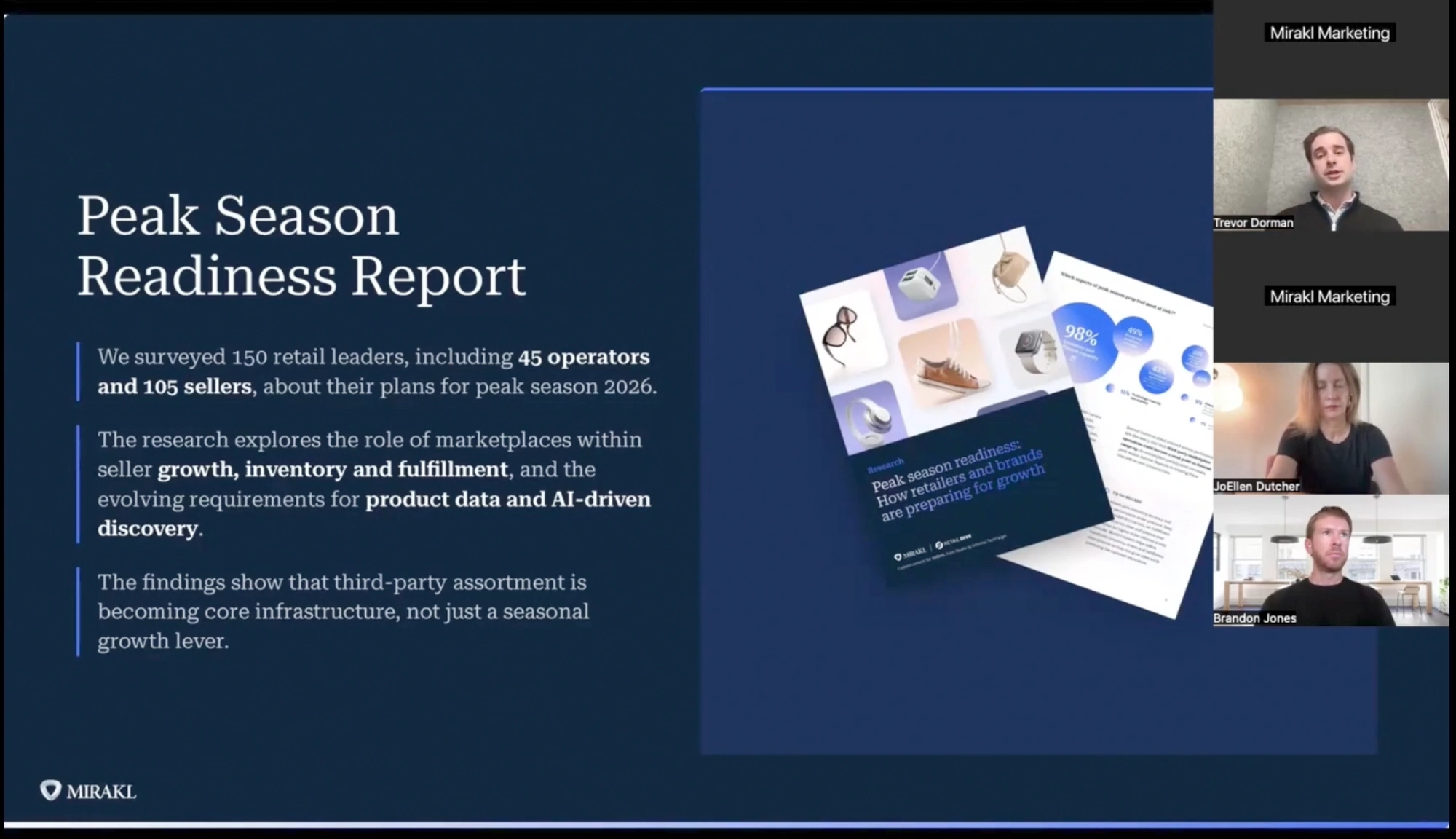

The channel most brands count on to grow holiday revenue is also the one most likely to buckle under it. In our peak season research with Retail Dive (opens in a new tab), 86% of sellers said marketplaces will account for a major portion of their peak season revenue. Yet 98% of respondents named inventory and fulfillment capacity as a risk.
Adding marketplaces is the easy part. The hard part comes as the end of the year approaches, when every one of those channels needs accurate stock, healthy margins and a team that can keep up.
To see how one brand handles it, we sat down with JoEllen Dutcher (opens in a new tab) and Brandon Jones (opens in a new tab) of Cuyana (opens in a new tab). The leather goods brand sells on four marketplaces alongside its own direct-to-consumer (DTC) site. Their approach to peak season starts much earlier than most.
You can catch our conversation on-demand here (opens in a new tab), or read on for the most important takeaways from our peak season webinar.
1. Run peak prep on two timelines
Handbags aren't a quick-turn product. Leather goods carry long lead times, so Cuyana starts holiday inventory planning nine to 10 months out.
"We're really thinking about projecting our sales for the holiday time period, understanding our marketplace penetration by style," Dutcher said.
The second timeline starts about three months before peak. The brand team builds creative assets and refreshes product catalogs with new styles. At the same time, Cuyana builds its marketplace assortments, well before the final month when every other brand scrambles to get products live.
Operations run on the same three-month runway. Cuyana owns its distribution center instead of using a third-party logistics provider. Jones and his team plan labor for fulfillment and customer experience, audit internal technology and walk the team through peak processes.
For sellers, the lesson is to separate long-lead decisions from last-mile work. Build marketplace catalogs alongside holiday creative, and they won't compete for attention the week before Black Friday.
2. Forecast marketplace demand down to the SKU
Cuyana doesn't treat marketplaces as one bucket. Products sell differently depending on where they're listed, so the team forecasts each marketplace down to the style and SKU.
"We have products within our assortment that sell better on our own channels, but then we have some that sell better on our marketplace channels," Dutcher explained.
Every month, the team reviews inventory levels and sales trends across DTC and marketplaces. When a style outperforms, Cuyana pulls its chase levers: air freight instead of ocean freight, or fast-tracked production with its factories.
Tight styles get a different treatment. DTC is Cuyana's highest-margin channel, so the team temporarily pulls at-risk styles from marketplaces ahead of the holidays and reviews that call weekly. If inventory is trending better than expected, those styles go back up.
"It's just a lot of making the best decisions we can now with the data we have, and then constantly revisiting them," Dutcher said.
That margin-first discipline shapes pricing, too. In the full session, Dutcher explains why Cuyana stays right-price forward and runs no promotions on its marketplaces today, even in the most promotional stretch of the year.
Brands without a dedicated planning team can still allocate this way with channel-level stock buffers. In Mirakl Connect (opens in a new tab), a seller can leave inventory untouched on a priority marketplace and automatically switch off a lower-priority channel once stock drops to 20 units.
3. Stand out on crowded marketplaces without relying on paid placements alone
Every brand wants visibility during peak. Cuyana starts with the fundamentals most brands underinvest in. For example:
- Product pages come first. Shoppers weighing a higher-priced handbag do their homework, and the product page is where they do it. Cuyana gives every listing its best imagery and full product details.
- Assortment changes by marketplace. Over the course of the year, the team has learned what each partner's customers want. One marketplace does best with core totes, while another responds to color. Meanwhile, a third moves giftables, so Cuyana sends a broader gifting range there.
- Organic curation gets real effort. When partners share plans for seasonal stories and product groupings, Cuyana joins every one. The team recommends specific products for each curation instead of handing over a laundry list.
- Paid and awareness plays round it out. Cuyana's digital marketing team optimizes promoted listings and looks for placements in partner emails and onsite spots. For high-visibility marketplaces, the brand sends free products for photography and joins the marketplace's influencer program.
Behind all four is one mindset. Cuyana treats each marketplace as a distinct retailer with its own customers and marketing levers, then works within each one.
4. Build for discovery by AI shopping agents
When asked whether AI discovery is a priority or a nice-to-have, Dutcher didn't hesitate. "It is a priority, and it should be a priority for everyone," she said. Shopping behavior, she noted, looks very different than it did even six months ago.
Cuyana works on two fronts. The first is structured data: The team optimizes the brand's backend product data for LLM discovery (opens in a new tab). The second is earned content. Cuyana already appears in editorial roundups for queries like the best work bag, and the team amplifies that presence across press, YouTube and Reddit because those sources shape what AI models recommend.
Jones shared a tactic any Shopify brand can borrow. Cuyana's internal AI task force added an "agent summary" field that condenses scattered product copy into one description. The team uses that field as the main description in Shopify's universal catalog, and Jones said it has made a meaningful difference in agent discovery.
Our research points the same way: Being live on a marketplace is not the same as being AI-ready (opens in a new tab). Rich, structured attributes and consistent catalog data give agents what they need to compare and recommend a product.
Fewer people, tighter systems
One detail may surprise brands planning to staff up: Cuyana runs its marketplace business without a dedicated marketplace team. Dutcher and Jones own the front end and back end. Existing roles in distribution, paid marketing and customer experience have expanded to support the channel. One part-time associate handles assortment management.
"We've been taking a minimal headcount investment approach to marketplaces," Dutcher said.
That model works only when the operational load stays in one place. Mirakl Connect brings product data, inventory, orders, returns and customer care from every marketplace into a single workspace and syncs them back to your own system. A lean team spends peak season selling instead of toggling between four seller portals.
Watch the full webinar
Hear JoEllen Dutcher and Brandon Jones walk through Cuyana's peak season playbook in their own words, including its margin-first pricing stance and how the team makes allocation calls week to week.
Want the data behind the conversation? Download the peak season readiness report (opens in a new tab)..