
What if peak season does not reveal a demand problem? What if it reveals a readiness problem?
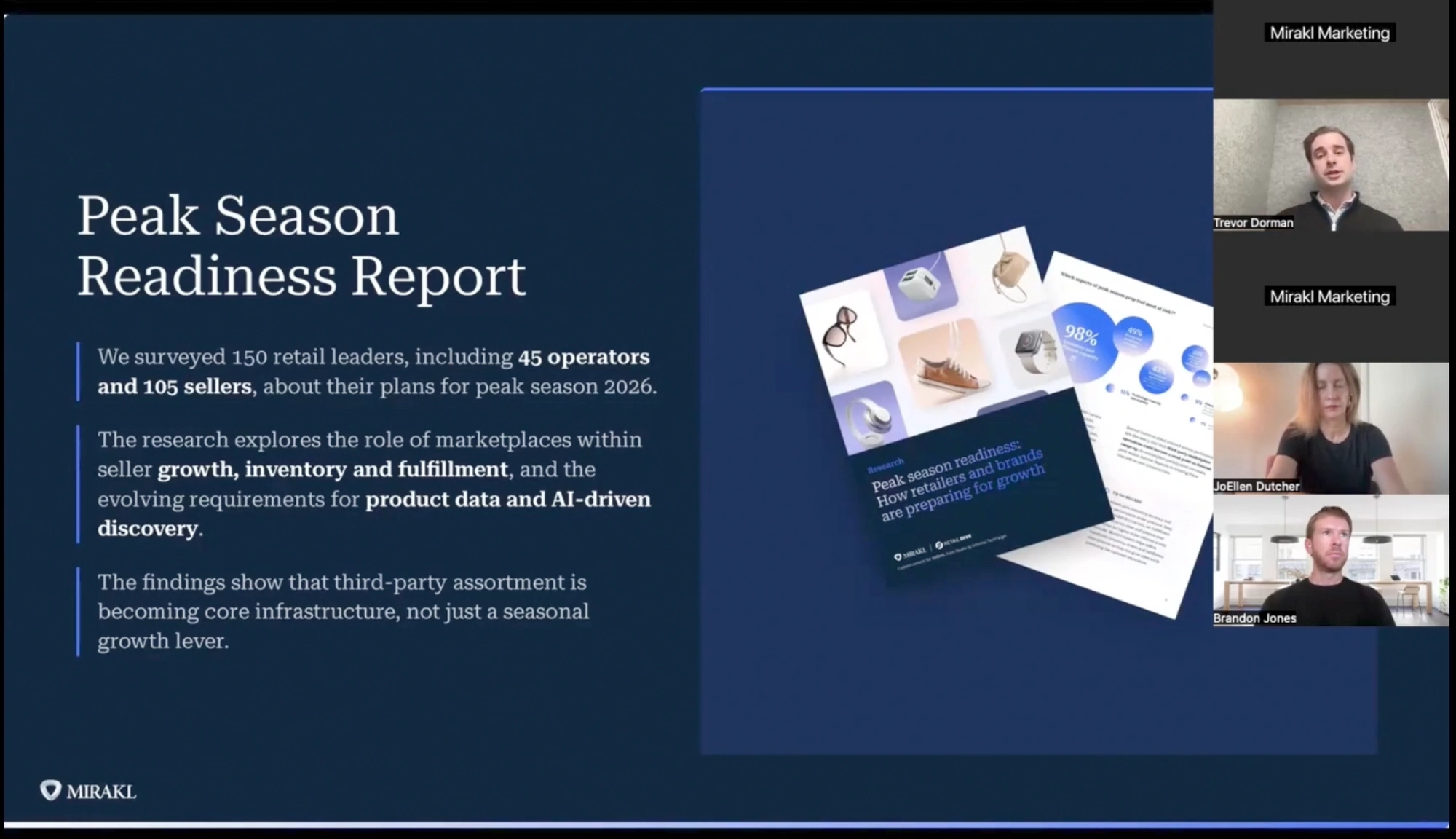
A new survey from Mirakl (opens in a new tab) and Retail Dive Studio (opens in a new tab) found that all 150 respondents — including 45 marketplace operators and 105 sellers — expect 2026 online purchases to surpass last year's numbers. At the same time, 98% identify inventory and fulfillment capacity as a peak-season risk.
The demand is coming. The question is whether operators and sellers can turn it into growth before operational gaps turn it into missed opportunity.
Marketplaces are no longer a side channel
Among surveyed operators, 89% expect marketplace and dropship channels to drive a significant share of peak-season online sales. Among sellers, 86% expect marketplaces to account for a major portion of peak-season revenue.
Every respondent also considers marketplaces either critical or very important to peak-season performance. And every respondent expects third-party assortment to increase over the next two years.
That is a significant shift. Marketplace and dropship programs are moving from an additional channel to a core part of how operators and sellers respond to demand.
For operators, third-party assortment can help fill category gaps and improve availability when first-party inventory is constrained.
For sellers, marketplaces create more opportunities to reach customers and diversify demand. 90% of surveyed sellers already sell on four or more online marketplaces, which makes accurate product, inventory and order information increasingly important across channels.
For a look at how marketplace operators performed during the last holiday season, read Holiday 2025 marketplace performance (opens in a new tab).
Can your marketplace capture demand when inventory runs short?
Adding assortment is one thing. Making sure it is available, accurate and fulfillable when demand arrives is another.
Operators need to know where third-party assortment can strengthen the customer offer, which sellers can close the most important gaps and whether those offers will be ready when shoppers arrive.
That is where marketplace and dropship strategy becomes an operating question, not simply an assortment question. This overview of marketplace and dropship programs (opens in a new tab) provides additional context on how operators can approach assortment expansion and fulfillment flexibility.
The operators that prepare early will have more choices when demand shifts. Those that wait may be left trying to solve assortment, inventory and fulfillment problems at the same time.
Can your channels keep up?
For sellers, selling across more marketplaces can expand reach. It can also multiply the number of product listings, inventory feeds, orders and delivery promises that need to stay aligned.
Before peak season, sellers should ask:
- Is product data complete for every channel?
- Are pricing and inventory updates flowing accurately?
- Can fulfillment capacity support the promises customers see?
- Are orders, returns and customer questions easy to manage?
- Which channels are creating profitable growth?
Sellers using multiple channels can learn more about coordinating product data, inventory and orders with Mirakl Connect (opens in a new tab).
More channels can create more opportunities. They can also create more places for small data or operational gaps to become customer-facing problems.
Where will the gap show up first?
Inventory and fulfillment are the most visible risks, but they are not the only ones.
Respondents also identify pricing and promotion execution, marketplace operations and returns as areas of concern. When demand increases, each one can affect the others.
An unavailable product creates a lost opportunity. An inaccurate delivery promise creates a service issue. A promotion that does not reach the right offer creates wasted demand.
Peak season does not create every operational weakness. It exposes the ones that have not been resolved.
Who owns peak performance?
Only 7% of respondents have a dedicated marketplace or dropship team with clear ownership and KPIs.
The rest manage third-party activity through individuals with broader roles or shared responsibility across eCommerce, merchandising and marketing.
A dedicated team is not the only model that can work. But someone still needs to own the full picture.
For operators, that means connecting marketplace, category, merchandising, marketing and fulfillment decisions.
For sellers, it means assigning accountability for catalog updates, pricing, inventory, orders and service levels across every marketplace.
If ownership is unclear, the problem will not stay internal for long.
Are you measuring the marketplace or just the business?
Overall revenue and GMV are important. But are they enough to show what is happening across your marketplace or selling channels?
72% of respondents track overall online revenue or GMV as a top peak-season KPI. In the same question, 0% selected marketplace-specific KPIs among their top responses, such as third-party GMV or third-party share of online revenue.
The 0% finding does not mean that no organization tracks marketplace-specific metrics. It means those measures were not selected among the top responses to this survey question.
The question is what teams may be missing when marketplace performance remains buried inside broader ecommerce results.
For additional context, read about using marketplace data to identify issues and opportunities (opens in a new tab).
Is your product data ready for what comes next?
A product can be live on a marketplace and still be difficult to find, compare or recommend.
As AI-powered discovery develops, product data needs to do more than meet the minimum requirements for publication. Attributes, descriptions, images, reviews and Q&As all influence how products are understood across channels.
This article on AI-powered catalog management (opens in a new tab) explores how catalog quality affects launch speed, discoverability and future shopping experiences.
Find the gap before peak finds it
The survey shows that operators and sellers expect marketplaces to play a major role in peak-season growth. It also shows that inventory, fulfillment, ownership, measurement and product data remain potential constraints.
The teams that identify those gaps early will have more time to address them.
The teams that wait may be left responding to problems while customers are already shopping elsewhere.
Source: Mirakl and Retail Dive Studio survey, 2026, n=150. Selected-response questions allowed respondents to choose up to three answers.