
How Mirakl builds on NVIDIA’s expanding AI ecosystem without giving up model choice.
When a product is miscategorized on a marketplace, the consequences aren't abstract. A shopper can't find what they're looking for. A seller's listing disappears from the right results. Product categorization is just one example of where AI drives real outcomes for platform operators and sellers. The same precision applies across catalog quality, seller scoring, customer support, delivery prediction and more.
Behind the data point is a real item, a real transaction, a real customer experience. And when the AI powering that data gets it wrong, it costs operators revenue, sellers visibility and customers trust.
That's why the AI Mirakl (opens in a new tab) builds for commerce can't rely on a generic, one-size-fits-all approach. That’s also why open source has been part of Mirakl's AI strategy from the very beginning as the most effective way to build AI that actually works in the specific, high-stakes context of retail and marketplace operations.
Why open source has always been central to Mirakl's AI strategy
Mirakl's first production AI model was built in 2020 with FastText, an open-source toolkit that represents words as numerical vectors a system can compare. Its task was concrete: identify products that may have been placed in the wrong category and, when confidence was high enough, suggest a correction to the marketplace operator.
The decision to use an open-source model reflected a straightforward engineering logic. Rather than designing a system from scratch, the team could start from a model that had already learned useful patterns from large amounts of text, then fine-tune it on commerce-specific examples. The result was more accurate, more controllable and faster to iterate on, and crucially produced real business outcomes: fewer miscategorized products, better search relevance and a higher-quality catalog for operators and their sellers.
That pattern — starting from a strong foundation, adapting it precisely to what commerce requires, evaluating rigorously and maintaining control over how the output is operated — has guided every AI decision at Mirakl since. As models have grown in capability and in scale, the principle has remained constant, what has evolved is the strategic weight it carries.
From specialized models to LLMs: how Mirakl's AI has scaled with commerce
For years, open source at Mirakl was primarily a quality and efficiency decision. Today, it is also a sovereignty decision. Understanding why requires looking at what has changed in the global AI landscape.
The market for AI models has become increasingly concentrated and geopolitically sensitive. Access to frontier AI capabilities flows through a small number of providers, and that access can be disrupted by factors that have nothing to do with technology: regulatory changes, shifts in licensing terms or political decisions that affect which models can be used in which markets. Companies that have built their AI stack exclusively on third-party APIs (sending a request, receiving a response, never actually holding the model) have limited options when those conditions change. They are dependent on the continued availability of a service they do not control.
Open-source and open-weight models fundamentally change this dynamic. When Mirakl can host a model internally, meaning in its own infrastructure, on its own terms, the AI keeps running regardless of what shifts in the market around it. For enterprise operators running marketplaces that process billions of euros in GMV annually, this kind of continuity is a business requirement.
How Mirakl chooses the right AI model for every commerce task
Hosting a software platform and hosting AI are not the same challenge but at Mirakl, the quality of service expectation is identical: zero-downtime and enterprise-grade security.
That’s why Mirakl has invested in building an inference platform: the system that runs trained AI models in production, based on open-source technologies. The design goal is Graphics Processing Unit (GPU) agnosticism: regardless of which hardware or cloud provider supplies compute, Mirakl can deploy its full AI stack on top of it. This architecture means that no single infrastructure vendor becomes a hard dependency, and that new GPU capacity can be brought from any source online without rebuilding the system around it.
That flexibility has tangible cost and resilience implications. When models have grown from compact, task-specific systems to large language models (LLMs) that are ten to a hundred times larger in scale, the infrastructure needed to run them has grown proportionally. The ability to route workloads across providers, optimize for cost and latency and maintain continuity regardless of what any single vendor does is what turns infrastructure investment into competitive advantage.
This is where NVIDIA (opens in a new tab) sits at the core of Mirakl's strategy. By running on NVIDIA accelerated computing, including through European cloud providers such as Scaleway (opens in a new tab), Mirakl can serve customers with open-source models at the same speed, reliability and scale they expect from the platform as a whole.
Why retail AI must be specialized, not just powerful
General-purpose AI models have become genuinely impressive. They can write, reason, translate and summarize across a vast range of tasks. But impressive breadth is not the same as the precision that retail requires.
Commerce involves AI tasks that are remarkably diverse in their requirements. Classifying a product into the correct taxonomy, validating that it meets a marketplace operator's quality standards, detecting whether a returned item matches what was originally listed, scoring a seller's fulfillment reliability. Each of these problems has its own data structure, its own rules and its own definition of accuracy.
This is where the quality-to-cost tradeoff of open-source AI becomes concretely valuable. A well-fine-tuned, smaller model often outperforms a much larger general model on a defined task at a fraction of the inference cost. Mirakl's approach of working across multiple models, providers and fine-tuning methods is how we consistently get the best outcome for each specific problem while remaining cost-efficient at scale.
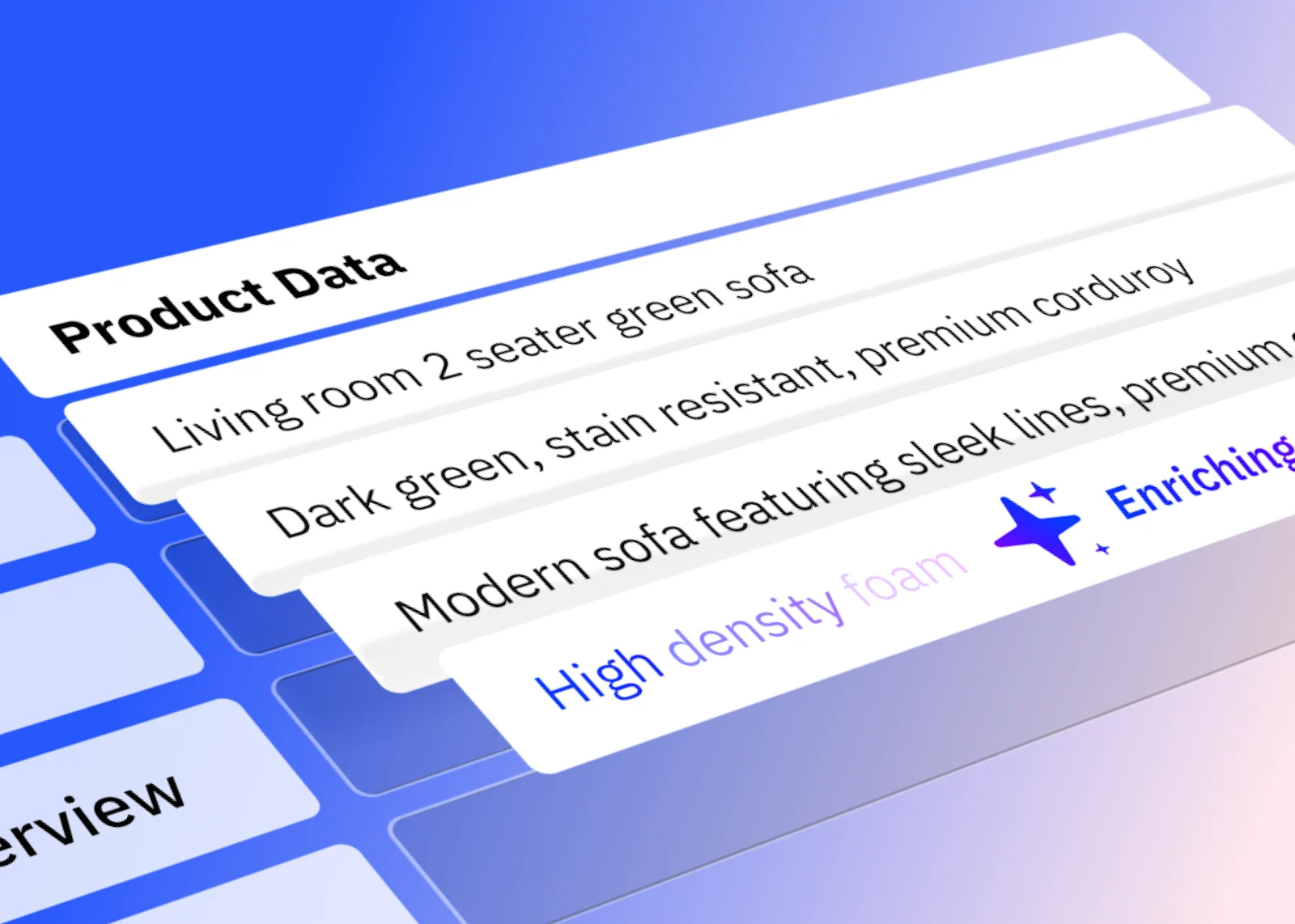
The business stakes of getting this wrong are direct. Product data is the operational layer connecting a brand's inventory to a buyer's decision. And when AI makes thousands of decisions per second across millions of products, even small error rates translate into significant revenue impact: missed searches, eroded seller trust, lost conversions.
How open-source AI translates into real outcomes for operators and sellers
The downstream beneficiary of this entire approach is not Mirakl. It is every operator building and managing a marketplace, and every seller who depends on that marketplace to reach customers.
Mirakl's Catalog Transformer (opens in a new tab), which combines internally hosted open models with proprietary services, has onboarded more than 70 million products. That scale is only achievable if the AI is both accurate and efficient: taking vendor data in multiple formats and structures and transforming it into catalog-ready content that meets operator standards, without distorting what the product actually is. At that volume, the difference between a general model and a fine-tuned one shows up in catalog quality, operator confidence and seller performance.
The same logic extends across other platform's AI capabilities: from multilingual customer support analysis and seller quality scoring to predictive delivery and AI-assisted documentation.
Each represents a specific problem with specific data and specific success criteria. Each benefits from an AI strategy that prioritizes control, adaptability and the ability to continuously improve.
Mirakl's customers get AI that has been shaped around the real demands of commerce, hosted under conditions that meet enterprise requirements and built to keep running regardless of what changes in the market around it.
Beyond adoption: how Mirakl is contributing back to the open-source AI ecosystem
Mirakl's AI strategy will remain hybrid. Proprietary models from leading providers continue to offer capability and speed for experimentation. Open-source and open-weight models provide control, adaptability and resilience. Hugging Face (opens in a new tab), recently acquired by NVIDIA, remains central to this work, serving as a model registry, development environment and deployment platform. All GPU infrastructure for training and inference runs on NVIDIA accelerated computing.
The next step in Mirakl's open-source journey is to contribute more back to the broader community, including the potential release of open-weight models trained on commerce-specific challenges.