
A shopper opens ChatGPT and types: "Best wireless headphones under 150 dollars." In seconds, an AI agent filters the web, ranks options by relevance and price, and surfaces three recommendations. Yours is not one of them.
Not because your product is inferior. Not because your price is off. But because your catalog was not built for AI.
That gap has real commercial consequences. According to Adobe Analytics data reported by Reuters (opens in a new tab) in June 2026, AI-referred shoppers generated 53% more revenue per visit than visitors from non-AI sources, and converted at a rate 54% higher.
When an AI agent recommends your products, the shoppers who arrive are not browsing. They are ready to buy.
This is agentic commerce, and it is already reshaping how buyers discover and purchase products across marketplaces and brand storefronts alike. If your listings are not structured for how AI agents read the web, you are invisible to a growing share of your highest-value buyers.
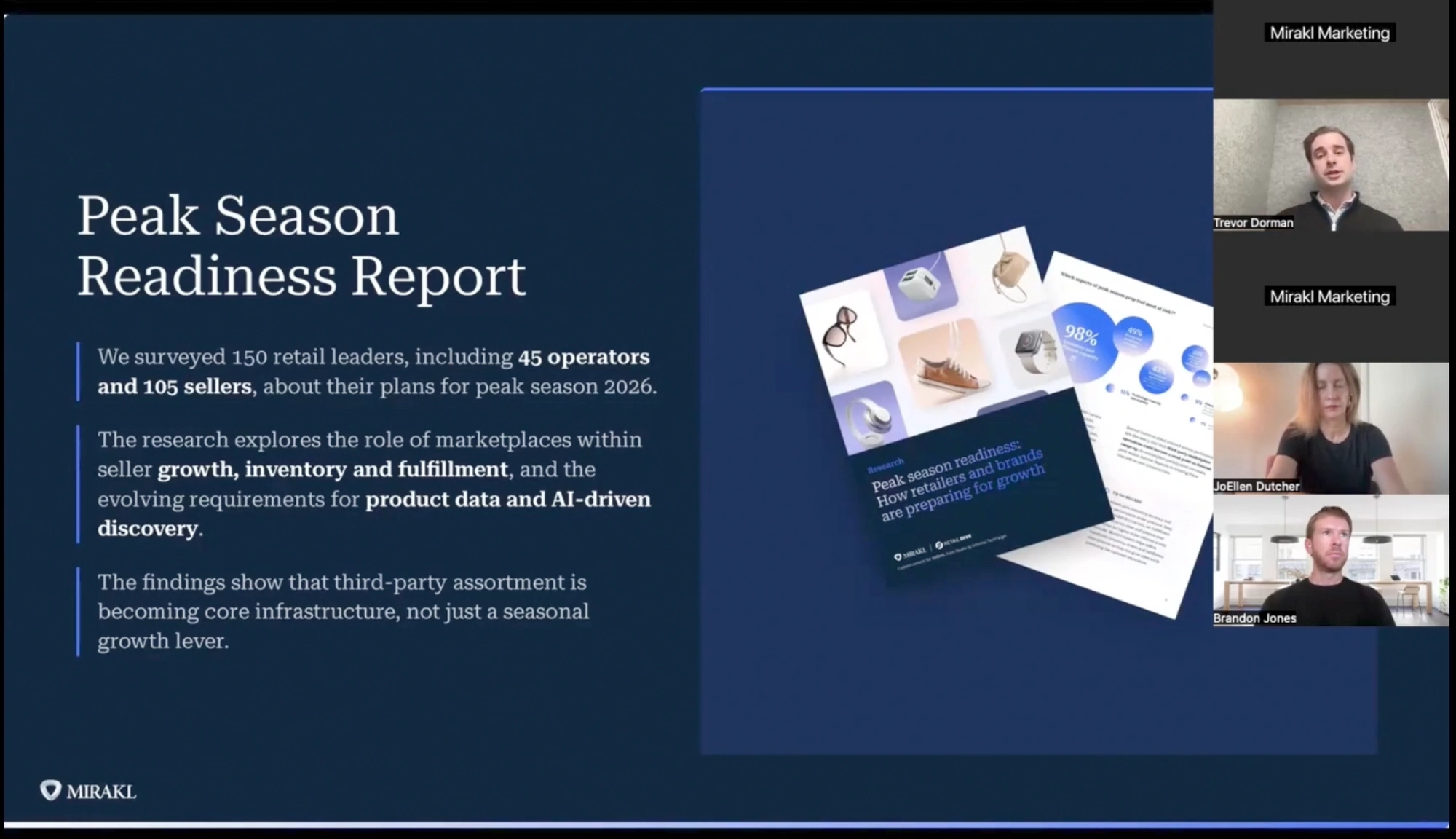
The following four-step framework from a webinar co-animated by Mirakl Connect and Marketplace Universe in May 2026, gives brands and sellers a practical playbook to stay visible, competitive and purchasable as AI agents become the dominant shopping interface.
Why agentic commerce is changing the rules now
AI-driven shopping is not a forecast anymore. Adobe Analytics (opens in a new tab) data shows AI traffic to retail websites grew 138% year over year, reaching its highest share of total retail visits since Adobe began tracking in October 2024.
Seventy-two percent of AI shoppers now use LLMs as their primary product search tool, according to Adobe (opens in a new tab). And the quality of that traffic compounds the urgency: AI-referred shoppers showed 38% higher purchase likelihood during Black Friday 2025.
What does this mean in practice? Agentic commerce is not only about autonomous shopping bots making purchases on your behalf.
BCG (opens in a new tab) maps it as a four-phase evolution: Discovery, purchase, autonomous and agent-to-agent. Brands and sellers who act now, on phases one and two, will be better positioned as the later phases mature. Those who wait will be rebuilding from a disadvantage.
Step 1: Be on the right channels
AI agents do not draw equally from every corner of the web. They pull from sources with broad assortment, competitive pricing and deep catalog data. That describes marketplaces, and the data confirms it.
According to a Mirakl analysis of more than 2,340 keywords in the electronics category on ChatGPT, specialized marketplaces appeared in results 93.67% of the time, compared to 72.29% for mass-market competitors. They also ranked first more frequently.
The reason comes down to three structural advantages: the breadth of assortment marketplace sellers bring, the competitive pricing that third-party sellers introduce and the catalog depth that fills product gaps a brand's own inventory cannot cover.
For brands and sellers, the implication is direct: marketplace presence is the foundation of LLM discoverability. And multi-channel presence compounds the advantage.
Sellers active on multiple marketplaces generate 17.5x more GMV than those selling on a single channel, according to the Seller Report 2026.
Mirakl Connect's Channel Manager helps brands and sellers expand and manage their presence across the right channels from a single platform.
Step 2: Be excellent on marketplaces
Presence is necessary. It is not sufficient.
Once your products are listed on the right channels, the quality of your product data determines whether AI agents surface them, or skip over them entirely.
Poorly categorized listings, missing mandatory attributes and incomplete product fields are effectively invisible to LLMs. They cannot recommend what they cannot parse.
Being "excellent" means your catalog is correctly categorized, your mandatory fields are complete and your attributes are structured in a way that AI systems can interpret accurately.
The challenge is that achieving this at scale is difficult to do manually. A seller might have the right information, buried in the wrong place. For example, a seller had "100% cotton" embedded in a free-text product description rather than mapped to the correct mandatory attribute. Accurate information, invisible to the systems that needed it.
Mirakl Connect's AI Catalog Transformer automatically rewrites and completes listings with all relevant attributes, acting as a co-pilot for richer, marketplace ready product data.
The results across the platform speak to the scale of the problem it solves: 47M+ products transformed, a 37% increase in attribute completion, a 50% reduction in categorization errors and a 91% reduction in seller onboarding time.
Something that used to take weeks or months can now be done in a fraction of that time.
Step 3: Optimize your product data for LLMs
This is where most brands and sellers are still behind, and where the biggest opportunity lies.
Getting your catalog structured and complete is step two. Step three requires a different kind of thinking entirely.
LLMs do not work like search engines. They do not reward keyword density or title tags. They look for contextual richness: FAQs, use cases, occasion tags, image metadata, intent signals and semantic descriptions that help them match a product to what a shopper actually means when they ask a question.
Consider the difference between these two product descriptions for a bracelet:
- Before (SEO-optimized): "Reversible double wrap bracelet in Chamonix calfskin with metal clasp. Made in France."
- After (LLM-ready): “Reversible double-wrap bracelet in Chamonix calfskin with contrasting beige and orange leather interior and a gold-tone H-buckle clasp. Perfect for office wear, evening events and casual outings. Not waterproof — Chamonix calfskin is sensitive to water; keep dry to avoid marks. Suitable for everyday wear, but avoid exposure to perfume and sharp surfaces. Offers two distinct styles in one, ideal for varying your looks. Care: wipe with a soft, dry cloth; avoid soaps and solvents; store in the dust pouch.”
The first version ranks well in a keyword search. The second is what an AI agent can actually use to answer a shopper's intent-based question.
Buyers are not just searching by keywords anymore. They are searching by intent, by context, by occasion.
Mirakl Connect's Agentic Product Enrichment add-on builds this semantic layer automatically. Once enriched, brands and sellers can deploy updated attributes in three ways: directly on product detail pages, embedded in front-end page code or mapped into LLM catalog feeds. The enrichment works across channels, so the investment compounds across every surface where your products appear.
Step 4: Be purchasable on LLMs
Steps one through three make your products visible and recommendable. Step four takes it further: making your products purchasable directly within the AI interface, without the shopper needing to leave.
This capability is earlier in its development than the first three steps, but the direction is clear. AI platforms are moving from surfacing product recommendations to enabling the full transaction within the conversation itself. Sellers who integrate now will have a head start as this functionality expands across platforms and markets.
The practical challenge for most brands and sellers is the technical complexity of connecting to LLM channels, managing evolving protocols and keeping pricing, inventory and fulfillment data synchronized in real time.
Mirakl Connect's Agentic Channels add-on handles that infrastructure, including emerging protocol standards like ACP and UCP, so your team focuses on selling rather than upkeep.
The window is open, but moving fast
The four steps are not a future roadmap. They reflect what is already required to compete in the discovery environment that exists today.
Be on the right channels. Be excellent on those channels. Optimize your data for the way LLMs actually read it. And position your catalog for direct purchasing within AI interfaces.
Each step builds on the last. Brands and sellers who treat them as a connected strategy, rather than isolated tasks, will compound their advantage as agentic commerce continues to grow.
Ready to make your catalog AI-ready? See how Mirakl Connect powers every step of this framework and book a demo to get started.