

In the next wave of B2B commerce, the decisive advantage goes to companies whose product data can answer a buyer's question before a competitor's does.
Nearly half of B2B buyers (opens in a new tab) already use generative AI during purchases, consulting an average of seven information sources along the way.
In fact, generative AI has quickly become the single most cited source of information B2B buyers use when researching purchases — outpacing vendor websites, product experts and sales reps, according to Forrester (opens in a new tab).
That is the opportunity. Here is the constraint: an AI system can only recommend what a catalog can prove.
Large language models (LLMs) can only reason with the data they are fed, yet a recent Mirakl analysis (opens in a new tab) shows that less than 1% of product pages are currently considered LLM-ready.
Incomplete, inconsistent or inaccessible product specifications represent a direct revenue bottleneck.
This blog examines how structuring your product catalog for Generative Engine Optimization (GEO) bridges the gap between isolated AI experimentation and scalable B2B revenue.
B2B buying now starts with product data
AI-assisted discovery, agentic buying, digital self-service and omnichannel commerce all run on the same foundation: product information that is structured, discoverable and trustworthy.
When product data is missing or ambiguous, that failure appears directly in front of the buyer at the decisive moment an AI engine chooses what to recommend.
Today, 69% of B2B buyers (opens in a new tab) still validate AI-generated insights with a sales representative before completing a transaction.
AI complements human interaction by helping analyse and filter initial customer research during the discovery stage, before the sales conversation begins.
Gartner's projection (opens in a new tab) that autonomous AI agents will intermediate up to 90% of B2B buying by 2028 emphasizes that machine readability is an operational imperative.
The commercial upside of being AI-recommendable is already measurable, according to Adobe Digital Insights (opens in a new tab):
- Higher conversion: Buyers arriving from AI search sources convert 42% better than traditional non-AI traffic.
- Higher basket values: AI-referred visits generate 37% more revenue per visit.
AI engines drive higher-intent traffic by helping buyers clarify their needs and resolve technical, fitment and compliance questions before they reach your website.
While AI-mediated buying journeys vary, from AI-assisted product discovery to fully autonomous purchases, one thing remains constant: accurate, structured catalog data is essential.
A modern eCommerce platform can orchestrate and govern product data, but it cannot invent facts that do not exist.
Why standalone AI initiatives stall in pilot purgatory
When companies fund isolated AI experiments without anchoring them to a unified data foundation, they inevitably run into what McKinsey calls pilot purgatory.
It describes the trap where organizations successfully demonstrate initial proof-of-concept tests but fail to scale them into measurable profit-and-loss (P&L) impact.
In their report, "From pilot to profit: Scaling gen AI in aftermarket and field services" (opens in a new tab), which analyzed more than 50 industrial organizations over 15 years, McKinsey outlines five fundamental moves to break out of pilot purgatory:
- Transform the domain, not just the tool: Redesign the future service journey around how AI can create value for different stakeholders, then align the associated processes, governance, KPIs, roles, and cross-functional collaboration.
- Prioritize high-impact use cases: Focus on a small number of AI applications with clear potential to improve revenue, customer experience, productivity, or cost efficiency, and prioritize measurable business impact over broad experimentation.
- Connect use cases so value compounds: Link AI use cases and the data behind them across the end-to-end service journey to create more value than isolated pilots can deliver.
- Build the data foundation before scaling AI: AI only scales as far as its data foundation allows, making integrated infrastructure, accurate and accessible data, clear governance and strong security essential.
- Challenge legacy assumptions: Capture AI’s full potential by challenging established ways of working, looking across entire journeys and pursuing bold opportunities with the right human oversight.
Escaping pilot purgatory in B2B commerce requires translating these organizational lessons into an operational discipline.
If generative AI scales only what a catalog can verify, commercial teams need a systematic methodology to structure, expose and package product specifications so answer engines can reason across them.
That operational discipline includes Generative Engine Optimization (GEO).
Building an AI-recommendable catalog: The 5-stage GEO framework
Generative Engine Optimization (GEO) focuses on making product data discoverable, interpretable and citable by AI models.
In contrast to conventional SEO, which optimizes for keyword rank and search engine crawlers, GEO optimizes for an engine's ability to reason across complex, multi-variable constraints.
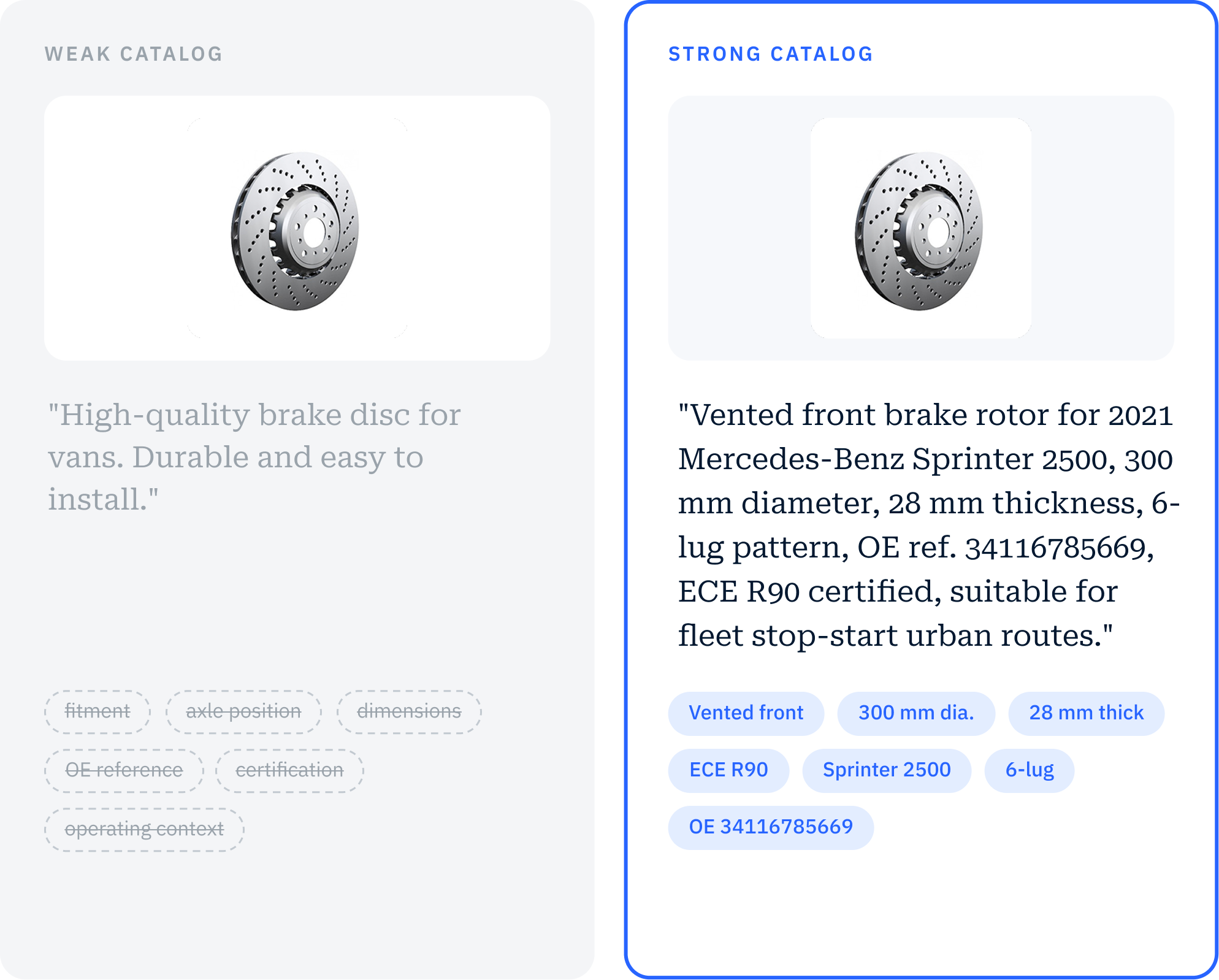
Consider a fleet operations manager asking an AI assistant: "Which front brake rotor fits a 2021 Mercedes-Benz Sprinter 2500 fleet van, handles heavy-duty urban routes and meets European safety certification?"

An AI engine breaks that single prompt into 8 to 12 distinct sub-queries (query fan-out): dimensions, bolt patterns, OE part cross-references, certification codes and thermal performance.
To ensure your catalog answers every layer of that query, the framework defines a five-stage readiness roadmap:
- Product truth (verified core facts): Consolidate identifiers (MPN, GTIN, OE numbers), dimensions, application fitment and compliance documentation.
- Dedicated attributes (machine-readable structure): Move specs out of generic marketing prose into schema properties (
PropertyValue,isCompatibleWith) with normalized units of measure. - Machine access (unrestricted crawlability): Pre-render product specifications server-side; eliminate JavaScript rendering walls, unlock PDF data and establish explicit
robots.txtandllms.txtpolicies. - Answer packaging (query fan-out readiness): Deploy modular, question-first FAQs and technical application notes that directly address common engineer, procurement and technician inquiries.
- Measurement & ROI (business impact tracking): Separate operational benchmarks (AI readability scores, attribute completeness) from commercial KPIs (AI referral conversion, citation share of voice).
Approached as a continuous operational discipline, this five-stage sequence equips your catalog to reliably earn citations, satisfy complex technical constraints and convert high-intent buyers across every AI search environment.
Your catalog is the foundation for your AI strategy
AI acts as an amplifier, directly exposing underlying product data readiness. In short, GEO doesn't make bad product data good. It makes good product data discoverable.
As McKinsey demonstrated in aftermarket and field operations, moving from pilots to measurable P&L impact requires clear prioritization, connected systems, disciplined governance and an unshakeable data foundation.
For manufacturers and distributors, that foundation starts with the catalog.
If you're trying to figure out where your catalog stands in that sequence, download The AI-Recommendable Catalog GEO playbook (opens in a new tab) for the full five-stage readiness playbook.