
The most successful enterprise marketplaces all have something in common, and it isn't scale. It's specificity. The commission rules shaped by years of seller negotiations. The return logic built around a particular category mix. The compliance checks no competitor would think to run. These details aren't operational clutter — they're the reason the marketplace is defensible in the first place.
But specificity has always come with a bill. Historically, when a requirement fell outside what the platform could do out of the box, operators had two paths: activating internal engineering teams to take care of workarounds and patchworks outside the platform or a roadmap request. Both are reliable. Both are also queues — and the arrival rate of those queues belongs to the vendor, not to the operator. Meanwhile, the operator's own engineering organization has changed. Roughly three-quarters of organizations (opens in a new tab) now run a dedicated platform team, and those teams are built around self-service delivery. A commerce platform that only exposes configuration asks them to work in a way they no longer work anywhere else in their stack.
That's the tension Mirakl Extensions was built to resolve. It's a governed, upgrade-safe extensibility framework that lets your engineering team build custom functionality — back-office menus, backend business logic, tailored UI components — natively inside Mirakl, on your own schedule, without giving up the SaaS guarantees you already count on.
The real cost of building around your platform
When a platform can't absorb a business requirement, the requirement doesn't disappear. It moves. Operators build around the platform — custom integrations, middleware, external scripts and spreadsheets that quietly become load-bearing. Each workaround solves today's problem and creates tomorrow's maintenance obligation.
Operators carrying this load watch their engineering capacity split in two: part of it moves the marketplace forward, and part of it maintains the scaffolding built around it — effort that never compounds into anything defensible. Worse, the business logic that makes their marketplace distinctive — how commissions are calculated for specific seller segments, when refunds are permitted, how shipping fees are recomputed for certain fulfillment conditions — ends up living outside the platform, where it can't be audited, versioned or governed as a coherent whole.
And every platform release becomes a test cycle, because the custom layer was never designed to be upgrade-safe. The fragility is invisible until something breaks.
There's an organizational cost, too. The stronger your engineering team, the more acutely they feel the limits of a platform they can configure but not extend. That capability is one of your greatest assets. An inextensible platform turns it into a source of friction.
What is platform extensibility — and why governed is the word that matters
Platform extensibility means your team can add functionality to the platform itself: new capabilities that look, behave and upgrade like native features, built against the platform's released interfaces rather than bolted on beside it.
The word doing the heavy lifting, though, isn't extensible. It's governed.
Here's why. Recent DORA research (opens in a new tab) found that shipping software and features faster doesn't automatically mean shipping better — acceleration in delivery throughput has been accompanied by measurable increases in instability and rework. What separates speed from fragility is the platform underneath: the guardrails, contracts and automated checks that let velocity scale safely.
Ungoverned extensibility is just a faster way to accumulate technical debt. Governed extensibility is different by design:
- Extensions run inside Mirakl, not alongside it. They're built against versioned APIs in a sandboxed, monitored environment.
- They survive upgrades automatically. An extension you write today still runs after the next platform release — that's the contract.
- Mirakl manages the infrastructure. Security, scale and automatic upgrades are preserved. Your team focuses on the business logic, not the plumbing.
It's worth being explicit about the trade-off, because a technical audience will ask. Extensions won't let you reach into platform internals or modify core behavior — that boundary is precisely what makes the upgrade guarantee possible. This is bounded flexibility with an explicit contract, not an escape hatch. If you've lived through a clean-core migration in another part of your stack, you already know why that boundary is the feature, not the fine print.
What your team can build inside Mirakl
Mirakl Extensions is a phased framework covering three surfaces:
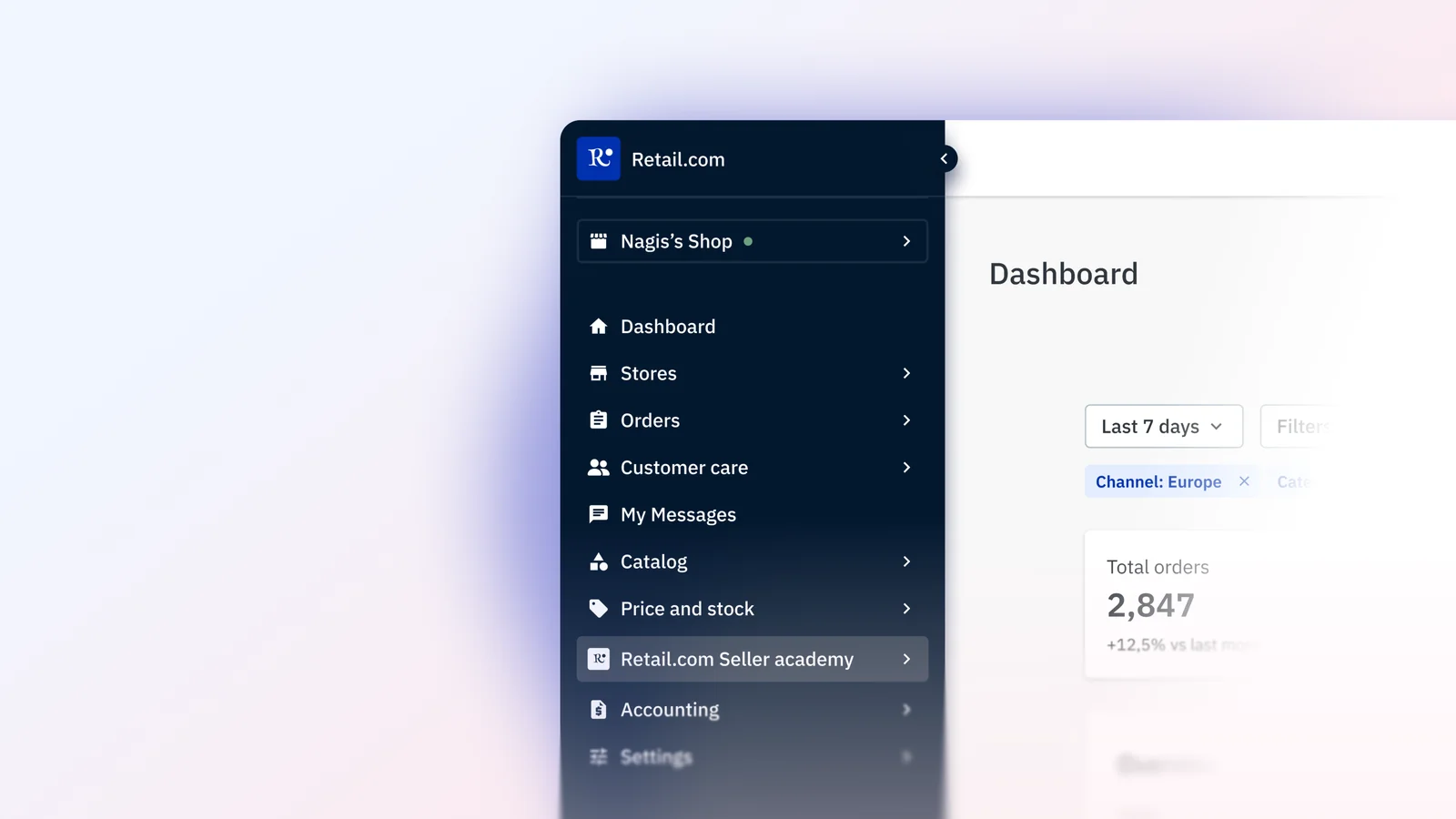
- Menu Extensions: Custom back-office menus that bring operator tools — seller documentation, onboarding academies, support portals — into a single hub inside Mirakl, instead of scattering them across systems your sellers have to learn one by one.
- Backend Extensions: Custom business logic for the rules that make your marketplace yours — commission structures, order state management, product validation workflows — defined and managed by your team, inside the platform.
- UI Extensions: Tailored interface components that make the platform experience fit your operation, natively.
The practical difference shows up in the timeline.
Custom requirements that historically meant a $50K–$200K Professional Services engagement running for months become work your team ships in weeks — and you control the priority.
That matters at the portfolio level, too.
Over 30% of our 2025 roadmap came from specific customer requests — a reflection of how customer-centric Mirakl's development is, but we'll acknowledge it's not the most efficient path for anyone. Every business is different, and Extensions exists to honor that difference with autonomy: your team builds what's specific to you, directly.
Phase 1 is live: Menu Extensions
Menu Extensions is a new way to add your own custom pages and navigation entries directly into the Mirakl back-office menu, the seller back-office menu or both.
Today, those tools live in separate tabs and systems — and every additional tool a seller has to learn is a point of drop-off. With Menu Extensions, your team builds them natively inside Mirakl instead. For example:
- A seller support portal with self-service answers
- A help and documentation hub
- An embedded analytics dashboard
How it works is deliberately simple. You define your extension with a JSON configuration — point it to your page or tool, choose which roles can see it and it appears natively in your Mirakl menu. Secure and upgrade-safe.
Why it matters:
- Save time and resources — build in days, not months. No lengthy projects, no waiting on a roadmap.
- Native and governed — it lives inside Mirakl and stays compatible with every upgrade.
- Only on Mirakl — the only marketplace platform that truly lets your team build inside it.
Backend Extensions follow later this year, with UI Extensions completing the framework in 2027.
As part of our beta program, a leading US retailer used Extensions to replace a manual, email-based support process with a native seller support portal inside Mirakl — one that suggests help articles to deflect common questions and auto-routes each case to the right person using Mirakl's secure token context, with no separate login to build or maintain. The team is now testing it in beta and preparing to roll it out to sellers in production.
From a product you configure to a platform you build on
Mirakl Extensions is more than a feature release. It's a deliberate evolution in what Mirakl is: from a product you configure to a platform you build on. Instead of trying to anticipate every possible need, we're giving operators the tools to build what's unique to their marketplace — with full control and without compromise.
The pattern is proven. The most durable enterprise software ecosystems won by letting customers build. What's been missing is that model purpose-built for enterprise marketplace complexity — sellers, commissions, orders, catalogs — with the SaaS guarantees intact. That's what Extensions delivers, and Menu Extensions is the first step.
The question for your team is no longer "can the platform do this?" It's "what will we build first?"
Menu Extensions is already available for Marketplace, Dropship and One creditor platforms. To learn how to create extensions check out the Mirakl documentation, here (opens in a new tab).
Frequently asked questions
Mirakl Extensions is a governed, upgrade-safe extensibility framework that lets enterprise marketplace and dropship operators build custom functionality directly inside the Mirakl platform. Operators' engineering teams can create custom back-office menus, backend business logic and tailored UI components that behave and upgrade like native platform features. The framework is rolling out in three phases: Menu Extensions (available now), Backend Extensions and UI Extensions coming later this year.
Platform extensibility is the ability for a customer's engineering team to add new functionality to a SaaS platform itself, rather than only configuring the features the vendor ships. Extensions are built against the platform's released, versioned APIs, so they integrate natively and continue working through platform upgrades. For enterprise marketplace operators, extensibility means business-specific rules and workflows can live inside the platform instead of in external scripts, middleware or spreadsheets.
Scalability is a platform's ability to handle growing volume — more sellers, orders and catalog data — without degrading performance. Extensibility is a platform's ability to absorb new functionality that the vendor never built. A marketplace platform can be highly scalable but rigid; extensibility is what lets operators adapt the platform to business logic that is unique to them.
Yes — if customization is governed. Ungoverned customization (forked code, bolted-on middleware, unsupported workarounds) breaks when the underlying platform upgrades, which is why SaaS customization has historically meant choosing between flexibility and stability. A governed extensibility framework like Mirakl Extensions removes that trade-off: extensions run in a sandboxed, monitored environment against versioned APIs, so security, scale and automatic upgrades are fully preserved.
Upgrade-safe means an extension built today continues to run after every future platform release, automatically. Because extensions are built against versioned APIs rather than platform internals, Mirakl's upgrades don't break them and operators don't need to retest or rebuild custom functionality with each release. The boundary is deliberate: extensions cannot modify core platform behavior, and that constraint is what makes the upgrade guarantee possible.
With Mirakl Extensions, an operator's own engineering team builds, deploys and manages custom functionality inside the platform on its own schedule — no Professional Services engagement or roadmap request required. Custom requirements that historically took months and significant consulting spend become work internal teams ship in weeks, with the operator controlling the priority.
Menu Extensions, the first phase of Mirakl Extensions, lets operators add custom menus to the Mirakl back-office. The most common first use case is consolidation: bringing seller documentation, onboarding academies, support portals and compliance resources into a single hub inside the platform, so sellers no longer navigate multiple external systems to do their work.