
Ask most retailers where dropship margin comes from and the answer arrives quickly: the spread between what you pay your supplier and what you charge your customer.
That answer is true. It's also the part of the equation that's easiest to see, which is why so many dropship programs post strong gross margins on paper while operating margin tells a different story.
In most respects, dropship and your owned inventory work the same way. You are the seller of record. You set the price. You record the retail price as revenue. From search to delivery, the customer sees your brand and nobody else's.
The difference is that you own the entire customer experience while a third party handles fulfillment, and that single split is where the complications start.
Your supplier picks the carrier and the service level. So when a parcel goes missing, when a birthday gift ships ground and arrives four days after the party, when the box turns up scuffed with someone else's packing slip inside, none of those were your decisions. All of them are your problem.
What follows lands on your topline alongside the full retail value of the sale. The return. The service ticket. The refund. The one-star review that mentions your name and not your supplier's. The customer who doesn't come back. You carry all of it, for a product you never touched and a delivery you didn't make.
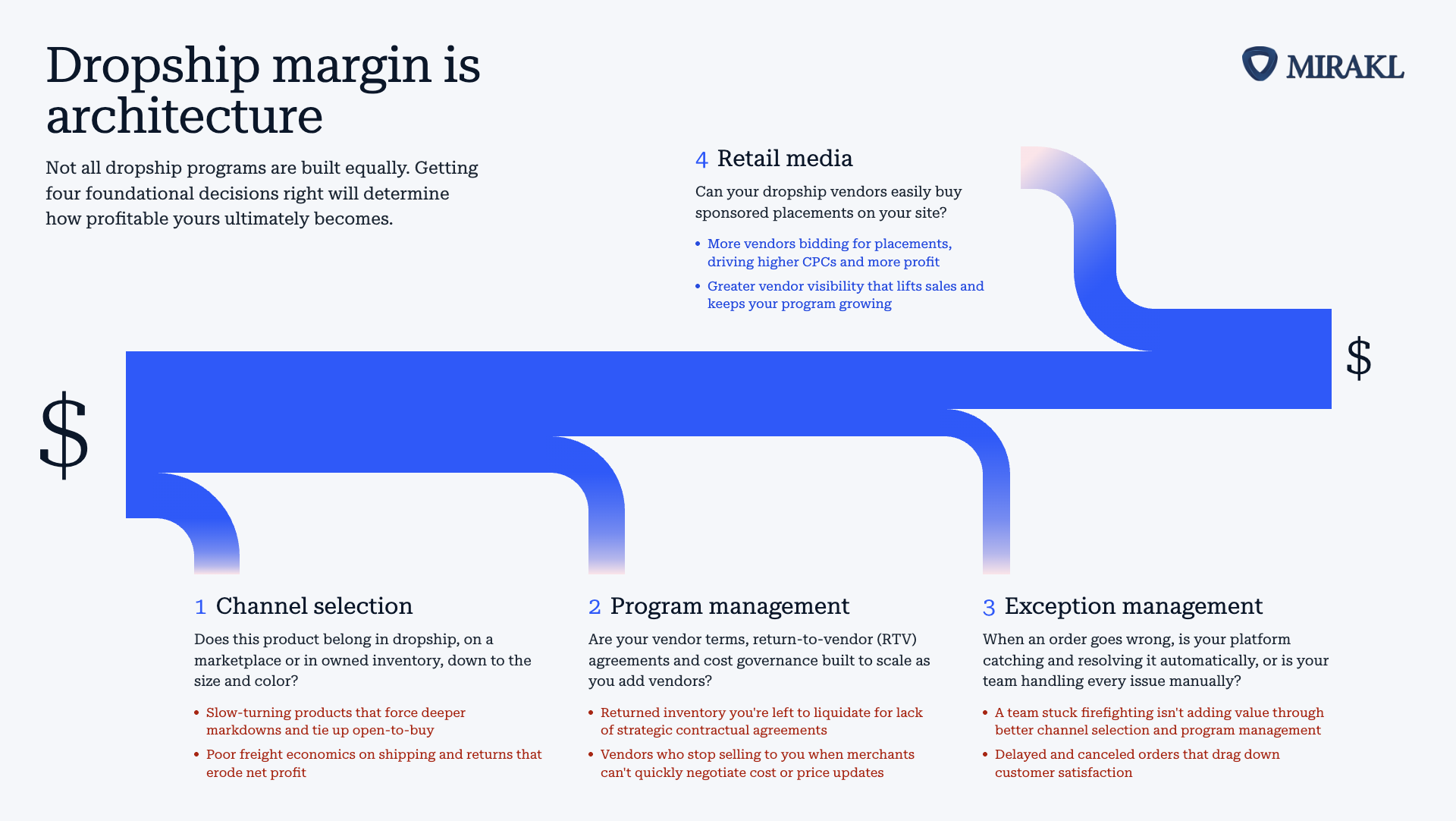
Which is why the wholesale cost you negotiate tells you so little about what you'll actually keep. Dropship margin isn't a number you measure after the fact, it's an outcome you design across four layers. Three of them are defensive, protecting the margin you expect:
- Channel selection: Deciding what belongs in dropship rather than owned inventory or marketplace, down to the supplier, product and variant.
- Program management: The terms and controls you put in the supplier agreement, before a single order flows through it.
- Exception management: Handling the overrides, disputes and service failures that scale alongside your supplier base.
The fourth plays offense, turning the assortment those decisions produced into revenue of its own:
- Supplier monetization: Selling advertising against the catalog your suppliers stock, funded by the suppliers who benefit when it sells.
Layer 1: Channel selection sets your ceiling
The single highest-leverage margin decision in your dropship program happens before you sign a supplier. It's the question of what belongs in dropship at all, and what belongs in first-party inventory or marketplace. And it isn't a category-level question. It runs down through supplier, category, product and even size and color, and the right answer can change at every level.
Most retailers make that call on markup. Wholesale cost, retail price, done.
But markup is a planning number, not a performance one. It tells you what the item should earn if everything goes to plan, and it can't see any of what determines whether it does. Markdown exposure. Fulfillment cost-to-serve. Return rates. Inventory turn. The open-to-buy dollars sitting in stock that isn't moving.
Take two sizes of the same shoe. Identical wholesale cost, identical retail price, identical markup. One turns at full price and earns the margin you planned for. The other sits until it's marked down twice and ends its life on a clearance rack, earning a fraction of it. The buy looked the same on both. What they actually returned isn't close.
This is where the decision gets interesting, because moving the slow variant to dropship does two things at once. It takes the markdown risk off your balance sheet, and it frees open-to-buy dollars you can put behind the sizes that actually turn. The gain isn't only the margin you stop losing on the item you no longer own. It's the margin you earn by buying deeper into the ones that sell.
Model those costs in and the picture shifts, sometimes sharply. Items that look strong on the spreadsheet quietly erode operating margin, while items written off as low-margin turn out to be worth carrying once you're no longer stocking them.
The industry is already reaching for mix as a margin lever. In Deloitte's 2026 Global Retail Industry Outlook (opens in a new tab), 72% of retail executives said they plan to absorb rising costs by shifting the product mix toward higher-margin or value-added items. Nearly three-quarters said they're concentrating on what they can control rather than spending energy on the macro environment.
But shifting the mix toward higher-margin items only works if you know which items those are. And for most retailers, the channel each product sits in was decided at launch and hasn't been revisited since, even as costs, return rates and sell-through have all moved underneath it.
If you're standing up a dropship program for the first time, this is the decision worth deeply analyzing. If you're already operating one, it's worth revisiting with operating margin rather than gross margin as the test.
In practice, that means running a different set of numbers than the ones that justified the original buy:
- Contribution margin after landed costs. Gross margin less fulfillment cost-to-serve, returns and markdown, calculated at the level you actually make decisions: supplier, category, product, size and color.
- GMROI. Gross margin return on inventory investment (opens in a new tab) tells you what each open-to-buy dollar is earning. It's the clearest read on which items deserve owned inventory and which are candidates to move.
- Full-price sell-through. The share of units that clear before the first markdown. Weak sell-through at variant level is the strongest early signal of a clearance rack, and the clearest case for moving that item to dropship rather than owning it.
- Return rate by supplier and by product. You absorb returns in either model, but a dropship return arrives as a one-off with no supporting stock behind it, so there's rarely a clean way to resell it. High-return items are expensive to own and expensive to dropship without the right terms in place.
- Weeks of supply and turn. Slow-turning items tie up open-to-buy dollars for months. That's budget you can't spend on the products your customers are actually buying.
Rank your assortment on those numbers and the order rarely matches the gross margin version. Items you assumed were carrying your dropship program slide down the list, and items you were ready to cut move up. The difference between the two views is the difference between a program that scales profitably and one that just scales.
Working through the model question for the first time? Our guide on choosing between dropship, marketplace or both (opens in a new tab) breaks down the trade-offs.
Layer 2: Program management protects what you negotiated
Channel selection sets the margin ceiling. Program management determines whether you ever reach it.
The wholesale cost you negotiate when a supplier comes onboard is the foundation of dropship margin. In most programs, that foundation gets almost no ongoing protection. Cost changes arrive by email. They move through spreadsheets. There's no approval gate, no threshold rule, no real-time view of what a proposed change does to margin on the SKUs it touches.
So the margin doesn't get renegotiated away. It drifts. A cost change flows through live orders for days or weeks before it surfaces in financial reporting, and by then the money is already gone.
The fix isn't tighter negotiation. It's treating supplier onboarding as the moment you install the mechanisms that keep the deal intact:
- Cost governance as a standing control. Approval workflows, margin thresholds and real-time visibility into what a cost change means before it goes live, not a monthly reconciliation exercise.
- Vendor-funded promotions written into the agreement. Not negotiated campaign by campaign, when there's no time and less leverage.
- Return-to-vendor terms and defect-rate accountability defined upfront. Who pays for the return, who takes the unit back and at what recovery rate. This is the term that decides whether a high-return item is viable in dropship at all, and it's far easier to agree before a supplier goes live than after the first quarter of returns lands.
- Performance standards with teeth. Service levels agreed at onboarding, tracked automatically and enforced without someone chasing them.
- Catalog data standards enforced, not requested. A return caused by a mismatch between the listing and the product is a margin loss created upstream, in data you accepted from a supplier. Set the requirement at onboarding and hold it automatically.
The common thread is leverage and timing. Before a supplier goes live, you have more of both than you will at any point afterward, and terms agreed at that moment apply automatically to every order that follows. Negotiate the same points later, one promotion or one dispute at a time, and you're doing it with less leverage and far more overhead. Skip them and you've built a program where margin depends on how many spreadsheets your team can watch at the same time.
The supplier agreement is also where a second, less obvious commitment belongs. We'll come back to that once the defensive layers are covered.
Layer 3: Exception management, where margin quietly disappears
Exception management is the layer that gets all the attention, and it deserves some, just not all of it.
Every dropship program runs on exceptions. A supplier needs a pricing override for a promotional event. A cost change requires manual rerouting to clear a threshold. A shipment misses its service level. A SKU goes live with incomplete data. At 50 suppliers, these are manageable. At 500 suppliers and tens of thousands of active offers, they stop being exceptions and become a pattern that grows in direct proportion to the program.
Returns are where this concentrates. According to the National Retail Federation's 2025 Retail Returns Landscape (opens in a new tab), an estimated 19.3% of online sales were returned in 2025, against a 15.8% blended rate across all retail channels. Roughly 9% of returns are fraudulent. And the customer consequence compounds: 82% of consumers now treat free returns as an important consideration when shopping online, while 71% say they're less likely to shop with a retailer again after a poor returns experience.
In dropship, you absorb all of that while your supplier ships the box.
This is well-covered ground, and we've written about it in depth: on the three hidden costs quietly draining dropship profitability (opens in a new tab) and on stopping returns at the source (opens in a new tab) rather than absorbing them as a cost of doing business.
The point worth adding here is one of sequence: Exception management cannot rescue decisions made badly in channel selection or program management. Operational excellence protects the margin you designed. It can't create margin the architecture never allowed for.
Offense: Monetizing the program you've built
Everything so far is defense: protecting the margin your channel decisions created. Now the more interesting question: Where does dropship margin actually grow?
The answer sits in a place most retailers discover late, if they discover it at all. The same infrastructure required to protect margin, including supplier governance, catalog data quality and terms enforcement, is also what lets you monetize the assortment you've built.
Retail media is the clearest example, and it's almost always discussed as a marketplace play. That framing misses what makes dropship different, which comes down to where your supplier's revenue actually lands.
In a wholesale relationship, your supplier earns when the goods reach your warehouse. Their sale is complete. What happens to those units afterward is your problem, and their remaining exposure is limited to whatever return-to-vendor allowances and markdown support you negotiated up front. The incentive runs to sell-in.
Dropship inverts that. The supplier holds the inventory until your customer buys, so neither of you books anything until the item actually moves. And because you set the retail price, your supplier can't discount their way to velocity. Visibility is the lever they have left.
That changes what you're asking for. Ask a wholesale vendor to fund advertising and you're asking them to spend against goods they've already sold you, which is why trade fund negotiations so often turn adversarial. Ask a dropship supplier and you're asking them to invest in moving stock still sitting in their own warehouse. Same request, very different economics.
The money is already moving, too. Deloitte found that 83% of retail executives expect trade promotion spend to be diverted into retail media networks, and 88% of executives operating a network believe it will be crucial to revenue and profitability in the year ahead. US advertisers are forecast to spend $71.09 billion on retail media in 2026 (opens in a new tab).
The economics explain the migration. Advertising sold on a retailer's own site and app has long carried gross margins in the region of 70% to 90% (opens in a new tab), against 20% to 40% for offsite media once media and agency costs come out. That benchmark has held as the industry-standard reference for years.
This is the commitment that belongs in the supplier agreement alongside the defensive terms, and it's the one most retailers never ask for. Historically the money moved as co-op, a negotiated allowance covering print, in-store and everything in between. The same funds are now shifting toward retail media.
And it works differently from everything above it. The first three layers protect margin you've already earned. This one adds margin the program never had, on assortment you don't own, paid for by the suppliers who benefit when it sells.
Margin is architecture
The retailers running the most profitable dropship programs aren't negotiating harder than everyone else. They made each of those four decisions deliberately, and in the order the decisions actually occur: what belongs in the channel, what goes into the agreement, what gets automated at scale, and what they sell on top of all of it.
Channel selection is a strategic decision and it stays one. But it's only as good as the numbers underneath it, and producing contribution margin or GMROI by supplier, product and variant across a dropship program is a systems problem before it's a merchandising one. Most programs don't stall on judgment. They stall because the visibility to exercise that judgment doesn't exist.
The layers below it are more straightforwardly infrastructural. Enforcing terms at onboarding, managing exceptions at scale, holding catalog quality across hundreds of suppliers and running a media business on top of the assortment are all capabilities as much as they're strategies. Deloitte found that 44% of retail executives say legacy systems are slowing innovation at their companies.
The useful question isn't whether your dropship program is profitable. It's whether you know which layer is capping it.
That's what a dropship maturity assessment (opens in a new tab) is built to answer. In five minutes, it scores your program across supplier management and scale, product and catalog management, operational excellence and strategic growth, then shows you where the ceiling is.